


August Corominas, Professor of Human Physiology at the University of Murcia and the Autonomous University of Barcelona, and emeritus member of the Royal European Academy of Doctors (READ), shares with the academic community the article “The Human Brain,” in which he explains the morphology and functioning of this organ. The academic has recently shared in this publication the articles “The Secret of Longevity in the ‘Blue Zones’”, “Beware of Falls, by Night and by Day”, “The Good Life and a Life Well Lived”, “Biological Life and Quantum Life”, “Smart Hospitals”, “Cosmonautics and Space Medicine”, “Abuse and Its Management”, “Quantum Biology”, “The Black Man of Banyoles (Bushman or Hottentot)”, “Polydactyly”, “Adolescence, a Critical Stage of Human Life”, “Mermaids, the Illusion of Sailors and Seafarers”, “Biblical Diet: Pure and Impure Foods”, “Rare Diseases”, “The Starving People of Gaza”, “Sexology in Adolescence and Somatopause (Andropause and Menopause)”, “Cyberattacks, Cyberwarfare and Cybersecurity”, “Refugees”, “Human Evil”, “The Geostrategy of Rare Earths”, “Conscience and Omission: The Misery of the Ruler”, “Plasticosis”, “Humanisation”, “The Island of Doctor Moreau and the ‘Therians’”, “Astatine, a New Element of Technological Importance”, “The Corominas Family: More Than Two Centuries of Medical Vocation” and “The Positive Impact of Artificial Intelligence on Medicine”. He is also the author of one of the chapters of the book “Vitality in Ageing. If You Wish, You Can Live Longer in Good Health,” published by the Royal Corporation with the support of Vichy Catalán.
The Human Brain
The human brain is the central organ of the nervous system, located in the human head and protected by the skull. It has the same general structure and anatomy as the brains of other mammals, but with a more developed cerebral cortex.
Larger animals, such as whales or elephants, have larger brains in absolute terms, but when measured using the encephalisation quotient, which compensates for body size, the human brain quotient is almost twice that of the common dolphin and three times that of the chimpanzee.
Most of this expansion is due to the cerebral cortex, particularly the frontal lobes, which are associated with executive functions such as reasoning, planning, self-control and abstract thinking. The visual cortex, the part of the cerebral cortex devoted to vision, is also larger in humans.
Brain Functions
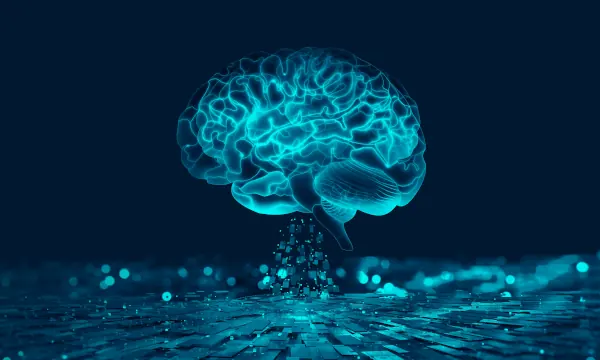 The brain’s primary function is to keep the organism alive so that it can interact with its environment. Everything a human being thinks, feels and does is related to specific brain functions. A large part of the brain’s physiological functions involves receiving information from the rest of the body, interpreting it and directing the body’s response. It is ultimately responsible for thought and movement.
The types of stimuli interpreted by the brain include sounds, light, smells and pain. It is also involved in vital functions such as breathing, releasing hormones and maintaining blood pressure levels. It enables humans to interact with their surroundings by communicating with others and interacting with inanimate objects.
It is composed of nerve cells or neurons that interact with the rest of the body through the spinal cord and nervous system. The brain also contains various chemical compounds that help it maintain homeostasis. Keeping nerve cells functioning properly and maintaining a balance of chemicals are essential for brain health.
Parts of the Human Brain and Their Characteristics
- Cerebral cortex. This is the part that integrates afferent and efferent information. The cortex is almost symmetrical and is divided into the right and left hemispheres. Conventionally, scientists have divided it into four lobes: frontal, parietal, occipital and temporal. However, this division is not based on the actual structure of the cerebral cortex, but rather on the bones of the skull that protect it.
The frontal and parietal lobes are separated by the central sulcus, a fold where the primary somatosensory and motor cortices meet. The different areas of the cerebral cortex are involved in different behavioural and cognitive functions. - Frontal lobe. In evolutionary terms, this is the most “modern” of the lobes. It controls various functions, including problem-solving, creative thinking, judgement, intellect, attention, behaviour, physical reactions, abstract thinking, coordinated movements, coordinated muscles and personality. It contains Broca’s area, where linguistic and spoken language production takes place.
- Parietal lobe. It focuses on movement, calculation, orientation and certain types of recognition. Damage to this area can result in difficulties carrying out simple everyday tasks. The parietal lobe contains the motor cortex, which enables the brain to control body movement. It is located in the upper middle part of the brain; the sensory cortex, located at the front of the parietal lobe, receives information from the spinal cord about the position of various parts of the body and how they move. This region can also be used to transmit information from the sense of touch, including pain or pressure, affecting different parts of the body.
- Temporal lobe. It controls visual and auditory memory and speech comprehension. It includes areas that help control speech and listening abilities, behaviour and language. Wernicke’s area is a portion of the temporal lobe located around the auditory cortex and is responsible for processing and understanding speech.
- Occipital lobe. It is located at the back of the head and controls vision. Damage to this area can cause reading difficulties.
- Striatum. It is located within the walls of the cerebral hemispheres and contains correlation and coordination centres that regulate the rhythm of movements and facial expressions during communication.
- Limbic system. Many of the hormonal responses generated by the body begin in this area. It is related to memory, attention, sexual instincts, emotions, personality and behaviour. The limbic system includes the hypothalamus, which contains centres that regulate the body’s internal balance and homeostasis. It controls mood, temperature, hunger and thirst; the amygdala, which enables responses to emotions, fear and memories and is a large portion of the telencephalon; and the hippocampus, whose main functions are learning and memory, particularly converting short-term memory into long-term memory.
- Thalamus. It is a relay centre that controls attention. Afferent stimuli that reach conscious awareness pass through it.
- Brainstem. All vital functions originate in the brainstem, including blood pressure, breathing and heartbeat. In humans, this area contains the medulla, midbrain and pons.
- Midbrain. It carries motor impulses from the cerebral cortex to the brainstem pons and carries sensory impulses from the spinal cord to the thalamus.
- Pons. Also known as the brainstem bridge, it lies between the medulla oblongata and the midbrain. It participates in vital functions such as vision, motor coordination, sleep and states of alertness.
- Medulla oblongata. Its functions include transmitting impulses from the spinal cord to the brain. It also regulates cardiac, respiratory, gastrointestinal and vasoconstrictor functions.
- Cerebellum. Also known as the “little brain”, it is considered the oldest part of the brain on the evolutionary scale. It controls essential bodily functions such as posture, coordination and balance, enabling humans to move correctly.
Metabolism of the human brain.
The brain consumes ten times more energy than would be expected given its size. Between 60% and 80% of the energy consumed by the brain is devoted to maintaining connections between different neurons, while the remaining energy is used to respond to environmental demands.
Weight and Capacity of the Human Brain
Weight. According to the most recent research, the average weight of the adult human brain is around 1,400 grams. Its average volume is 1,260 cm³ in men and 1,130 cm³ in women.
As age increases, brain weight decreases by 2.7 grams per year in men and 2.2 grams per year in women. For every additional centimetre of height, brain weight increases by an average of 3.7 grams. Brain weight, however, is not related to body mass index.
Capacity and Memory: How Many Neurons Does the Brain Have?

Dr August Corominas
The human brain is made up of approximately 100 billion neurons, each of which has 1,000 or more connections (synapses) with other neurons. The strength of these synapses depends on experience. When two neurons on either side of a synapse are activated, that connection becomes stronger. In addition, in order to adapt to the strength of the new connection, the dendrite of one of the neurons becomes larger.
Synapses are associated with learning and memory, and as neuronal connections become stronger, what has been learned and remembered becomes more firmly established.
Brain Tissue
Brain tissue can be divided into two main classes:
White matter: composed mainly of axons, its function is to process brain information correctly.
Grey matter: composed of neuronal cell bodies and their somas. It is involved in motor control, sensory perception (sight and hearing), memory, emotions, language, decision-making and self-control.