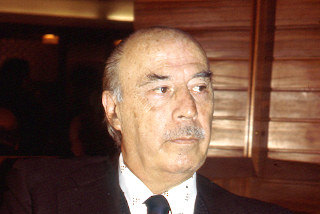


Enrique Sada
Mexican historian Enrique Sada, a regular collaborator of the Royal European Academy of Doctors (READ), shares with the academic community the articles “Halftime Hangover,” “Heritage, Dissent and Vandalism,” “Socialism and Euthanasia” and “Bloody Holy Week,” published between 12 February and 3 April on the digital platform Código Libre and in the newspaper “El Siglo de Torreón,” in which he addresses various episodes of current Mexican and international affairs and their historical links.
In “Halftime Hangover,” the expert criticises the performance by Puerto Rican musician Bud Bunny at the American football Super Bowl final held in Santa Clara (California) last February. “Despite the fake applause (pre-recorded) that was played in the background for the televised broadcast of the show, more than 97% of those attending the stadium remained stunned, without moving or dancing as they had visibly done in previous years, and the reason was very simple: no one understood the babbling in something resembling Spanish during what must surely have seemed to them a surrealist performance, certainly, but entirely dispensable; to such an extent that not even the presence of Lady Gaga or Ricky Martin managed to retain that other half who, far from remaining frozen, chose instead to leave to buy beer and soft drinks,” he summarises.
Moreover, in “Heritage, Dissent and Vandalism,” Sada refers to the episode of vandalism at the parish church of the Metropolitan Sagrario of San Luis Potosí, Mexico, which coincided with the protest events of the latest Women’s Day. “A group of demonstrators set fire to one of the church doors, causing the flames to spread inside and generate the beginning of a fire that threatened to destroy it, together with the rest of the historical-religious heritage also safeguarded within. It was only upon the arrival of members of the Metropolitan Fire Brigade of San Luis Potosí that the situation was brought under control, managing to extinguish the fire late into the night in order to prevent greater damage to the historic building, and they were applauded for their courageous intervention by the community of the faithful and the citizens, who knew how to recognise their work with applause in their favour and with the no less surprising cry of ‘Long live Christ the King!’, which had not echoed in the surroundings for almost one hundred years with such singular enthusiasm,” he explains.
 Sada devotes the article “Socialism and Euthanasia” to addressing the weakness and lack of protection of the latest young women who have decided to resort to assisted death or to whom it has been offered by public institutions as a way out of their situation, with the case of Catalan Noelia Castillo as a paradigm. “In all cases, this ominous practice has been perpetrated against very young and easily manipulated women who, although in most cases physically healthy, suffer from a lack of professional psychological care, while the State, which should protect and heal them, through socialist policies, after convincing the parents, sells them suicide as a solution and kills them. Under this sick political agenda in which human life is disposable, criminals are protected instead of victims, and crime is rewarded twice over with impunity for the perpetrator and the disappearance of their victims or of those whom the left considers ‘weak’, the same actions carried out by National Socialism in 1930s Germany or by the communists in Soviet Russia are repeated: legal, disguised as false mercy, but immoral and inhuman because of the eugenic purpose they truly pursue,” he denounces.
Finally, in “Bloody Holy Week,” the collaborator of the Royal Academy links the impossibility of the Patriarch of Jerusalem officiating the Palm Sunday Mass at the Holy Sepulchre with the continuing slaughter of Christians in Nigeria. “Everything would have remained an isolated घटना had it not been for the immediate massacre of Christians that was unleashed in Nigeria from that very day, in which Muslims are impunitively murdering Christians in the main cities and avenues, in full view of the eyes of the world and without anyone doing anything to stop it. A viral video shows a woman in deep mourning in Angwan Rukuba, in Jos (Nigeria), weeping inconsolably while embracing the lifeless body of her son, having also lost her husband in another Muslim attack in which nearly 50 victims have been reported due to machine-gun assaults, bombs in churches and public lynchings in the Plateau region,” he concludes.