

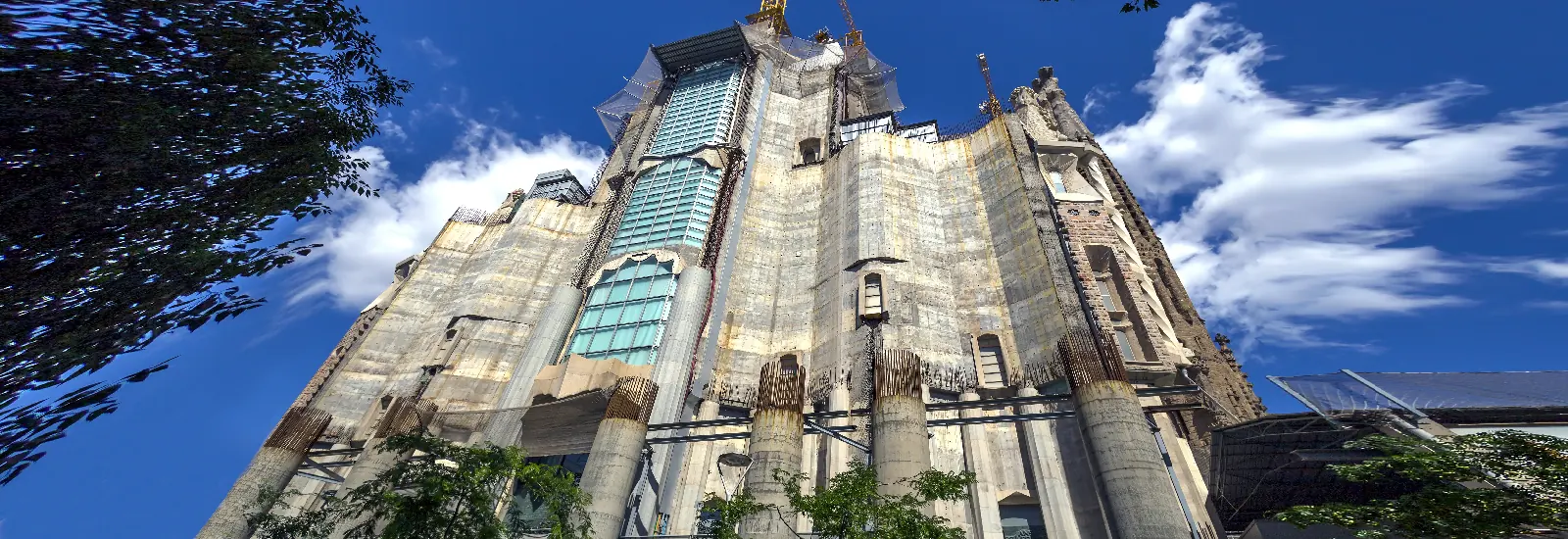
Francesc Torralba, director of the Ethos Chair in Applied Ethics at Ramon Llull University and of the Chair of Christian Thought of the Bishopric of Urgell, member of the Holy See’s Dicastery for Culture and Education and full member of the Royal European Academy of Doctors (RAED), analyses in an article published by the newspaper “El País” on 4 September the competition to design the Glory façade of Barcelona’s Sagrada Família basilica, which will complete the temple’s construction. Torralba is a member of the Advisory Committee of its Construction Board. In recent days, the academic has also featured in an episode of the podcast “El secreto de la vida”, where he reflected on the uncertainties of contemporary life, and delivered the lectures “The Art of Knowing How to Listen: Ethics of University Dialogue” and “The Ethics of Organisations: Challenges for the University and Society” at the Juárez Autonomous University of Tabasco, in Mexico, both of which received extensive media coverage.
In conversation with journalist Clara Blanchar, the expert says that the façade still to be defined at the Sagrada Família is Antoni Gaudí‘s eschatological testament: not a monumental ornament, but an answer to the ultimate questions. The temple, now completed vertically and blessed by Pope Leo XIV, is preparing to decide who will give artistic form to its main entrance. Torralba insists that the commission does not start from a blank slate. Gaudí, he says, explained it in detail in the temple albums published during his lifetime and in one issued after his death. According to the theologian, the aim is to narrate the meaning of human life, its end and what may be expected after death according to the Christian faith. The composition he envisaged and which remains to be completed, the academic adds, is a narrative on three levels. Heaven above. Purgatory in the centre. Beneath the entrance esplanade, hell, whose figures will be visible through skylights. On the middle level, seven doors already created by Josep Maria Subirachs represent the seven sacraments. Sixteen lanterns will descend from above on slender columns, allowing light to pass through, and the Creed in Latin will be inscribed above them.
Gaudí, Torralba explains, wanted to show on this façade what can be hoped for and, at the same time, how one must live in order to attain that fulfilment: which virtues to cultivate and which works of mercy to practise in order to deserve it. The heaven he conceived is neither an abstract space nor an icy judgement. It is inhabited by saints who already participate in eternal life and enjoy infinite love. In this interpretation, the façade, whose final project is being contested by visual artists Miquel Barceló, Cristina Iglesias and Javier Marín, is not merely a question of style or scale, but the contemporary translation of a catechesis in stone: from Adam and Eve to the Last Judgement, from the teachings of Jesus to Glory. Torralba places the criterion there. Whoever sculpts it does not invent the meaning; they inherit it. Gaudí already said where life is heading. The task still pending is to give material form to that hope.
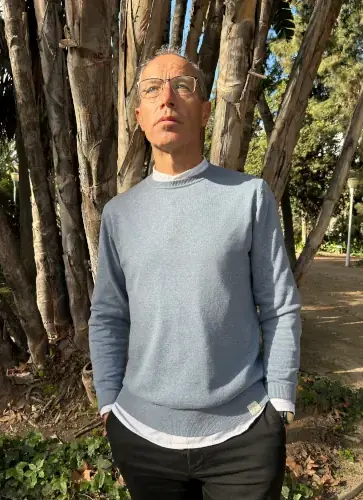
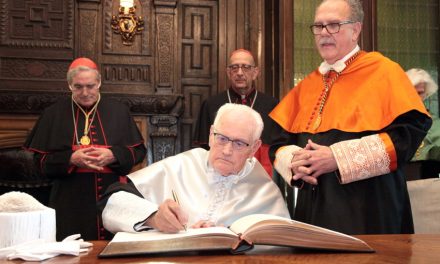
Dr. Francesc Torralba
For his part, in the podcast “El secreto de la vida”, directed and presented by Crisol Tuà, Torralba analyses the study on fears and uncertainties carried out by the Centre for Sociological Research to determine the state of anxiety in which a large part of the population has settled and points out that the best way to approach the relationship between past, present and future is to accept that the latter is uncontrollable. ”It is in our mind. One imagines one’s future as a father or as a professional, but the future, as such, does not exist; it is simply in our mind as a hypothetical project, and circumstances may arise that frustrate it, such as an epidemic, a catastrophe or an illness,” he says.
Finally, in his lecture at Juárez University, the academic, who a year ago received an honorary doctorate from the same institution, argued that listening goes far beyond hearing, as it involves willingness, attention and a readiness to understand the other, particularly someone who does not belong to one’s own community of thought. He identified the main obstacles that hinder this practice: saturation, prejudice, fear, haste and lack of time, resentment, mistrust and arrogance, as reported by the university’s own channels. As part of his presentation, he also warned that these barriers can lead people to listen only to themselves or to those who confirm their own ideas. He therefore called on university students to overcome the fear of uncomfortable truths and to question prejudices related to people’s age, origin or circumstances, considering that listening to those who are different activates thought and enriches one’s own view of the world.
A lecturer and populariser of Christian humanism in major Catalan media outlets such as Catalunya Ràdio and the newspapers “La Vanguardia” and “El Punt Avui”, the academic is the author of notable books such as “El sentit de la vida” (2008), “No passeu de llarg” (2010), “El valor de tenir valors” (2012), “Un mar d’emocions” (2013), “Córrer per pensar i sentir” (2015), “Saber dir no” (2016) and “Món volàtil” (2018). During the pandemic, Torralba published the books “Humildad”, “Paraules de consol. En la mort d’un ésser estimat”, “Formar personas. La teología de la educación de Edith Stein”, “Vivir en lo esencial. Ideas y preguntas después de la pandemia”, “L’ètica algorítmica”, which was awarded the Bones Lletres Prize for Humanistic Essay by the Royal Academy of Belles Lettres and the publisher Edicions62; “La façana de la Glòria de la Sagrada Família. Fonts espirituals i teològiques de l’escatologia d’Antoni Gaudí”, the result of his fourth doctoral thesis; “Cuando todo se desmorona. Meditar con Kierkegaard” (2023), “No hi ha paraules. Com assumir la mort d’un fill” (2024) and “Benaurances per a agnòstics” (2024). He was awarded the 2023 Ratzinger Prize by the Joseph Ratzinger-Benedict XVI Vatican Foundation.