

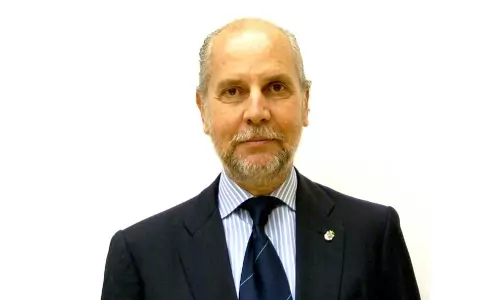
Dr. Pedro Rocamora
Pedro Rocamora, full member and former President of the Royal Academy of Doctors of Spain and honorary member of the Royal European Academy of Doctors (READ), formally took his seat as an honorary member of the Royal Academy of Veterinary Sciences of Spain during a solemn ceremony held on 25 May at the Royal Corporation’s headquarters in Madrid, presided over by its President, Salvio Jiménez. Recognised for his interdisciplinary contributions to the comparative ethology of primates and humans in the genesis of ritualised mechanisms for inhibiting aggression, the new member delivered the speech “Why Do We Kill One Another? The Ethology of Conflict in Primates and Humans.”
The new honorary member addressed aggression and conflict from an interdisciplinary perspective combining ethology, neuroscience, psychology and the philosophy of law, to understand why the natural mechanisms for containing violence, present in other primates, weaken or are transformed in the human species. After analysing the role of culture and social norms as restraints on instinctive reactions, he highlighted the dual function of law: preventive, by seeking to inhibit unlawful conduct, and punitive, when such conduct occurs. For Rocamora, the mechanisms that prevent primates from killing one another have, in humans, been transformed into normative and institutional systems. Understanding this transformation through ethology, neuroscience and law is essential to understanding both the origins of violence and the tools available to contain it.
 Also an expert in neuroscientific analysis, Rocamora holds a doctorate in Law and another in Medicine-Neuroscience from the Complutense University of Madrid, as well as a doctorate in Psychology from the National University of Distance Education. He is the author of reference works in these fields, such as “Aggression and Law,” in which he explores the roots of human aggression, arguing that both genetic and environmental factors play a crucial role in aggressive behaviour and drawing on frustration-aggression theory; and “The Psychology of Suggestion in Freud,” in which he analyses the concept of suggestion and its implications for psychology and social dynamics, while challenging common misconceptions about the work of the man regarded as the father of psychoanalysis in relation to hypnosis. He also investigates consciousness from a neuroscientific perspective in “Consciousness and Psyche: A Neuroscientific Analysis of the Human Condition,” which examines its concept, functions, alterations and relationship with psychic processes, and explains how neuroscience has contributed to understanding the relationship between brain activity and consciousness.
Rocamora joined the READ in November 2024 with the admission speech “Neuroscience and Criminal Law,” in which he addressed various legal aspects of custodial sentences, the psychopathologies of imprisonment, psychosocial theories of violence, and psychopathogenic and criminogenic factors, while advocating the need to approach research in these fields from a multidisciplinary perspective. He is an honorary member of the Scientific Hypnological Society for his research into the psychology of suggestion and has been awarded the Gold Medal of Merit in the Fine Arts and the Gold Medal of Doctoral Merit by the Royal Academy of Doctors of Spain.