

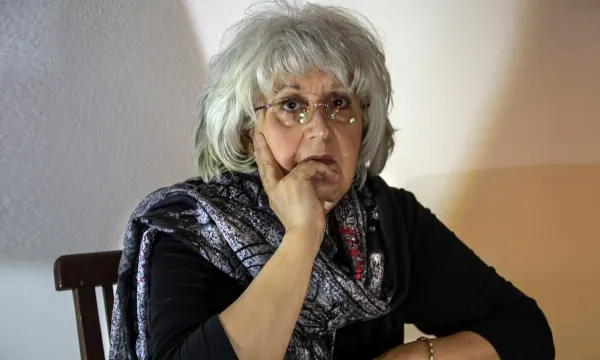
Dr Teresa Freixes
Teresa Freixes, Jean Monnet Professor ad personam, President of the international organisation Citizens pro Europe, Vice-President of the civic platform Societat Civil Catalana and Numerary Member and Vice-President of the Governing Board of the Royal European Academy of Doctors (READ), reflects on current Spanish and international politics in the articles “The calculation of hatred”, “The Baltic mirror”, “Neither a right nor entrenched”, “The government of judges and the control of prosecutors”, “Poetic justice”, “Making a complete mess of it” and “Institutional trust and the rule of law”, published in the specialist portal Artículo 14 and the digital newspaper The Objective between 11 April and 17 May.
In “The calculation of hatred”, the legal expert reflects on the Islamophobic chants that took place at the RCD Stadium during the match played by the Spanish national team in Cornellà de Llobregat, the similarities with other episodes of various kinds and the government’s response. “Unfortunately, this is not the first time this has happened. Similar situations, although in other contexts, have been almost habitual in certain circumstances or places. A former Vice-President of the Government stated that he was offering himself to ‘smash the right’. At my former university, with the outburst ‘Castilian scum out of the UAB’, an attempt was made to violently prevent an event from taking place. On numerous occasions we have also heard Hispanophobic chants and attacks on anthems or symbols. All these positions are clearly inciting the exclusion of a specific social segment: the right, the Castilian, the Spanish…”, she considers.
For her part, in “The Baltic mirror”, Freixes compares the so-called “Baltic way” claimed by Catalan pro-independence movements with the path towards secession taken by the Catalan Parliament outside the law. “The dismemberment of the USSR meant that the territory occupied by one state became the territory of 15, although Russia was regarded as the natural heir to the former Soviet Union and retained its international responsibilities. At that time, the Constitution of the USSR of 1977 was in force, recognising the right of secession of its republics, and a law had also been adopted in 1990 regulating the procedure for carrying it out, which included a referendum for the population to express its view, in addition to the decisions of the councils/parliaments of the republics. Estonia, Latvia and Lithuania seized the moment to proclaim independence before the failed Commonwealth of Independent States that Russia wanted to lead was created, since this would change the legal coordinates of secession,” she explains.
In “Neither a right nor entrenched”, the Vice-President of the Royal Academy addresses the initiative undertaken by the Executive to entrench the right to abortion in the Constitution. “The Venice Commission, in its reports on constitutional reforms, requires that they be adopted by broad majorities and always in agreement with the opposition, since they affect the life of the nation. This does not seem to be the line being followed, but rather an attempt to seek the easy route, through an ordinary reform procedure that will not be possible either. Not to mention the aggravated procedure, since dissolving the chambers is the last thing the Prime Minister intends to do. So, what is the point of proposing something that will not be possible to carry out? It will surely be another smokescreen, so that we remain ‘entertained’. That way all the blame can be placed on the conservative opposition,” she points out.
In “The government of judges and the control of prosecutors”, the academic focuses on judicial independence and the separation of powers, denouncing the systematic attack on the judiciary when its actions harm those in government. “The contempt for judicial decisions, the populist political criticism of court rulings that is so fashionable nowadays, and which has been denounced by the President of the European Court of Human Rights himself, takes us back to times when arbitrariness prevented the very existence of legal certainty or the rule of law – in short, of democracy itself. Because democracy requires respect for both content and form and, indeed, by definition, form constitutes the prerequisite of legitimacy for the adoption of content. And this is also applicable, by definition, not only to the appointment and functional independence of judges, but also to prosecutors, because the Constitution and European standards, although in Spain the Public Prosecutor’s Office is subject to functional hierarchy, do not make this the only principle governing its actions, since legality and impartiality are also constitutionally required,” she details.
The President of Citizens pro Europe devotes “Poetic justice” to the success achieved by the writer Eduardo Mendoza on Sant Jordi’s Day, when he became the best-selling author despite the veto and burning of his books advocated by radical nationalism. “You are not a good Catalan if you write in Spanish and, for that reason, you become the enemy to be defeated. You are not part of that homogeneous society sought by nationalism if you defend a plural Catalonia, as Spain and Europe are, founded on constitutional and European values, and for that reason they seek to condemn you to ostracism. Into the fire with everything, to ‘purify’ minds, stripping them of elements alien to what they consider nationally acceptable. However, since the aim of that intellectual reductionism does not fit reality, here we are, on this Sant Jordi festival, the festival of the rose and the book, where the roses were not made of fire and smoke and the books most sold during that beloved celebration were precisely those of Eduardo Mendoza. Poetic justice,” she argues.
 In “Making a complete mess of it”, Freixes addresses the management of the hantavirus crisis, with different protocols in the countries that received passengers from the cruise ship “Hondius”, where an outbreak occurred. “Numerous real experts on the handling of these cases — not the politicians of the moment, but those with experience in the matter — state that the best measure would have been confinement on the ship in order to carry out the proper triage among passengers and transfer those who were asymptomatic to another vessel, at sea, carrying out all the required tests to detect those who were infected, sending passengers directly back to their countries of origin with the appropriate protective measures, or having all of them received in the country legally responsible for the case, the Netherlands, so that they could be given the appropriate treatment there according to each individual situation, with quarantine. But it seems that we have also preferred to make a complete mess of this matter. Some say that the particular interests of our Minister of Health with the World Health Organization may have something to do with it, but this is not entirely clear,” she considers.
Finally, in “Institutional trust and the rule of law”, she underlines the paradox that, according to the latest Eurobarometer, while almost three quarters of Europeans agree that the European Union is a place of stability, Spain shows a high degree of mistrust. This survey coincides with the also negative conclusions of the report prepared by the Democracy, Rule of Law and Fundamental Rights Monitoring Group of the Committee on Civil Liberties, Justice and Home Affairs of the European Parliament. “Some indications of this mistrust can be found in the aforementioned report by the Committee on Civil Liberties, Justice and Home Affairs, which concludes with a sound and balanced reflection, as it highlights that, although we are not yet facing a systemic deficiency, institutional disagreements and attempts at political control over the judiciary prevent polarisation from being reduced and the rule of law from responding better to European standards,” she concludes.
Read “The calculation of hatred”
Read “Neither a right nor entrenched”
Read “The government of judges and the control of prosecutors”