


Dr. Francisco López Muñoz
Francisco López Muñoz, Professor of Pharmacology and Vice-Rector for Research, Science and Doctoral Studies at Camilo José Cela University, Corresponding Member of the Royal Academy of Medicine of the Basque Country and of other national and international academies, and Numerary Member of the Royal European Academy of Doctors (READ), addresses the anniversary of the war waged by the United States and Spain at the end of the 19th century, the Disaster of 1898 and its consequences for contemporary geopolitical relations in the articles “25 April 1898. The United States’ Declaration of War on Spain”, published on 25 April through the channels of the Academy of Military Sciences and Arts, of which he is also a member, and “What does the war between the United States and Spain over Cuba tell us about interventionism and current geopolitics?”, published in the specialist portal The Conversation on 11 May and subsequently in various Spanish and Latin American media outlets.
In “25 April 1898. The United States’ Declaration of War on Spain”, the expert recounts the events that triggered the declaration of war, based on disinformation about the causes of the sinking of the battleship “Maine” in Havana harbour, and analyses Washington’s opportunism in a conflict it knew it had already won. “From a strategic perspective, the declaration formalised a short, diplomatically calculated and carefully prepared war, since the United States had accelerated its naval modernisation programme in the preceding decades, allowing it to enter the conflict with clear material superiority. By contrast, Spain, under the government led by Práxedes Mateo Sagasta, was pushed into a war for which it was not fully prepared, with particularly obsolete military capabilities in the naval sphere and with the political difficulty of accepting the ultimatum without fighting,” he explains.
For its part, in “What does the war between the United States and Spain over Cuba tell us about interventionism and current geopolitics?”, in addition to offering a concise account of the wars in Cuba and the Philippines and reflecting on Spain’s lack of foresight in avoiding them, the academic focuses on their short- and medium-term repercussions. “The signing of the Treaty of Paris on 10 December 1898 formalised the end of hostilities and entailed the cession of Cuba, under tutelage, Puerto Rico, the Philippines and Guam – the largest island in the Mariana archipelago – to the United States, as well as the definitive collapse of the Spanish Empire. This generated an absolute moral, political and social crisis in mainland Spain, popularly known as the Disaster of 1898, and a process of popular and political reaction that took shape in the regenerationist movement led by Joaquín Costa. From a military perspective, the defeat revealed the need to modernise the Armed Forces and review the Spanish strategic doctrine. For the United States, however, the war represented its consolidation as an emerging power with global projection, marking the beginning of a more active and interventionist foreign policy,” he concludes.
A recognised communicator on contemporary history, Spanish literature of the Golden Age, medicine and pharmacology, López Muñoz holds a PhD in Medicine and Surgery and a PhD in Spanish Language and Literature. He is a specialist in Pharmaceutical Medicine and holds a diploma in Holocaust Studies from the International School for Holocaust Studies at Yad Vashem in Jerusalem. He is a researcher at the Hospital 12 de Octubre Research Institute in Madrid, a member of the Governing Council of the HM Hospitales Health Research Institute and of the Miguel de Cervantes Institute for Medieval and Golden Age Studies of the University of Alcalá de Henares, a member of the Science and Technology Council of the Community of Madrid, scientific adviser to the Ibero-American Committee on Ethics and Bioethics, a member of the Observation Committee of the Spanish Human Rights Observatory, of the Spanish Chapter of the Club of Rome, and an honorary member of the Gandhi-Mandela Foundation.
He has taken part in numerous research projects and is the author of monographs and articles in his field of study. He has recently been named Honorary Colonel of Kentucky and Honorary Guardia Civil, coinciding with the 25th anniversary of the creation of this status, the corps’ highest civil distinction, which is awarded exceptionally. On 20 March, he was also recognised with the Medal of Merit in Cyberdefence, awarded by the Professional Association of New Technology Experts.
Read “25 April 1898. The United States’ Declaration of War on Spain”
Read “What does the war between the United States and Spain over Cuba tell us about interventionism and current geopolitics?”
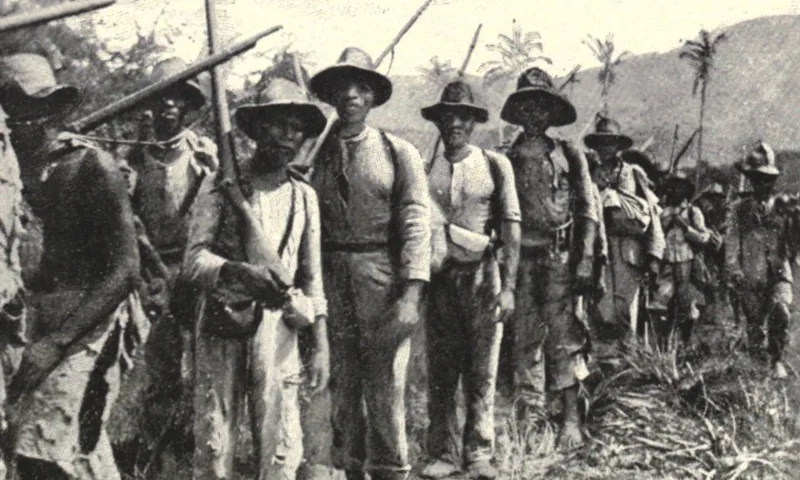
Soldiers of the Cuban Army, from a photograph taken at the time of the landing of the American army, from page 312 of Harper’s Illustrated History of the War with Spain, vol. II, published by Harper and Brothers in 1899.