

Dr. Ignacio Buqueras
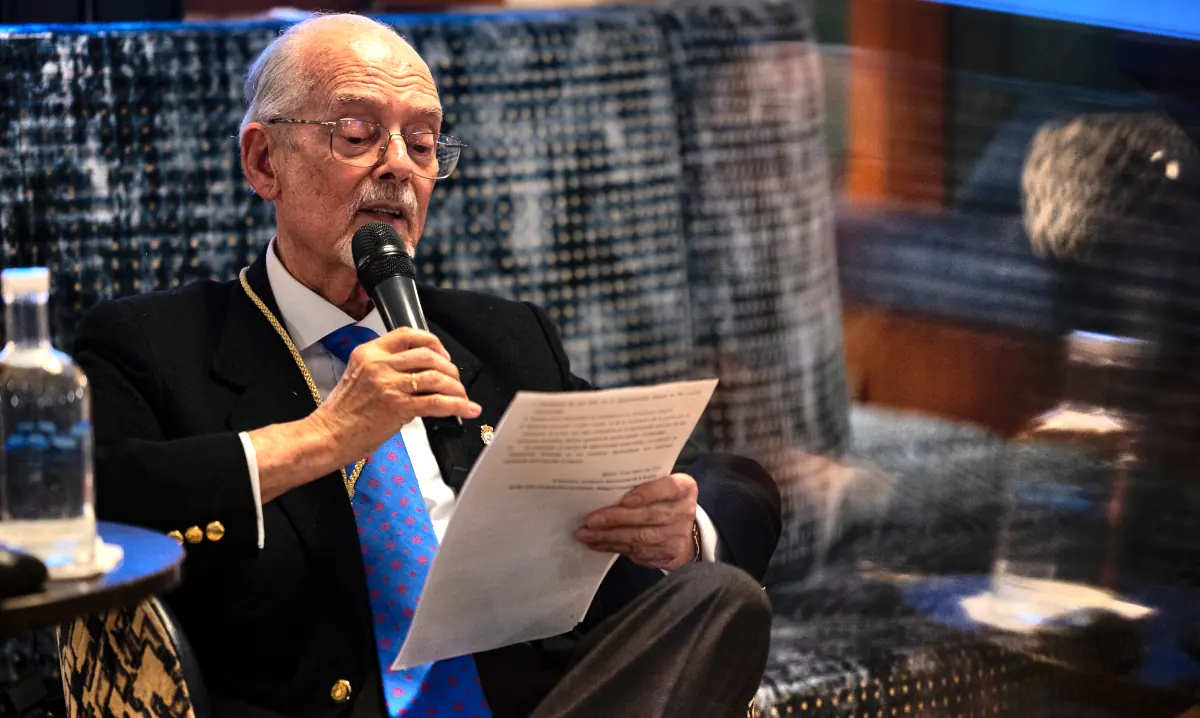
Ignacio Buqueras, President of the Foundation of the Association for the Dissemination and Promotion of the World Heritage of Spain–Adiprope, Honorary President of the Spanish Confederation of Organisations for Older People, full member of the Royal Academy of Doctors of Spain and emeritus member of the Royal European Academy of Doctors (READ), presented at the 10th International Academic Meeting held by the Royal Corporation between 15 and 20 March in various German cities under the general title “The Rhine as a Current of Knowledge: Cross-Border Dialogues” the lecture “Civil Society and the Political Class,” in which he analysed the role that citizens must play in the democratic system in order to become its central axis.
The academic began his address by warning of the historical weakness of Spain’s social fabric, marked by poor civic education and excessive dependence on political power. In response, he argued for the construction of a strong, independent and participatory civil society, capable of acting as a counterweight to the State and energising public life. For Buqueras, democracy can only be consolidated through the active participation of citizens, which requires an education aimed at forming critical, responsible and committed individuals. In this regard, he considered that education must serve as the driving force behind these social dynamics, which are weak today. It is, in his view, the great unfinished task of recent decades. “To strengthen democracy, an extremely fragile and complex system of government, it is essential to develop democratic policies that promote participatory citizenship in the spheres of power. Only its exercise teaches one to be a democrat, and only through participation does one truly become a citizen. Democracy is the fruit of a long apprenticeship and of daily practice,” he stated.
The speaker examined the evolution of civil society in Spain, shaped by factors including delayed industrialisation, the weakness of the middle class, the weight of the State, the role of the Church, and the legacy of Francoism. As a counterpoint to the current weakness of that civil society, he highlighted the rise of the so-called Third Sector, made up of non-governmental, non-profit organisations which, in some social areas, complement or directly replace the action of the administration and private initiative. “In reality, the non-profit sector is a response to the failure of the market and the public sector to meet certain demands for collective goods that neither one nor the other ultimately satisfies, the one due to lack of political interest and the other because it finds no business in it,” he argued.
 As for the political class, the expert called for replacing current leaders with others capable of envisioning the State, which he considered urgently necessary at a time when partisanship and populism dominate the political agenda. A political class, he insisted, that is ethical and devoted to public service. In the same way, he criticised the politicisation of the administration and the loss of institutional efficiency. His intervention concluded with a series of concrete proposals focused on strengthening democracy through civic education, citizen participation, political transparency and institutional regeneration.
An economist and Doctor in Information Sciences from the Complutense University of Madrid, Buqueras is a businessman and senior figure in other prominent civil organisations, including the Club Siglo XXI, the Royal Spanish Naval League, the Civic Panel, and the G2020 Civil Society Platform. He is also an adviser to the Spanish Consumers’ Organisation, a member of the Spanish Chapter of the Club of Rome, a knight of the Monastery of Yuste and a member of merit of the Carlos III Foundation, among others. He is also the author of other reference works such as “Catalonia in Madrid,” “Josep Pla, the Ironic ‘Seny’,” and “Rediscovering America. Discovering Spain,” “Cambó,” “Objective 92: Spain in the World,” “More Society, Less and Better State,” as well as the successful books “Time to Time,” published by Planeta, and “Let Us Stop Wasting Time,” in which he advocates the rationalisation of schedules, a cause that led him to found and chair the Association for the Rationalisation of Spanish Timetables.