


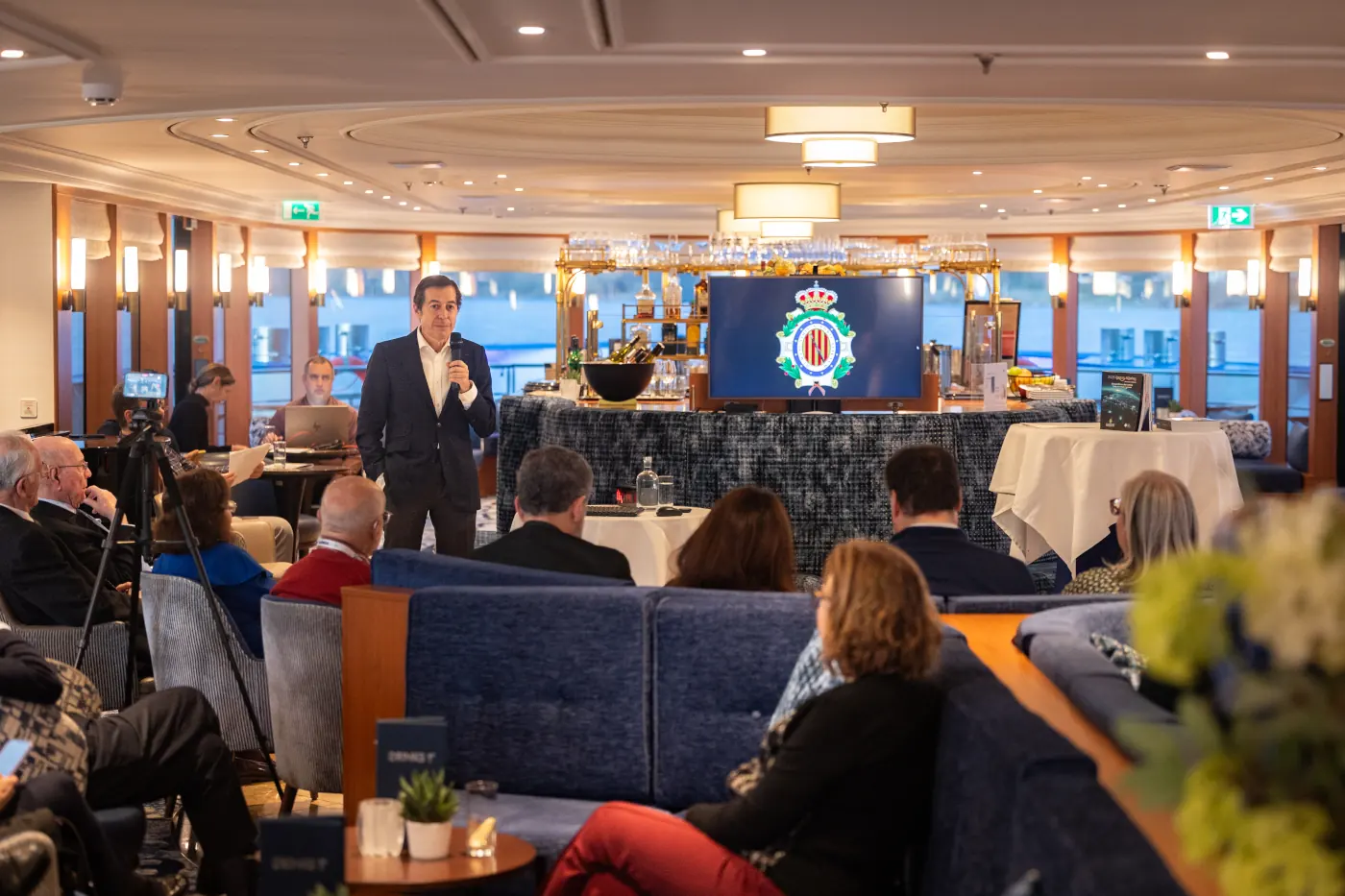
Dr. Óscar López, during his speech at the 10th International Academic Meeting of the RAED
Óscar López, notary and Corresponding Member of the Royal European Academy of Doctors (READ), presented the lecture “Mortal and vital testamentification: an approach to the concept of the will and the so-called living will” at the 10th International Academic Meeting held by the Royal Academy between 15 and 20 March in several German cities under the general title “The Rhine as a current of knowledge: cross-border dialogues”. In it, he analysed the evolution of inheritance law and the growing importance of planning not only the destination of one’s assets after death, but also vital decisions in situations of incapacity.
The expert began his address by recalling the foundations of the classical will: a unilateral, solemn, highly personal, revocable and mortis causa legal act by which a person disposes of their assets, rights and non-patrimonial matters for after their death. He also stressed the strict need to comply with legal formalities, since their absence renders the document null and void. These solemnities guarantee the testator’s capacity, the freedom of their will and certainty as to which is the last valid will. López highlighted that, despite its antiquity, the will is now experiencing a period of great popularity, thanks to the generalisation of private property, the increase in divorces, second unions, and new family models, which have made this instrument an essential tool for adapting inheritance provisions to changing personal realities.
From there, the academic focused on the so-called living will, a document through which an adult, capable, and free person expresses in advance their wishes regarding medical care, treatments, and the disposition of their body when, due to serious deterioration, they are no longer able to express their will. Inspired by bioethical principles of autonomy, its most common contents include the donation of organs and tissues, the refusal of artificial life-support techniques when there is no expectation of recovery, the authorisation of palliative pain treatments even if they shorten life, and the request for euthanasia in certain circumstances.
 For López, this instrument responds to a new reality in which the person loses the capacity to decide. To guarantee its effectiveness, he recalled, there is the National Register of Advance Directives, which allows healthcare professionals to consult these wishes throughout Spain. “Because of its direct link with dignity, we foresee a promising future for the living will, despite its limited use at present, as we consider it beneficial for the patient, relatives, doctors, healthcare institutions and society in general,” the academic concluded.
PhD in Law and author of numerous works on Private Law and legal thought, López is a member of the Professional Advisory Council of the Graduate School of the Autonomous University of Barcelona. He joined the Royal Academy in 2021 with the speech “Justice, law and genetics: a new equality of opportunity”, in which he addressed the legal and social repercussions posed, and soon to be posed, by biotechnological advances.