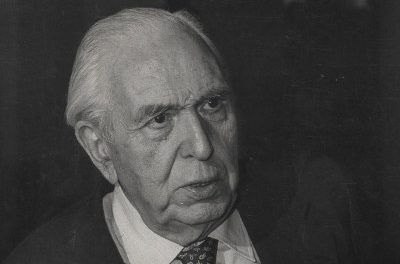



Dr. Joaquín Callabed
Joaquín Callabed, president of the Social Paediatrics Club, corresponding member of the Royal Academy of Medicine of Catalonia and the Royal Academy of Pharmacy of Catalonia, and full member and vice-president of the Health Sciences Section of the Royal European Academy of Doctors (RAED), shares with the academic community a new series of articles in which he examines the classical tradition and the lessons it offers for the present day. More specifically, the articles are “Democritus, Father of Modern Science”, “The Venus de Milo as an Icon of Beauty”, “The Landmark Achievement of Myron’s Discobolus”, “Zeno of Citium, Founder of Stoicism”, “The Struggle for Freedom, According to Herodotus” and “Prometheus, Benefactor of Humankind”, published over recent months in the “Expert Readers” section of the digital edition of the newspaper “La Vanguardia”, whose reader community he actively participates in.
In “Democritus, Father of Modern Science”, the expert examines the life and work of the thinker regarded as the founder of atomism and a pioneer in the study of physics. “The atomist theory of Democritus (460 BC–c. 370 BC) was a precursor of modern atomic theory. He belonged to the School of Abdera, located on the coast of Thrace and founded by Leucippus of Miletus, who was his teacher; both are regarded as the founders of atomism. He has been considered the father of physics or the father of modern science. His doctrines were highly influential in Epicureanism and were revived in the Modern Age during the Enlightenment. Alongside science, he contributed a morality founded on happiness and justice,” he summarises.
In “The Venus de Milo as an Icon of Beauty”, Callabed reflects on one of the figures that best embodies the ideal and canon of beauty of the Hellenistic period of Greek sculpture. “The Venus de Milo, or Milos, is an icon of classical beauty and femininity in Western culture. This work of Ancient Greece was sculpted during the Hellenistic period, between 150 and 50 BC. It is believed to have been created by the artist Alexandros of Antioch and was previously attributed to Praxiteles. Until 1820, the sculpture had a plinth bearing an inscription mentioning Alexandros, who also created a statue of Alexander the Great that is now preserved in the Louvre,” the expert notes.
In “The Landmark Achievement of Myron’s Discobolus”, the president of the Social Paediatrics Club continues his examination of Greek sculpture by turning to another icon: the Discobolus, regarded as the first figure to capture a moment of human action with realism and harmony without losing its serenity. “Stylistically, its great contribution lay in its ability to convey a sense of movement in sculpture, thereby engaging with the reflections of the Eleatic School on the problem of motion, as discussed at the time by Heraclitus and Parmenides,” he observes.
The academic devotes “Zeno of Citium, Founder of Stoicism” to the founder of the Stoic School of Philosophy, which he established in Athens around 300 BC. “Zeno was a disciple of Polemon, Crates of Thebes and Stilpo of Megara. His thought drew on elements of Heraclitus, Plato and some ideas from Aristotle, while opposing above all the rival school of his time: that of Epicurus. Like the Epicureans, Zeno divided philosophy into logic, physics and ethics,” the expert summarises.
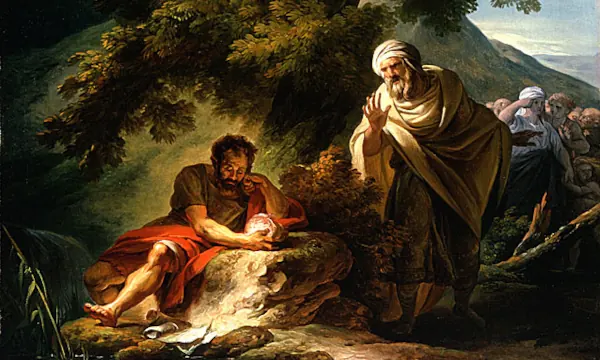
Democritus among the Abderites by François-André Vincent – Public domain image
In “The Struggle for Freedom, According to Herodotus”, Callabed returns to another major figure of Antiquity: Herodotus, who, in addition to being rightly regarded as the father of history, as Cicero described him, is also considered a father of geography and cultural anthropology. “Herodotus is, in a sense, the first anthropologist to explore worlds beyond his own culture. He opens his eyes and ears to the traditions of other peoples and constructs a picturesque narrative, a history of distant horizons that is monumental and at times novelistic; he appears to us as an enlightened traveller fascinated by the East and Egypt, a thinker of extraordinary breadth of vision,” he observes.
Finally, in “Prometheus, Benefactor of Humankind”, the academic recalls the myth of the human figure who defied the gods, one of the most influential figures in the history of Western culture who, from Antiquity to the contemporary era, has symbolised rebellion, scientific progress and sacrifice. “The myth of Prometheus is that of the Titan who defied the gods to give fire and knowledge to humankind. He has been one of the most influential figures in the history of Western culture. He taught human beings arts such as medicine, astronomy, mathematics and metallurgy, helping them to overcome their animal condition,” the expert recalls.