

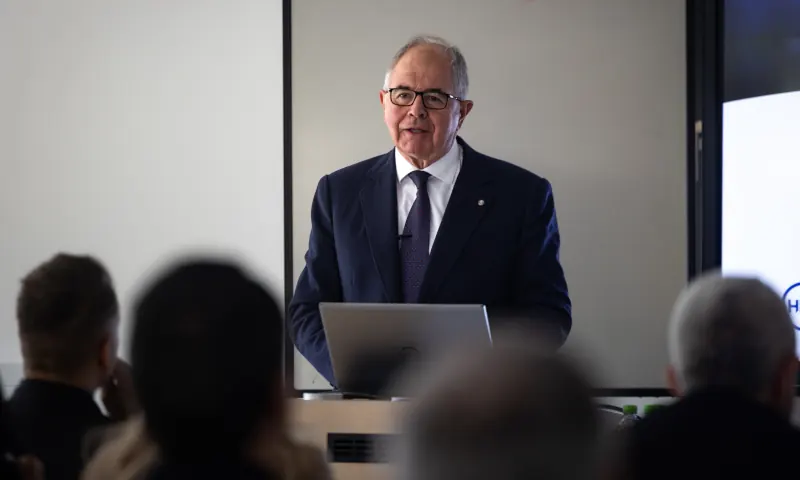
Dr. José María Bové
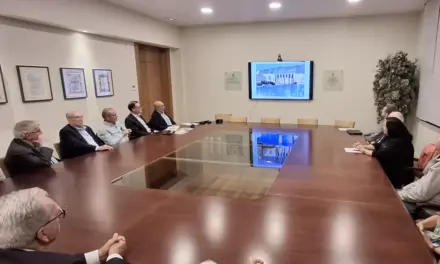
José María Bové, President of the audit firm Bové Montero y Asociados, Honorary Consul General of Austria for Catalonia and Aragon and Numerary Member of the Royal European Academy of Doctors (READ), presented the lecture “Fractured Eurasia: Russia’s repositioning” at the 10th International Academic Meeting held by the Royal Academy between 15 and 20 March in several German cities under the general title “The Rhine as a current of knowledge: cross-border dialogues”. In his lecture, he analysed Russia’s development from the 1980s to the present day and the effects that the war in Ukraine is having and will continue to have, opening up a new scenario for the European project and its defence.
For the expert, Russia remains largely unknown to the West. Following the disintegration of the Soviet Union, which meant the loss of its status as a superpower, the country experienced a traumatic decade of transition to capitalism in the 1990s, involving a form of shock therapy, with hyperinflation of over 2,500%, a GDP collapse of close to 50% between 1991 and 1997, the mass impoverishment of the population and the rise of a new class of oligarchs who divided up the main state assets at derisory prices. The financial crisis of 1998, with the devaluation of the rouble and default on payments, marked a turning point. The subsequent recovery, driven by the boom in oil and gas prices, enabled Vladimir Putin to consolidate a form of state capitalism, regain control of strategic sectors and project an image of Russia as an energy power.
Bové explained that, with Putin’s rise to power in 2000, Russia shifted towards a multipolar stance, asserting its sphere of influence in the post-Soviet space and opposing NATO’s expansion. Tensions with the West worsened with the war in Georgia in 2008, the annexation of Crimea in 2014 and, especially, the invasion of Ukraine in February 2022, which broke the post-Cold War European security architecture. This conflict, he noted, has acted as a turning point. The West responded with massive sanctions, the freezing of the Central Bank of Russia’s reserves, and energy embargoes. This has led Moscow to reorient its economy towards Asia, making China its main trading partner and India a major buyer of oil. Although it maintains a war economy that allows it to avoid collapse, it suffers from technological isolation, limited industrial diversification and a strong dependence on raw materials.
 Looking to the future, the academic outlined several possible scenarios for Russia, ranging from the prolongation and entrenchment of the conflict in Ukraine, with greater dependence on China and stagnant growth, to a negotiated de-escalation that would allow moderate growth, or even a possible controlled transition within the regime. “In the medium term, Russia is unlikely to recover the role of great Eurasian architect. It is emerging rather as a systemically relevant power, but one in relative decline, with demographic and economic limitations that force it to seek balances between China, the so-called Global South and a fractured West,” he concluded. For Bové, in a fractured Eurasia, Russia retains the capacity for influence, but faces serious structural constraints that complicate its future projection as a great power.