

Teresa Freixes, Jean Monnet Chair ad personam, President of the international organisation Citizens pro Europe, Vice-President of the civic platform Sociedad Civil Catalana, and full member and Vice-President of the Board of Governors of the Royal European Academy of Doctors (READ), reflects on the migration crisis affecting Spain since the mass crossing of Moroccan citizens at the Ceuta border on 30 and 31 July, as well as on other aspects of current affairs in Spain, in the articles “What Should We Do with the Foreign Minors in Ceuta?”, “Ceuta, città aperta,” “Historical Events, Physical Phenomena and Memory” and “Downhill and Toothless,” published between 9 and 25 August on the specialist portal Artículo 14 and the digital newspaper The Objective.
In “What Should We Do with the Foreign Minors in Ceuta?”, the legal expert outlines international humanitarian law and asylum policies to clarify what should happen to the minors who entered the autonomous city illegally and remain there without protection. “It is truly surprising that the politicians in charge already want to establish the distribution or reception among the autonomous communities of the unaccompanied minors who are in Ceuta. They do not even know yet how many there are, since while the Spanish Government speaks of around 1,500, the Ceuta authorities and organisations present in the area count more than 4,000, and they already want to distribute them. Nor have they been able to identify them or scientifically verify that they are in fact minors. Their families have not been sought, although it appears that some are trying to find them by their own means, attempting to get them back home,” she explains.
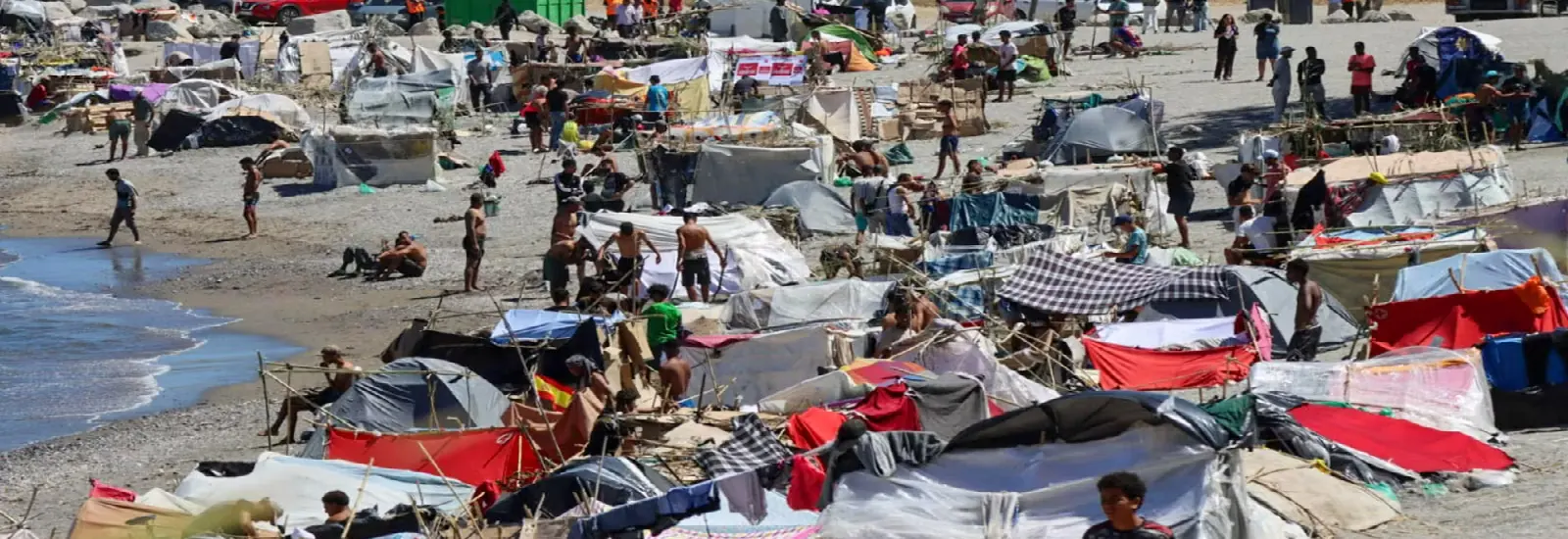
In “Ceuta, città aperta,” the Vice-President of the Royal Academy called, before its adoption, for the application of the National Security Law in response to an uncontrolled situation following the arrival of around 70,000 people in the Spanish North African city. “What are we faced with now? We are faced with a Spanish city located in North Africa that has been invaded, which for almost two days was a lawless city, overwhelmed by an influx of almost as many foreigners as inhabitants, without access to even the most basic sanitation, without food or water, without healthcare services capable of operating for such a large number of potential users, without accommodation, without the possibility of identification to individualise administrative needs, without any guarantee of security or respect either for those who entered or for the local population, economically paralysed, living in practical abandonment, while those who have the legal obligation to confront the situation do not even bother to concern themselves with what they should, some because they are away on musical holidays and others because they are preoccupied with the eclipse…” she argues.

Dr Teresa Freixes
In “Historical Events, Physical Phenomena and Memory,” the President of Citizens pro Europe brings into the present, prompted by the links drawn between certain historical events and the earthquakes that have affected the province of Granada in recent weeks, the existence in the Lleida municipality of Els Omells of a labour camp run by the Republic’s Military Investigation Service. “More than 600 prisoners from Barcelona’s Model Prison were sent there, most of them imprisoned for political reasons — they were not combatants captured in battle — for being Catholics or members of the bourgeoisie, homosexuals, Falangists, lawyers, professors, doctors, as well as deserters or Republicans opposed to the direction the regime was taking, particularly militiamen from the POUM and anarchists, after the May Days of 1937. According to what the residents of Els Omells told me. However, they greatly disliked talking about it, and the information had to be drawn out of them little by little; practically the entire village functioned as a concentration camp, while they themselves, also under exhaustive surveillance, were unable to have contact with the prisoners,” she recounts.
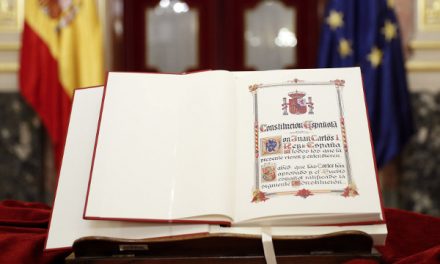
Finally, in “Downhill and Toothless,” Freixes lists a series of episodes that have led the Government to maintain fragile parliamentary balances without fully exercising its functions as would be expected of any democratic government. “The Sánchez executive intends to govern without taking into account that our constitutional system follows the principles of parliamentary monarchies, not presidential populisms, which is what they want us to become accustomed to. This allergy to Parliament may lie behind the refusal to apply the appropriate rules to the situation in Ceuta, through a declaration of national security interest, which would require going to explain it to Congress; to avoid doing so, instead of creating a single command structure, as prescribed by law, with clearly defined powers, they simply label Minister Ángel Torres as a coordinator and leave him to deal with the situation. They are certainly creative. The problem is that this kind of creativity is not very effective,” she concludes.