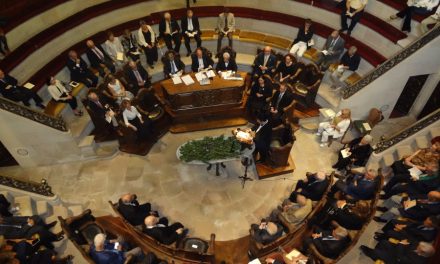


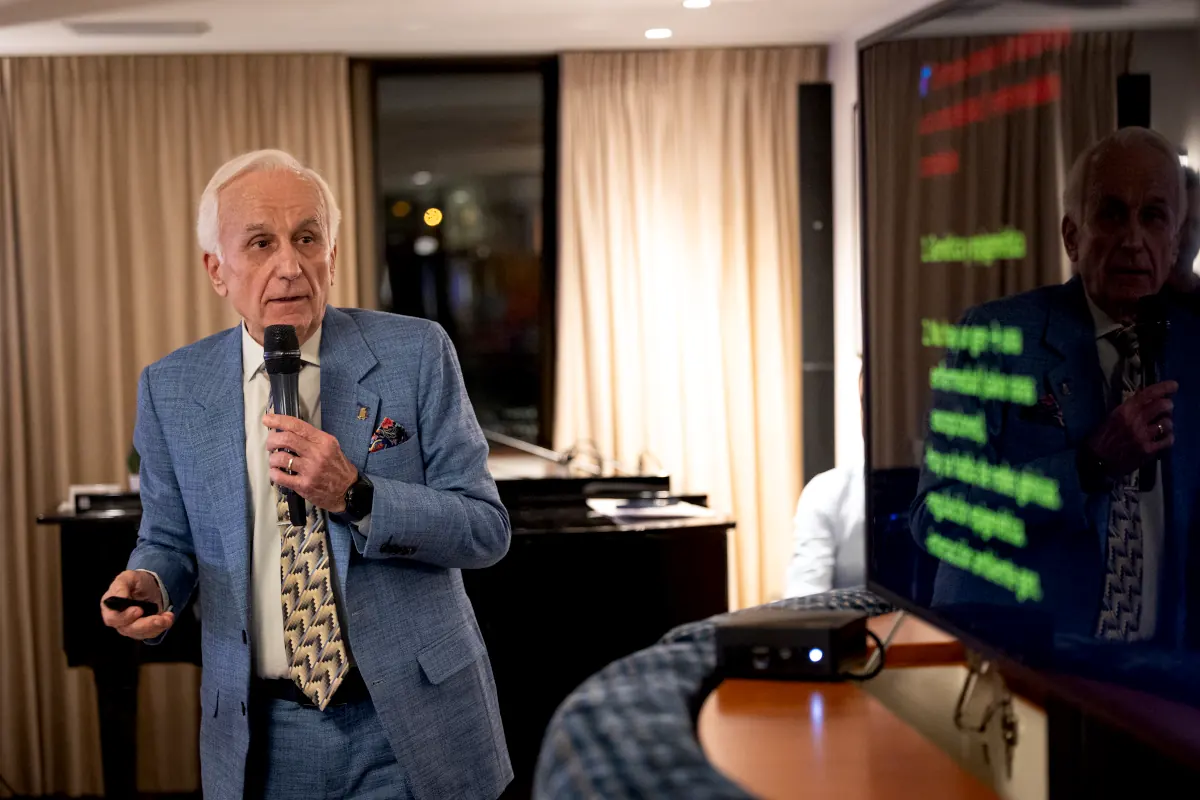
Dr. Joaquim Gironella, during the presentation of his paper at the X International Academic Meeting of the RAED
Joaquim Gironella, renowned urologist, medical co-director of the Laser Medical Rent centre and Numerary Member and Vice-President of the Royal European Academy of Doctors (READ), presented the lecture “Medicine of complex systems: a new paradigm” at the 10th International Academic Meeting held by the Royal Academy between 15 and 20 March in several German cities under the general title “The Rhine as a current of knowledge: cross-border dialogues”. In it, he proposed a profound change in the way medical practice is conceived. In contrast to the reductionist, linear model that has dominated medicine for centuries, Gironella advocated adopting a complex-systems perspective, in which health and disease are understood as emergent, dynamic, and multicausal phenomena.
For the expert, human beings live in a world surrounded by systems composed of countless components that interact nonlinearly through physical, chemical, biological, psychological, and social processes. This reality calls for an epistemological and ontological shift that leads science to abandon rigid, deterministic and fragmented thinking in order to embrace notions such as instability, bifurcations, emergence, self-organisation, resilience and unpredictability. In this regard, he referred to the theses on complex thought of the French philosopher and sociologist Edgar Morin. In contrast to simplifying knowledge, which reduces phenomena to single causes, complex thought accepts uncertainty, contradictions and interdependence. In medicine, Gironella noted, this means moving from a positivist and reductionist view, in which the organism is merely the sum of its organs, to a holistic, contextual and dynamic approach.
 The academic criticised the tendency of current medical training and evidence-based medicine to confine clinical practice within rigid protocols that clash with the unpredictable nature of living systems. Each patient is unique, and disease often manifests itself in a blurred and heterogeneous way, as occurs in Parkinson’s disease, type 2 diabetes, Alzheimer’s disease or cancer. Hence, his proposal involves radically transforming medical practice, beginning with the conventional, limited and static diagnosis giving way to a model of continuous evolution that integrates real-time biometric sensors, artificial intelligence, genomics and digital medicine. Treatments would no longer be isolated interventions, but adaptive processes that accompany the patient’s life trajectory, he stated.
Gironella considered that the so-called medicine of complex systems opens up promising horizons, from personalised medicine with artificial intelligence to anti-ageing therapies, dynamic gene editing, bioengineering and proactive prevention. However, he warned that the ethical challenges associated with its practice and the importance of equitable access to advanced treatments must be taken very seriously, as the risk of widening inequalities is evident. He also warned of the limits of artificial intelligence in the face of the radical complexity of human reality. In his conclusions, the speaker called for a multidisciplinary approach to medicine, open to uncertainty and capable of integrating the natural sciences, social sciences, and the humanities. “It is not a question of rejecting technical advances, but of enriching them with a deeper vision of the human being as an open system in constant interaction with its environment,” he concluded.