

José María Baldasano, Professor of Environmental Engineering at the Polytechnic University of Catalonia, Nobel Peace Prize laureate as a representative of the Intergovernmental Panel on Climate Change, and Numerary Member of the Royal European Academy of Doctors (READ), presents the book «Dos grados más no son para tanto. Una historia del negacionismo climático» (Two Degrees More Are Not Such a Big Deal. A History of Climate Change Denial) (Cátedra), in which he examines the controversial history of the denial of the climate crisis, consistently driven by political and commercial interests. The expert also introduces recently coined concepts such as delayism and technological neutrality and calls for collective responsibility in the face of the climate emergency.
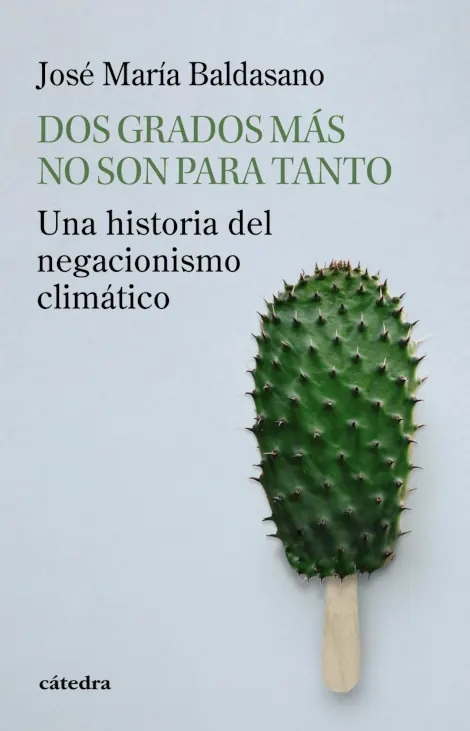 The book, prefaced by José Ramón Calvo, Corresponding Member of the Royal Academy of Medicine of the Basque Country and Numerary Member and President of the Institute for International Cooperation of the READ, was presented in Barcelona on October 23 at an event held at the Ateneu Barcelonès, with the participation of Santiago Vilanova, journalist and writer, and Antonio Cerrillo, a leading environmental journalist at «La Vanguardia.» «One of the strategies used by climate change denial has been to systematically question and place climate science in a constant state of doubt and uncertainty. Consequently, it has become necessary to put in black and white that we have more than two hundred years of scientific knowledge about how the atmosphere works and the role played by greenhouse gases,» the author explained.
«Climate change deniers and skeptics want us to believe that the entire issue of global warming is an idea dreamed up by a group of scientists bent on destroying the economy and society. However, the roots of scientific thinking about the Earth’s temperature and its causes stem from the development of knowledge throughout the nineteenth and twentieth centuries. The reason for recounting this journey through time of scientific knowledge that has enabled us to better understand how the Earth’s atmosphere and climate system function is that many of the myths, lies, and hoaxes promoted by denialism are based on a biased, manipulated, and falsified use of that knowledge. Climate change denial is fundamentally an economic, ideological, political, social, and media phenomenon that rejects or downplays the scientific consensus on current climate change and its consequences, with the primary objective of allowing humanity to continue within a fossil-fuel-based civilization,» Baldasano added during the presentation of the monograph.
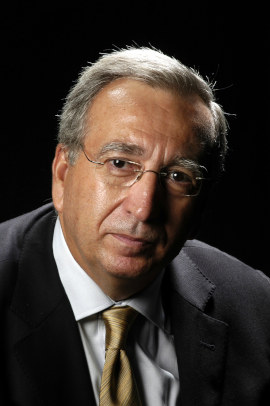
Dr José María Baldasano
In addition, the academic participated on December 5 in the Institutional Seminar organized by the Institute of Atmospheric Sciences and Climate Change of the National Autonomous University of Mexico, delivering the lecture «What Role Are Aerosols Playing in Current Climate Change?» via videoconference, which can be viewed on the institution’s YouTube channel. Drawing on an extensive compilation of data, the expert analyzed the historical and ongoing impact of these types of emissions on the planet’s temperature and its gradual warming.
Baldasano authored the «Report on Climate Change» debated by the Climate Emergency Committee of the Parliament of Catalonia and also prepared the «Report of the King Jaime I Awards for the Environment on Current Climate Change,» co-signed with José Luis Rubio and presented before the plenary session of the High Advisory Council for R&D&I of the Presidency of the Generalitat Valenciana. The academic also presented the study «Low-Emission Zones to Improve Urban Air Quality» at the virtual meeting «Barcelona, Low-Emission Zone,» organized by «La Vanguardia.» Baldasano also examined in depth the effects of emission reductions resulting from mobility restrictions during the pandemic in articles such as «Covid-19 lockdown effects on air quality by NO₂ in the cities of Barcelona and Madrid (Spain),» in which he called for the implementation of new urban mobility policies after confirming emission reductions of between 50% and 62% in these two cities during March 2020.