


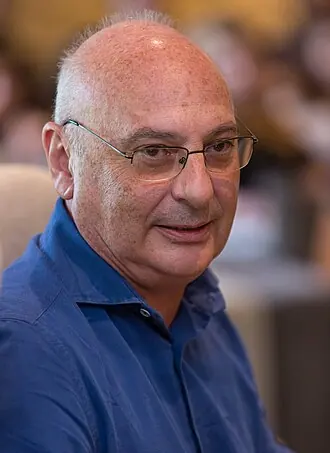
Dr. Francis Mojica. Image by Manuel Castells, CC BY-SA 2.0, via Wikimedia Commons
Francis Mojica, Professor of Microbiology at the University of Alicante, member of the Royal Valencian Academy of Medicine and honorary academic-elect of the Royal European Academy of Doctors (RAED), received the Medal of Honour of the Vives Network on 3 July. The network brings together around twenty universities in territories with Catalan language and culture, and the distinction recognises his contributions to the discovery and development of the CRISPR system (Clustered Regularly Interspaced Short Palindromic Repeats), one of the most important gene-editing tools of the 21st century. The award ceremony was held in the amphitheatre of the University of Perpignan Via Domitia under the presidency of its rector and current president of the Network, Yvan Auguet.
For his discovery, the academic-elect had already received highly prestigious international recognitions such as the King Jaime I Award for Basic Research, the BBVA Foundation Frontiers of Knowledge Award, the Lilly Foundation Award for Preclinical Biomedical Research, the Plus Alliance Prize for Global Innovation and the Albany Medical Center Prize in Medicine and Biomedical Research in the United States. The 2020 Nobel Prize in Chemistry, however, was awarded to scientists Emmanuelle Charpentier and Jennifer A. Doudna for the development of the method that has come to be known as “genetic scissors”.
“The CRISPR system is one of the greatest advances in recent history, regarded as one of the most important in microbiology worldwide, a scientific revolution, a technology that is changing the future of humanity because it has applications in a wide variety of fields, from agriculture to human health.
 With his discovery, Francis Mojica has transformed the way we understand and modify the genome,” said Amparo Navarro, Rector of the University of Alicante, in presenting the award. She added that this technology opens the door to the development of new treatments for diseases that until now have been difficult or impossible to treat, facilitates the early detection of certain conditions and offers new tools for preventing infections and treating diseases of genetic origin.
Mojica, for his part, thanked the Network for the Medal of Honour, which he described as a collective recognition of decades of research, shared work, scientific curiosity and commitment to knowledge. At the same ceremony, the Vives Network also presented its highest distinction to neurologist Mercè Boada, an international authority on the study and treatment of dementia and Alzheimer’s disease. “Your example inspires us. Your work is an invaluable contribution to science, health and collective well-being. You are proof that excellent scientific research transforms the world and the society in which we live,” Auguet concluded at the ceremony.