

The Board of Governors of the Royal European Academy of Doctors (READ), on behalf of the entire academic community, reiterates its sorrow at the passing of its Honorary Member Fernando Ónega and pays him a sincere and well-deserved tribute ahead of his academic memorial, reproducing the moving letter that José Ramón Calvo, Corresponding Member of the Royal Academy of Medicine of the Basque Country and Numerary Member and President of the Institute for International Cooperation of the READ, addressed to him on 6 March, shortly after his death, through the specialised portal 65ymás, founded and chaired by Ónega himself. The letter appeared in the article entitled “Chronicle of a War, Lament of a Loss.”
Chronicle of a War, Lament of a Loss
Dear Fernando,
I write these lines knowing that, contrary to your usual habit, you will not be able to return my call or reply to my messages, that the line which so often connected you to millions of listeners and readers has fallen silent, and yet your voice continues to resonate with that unmistakable tone you never lost. I do not know whether this letter will reach you wherever you are, but I do know that, thanks to your beloved newspaper 65ymás, it will reach those who loved you, listened to you, read you and admired you.
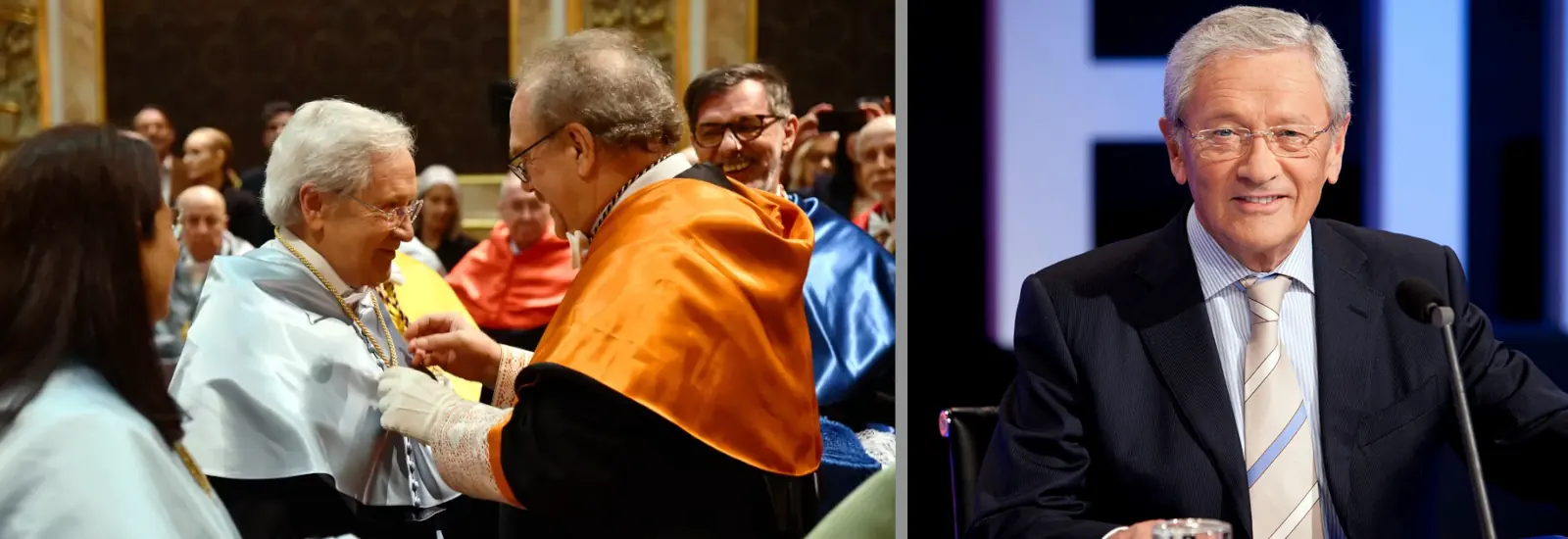
If memory serves me correctly, our last opportunity to be together in a personal and intimate way was almost a year ago, in one of the most distinguished halls of knowledge in this country, the auditorium of the Complutense University of Madrid, a place that has hosted some of the most eminent figures of universal learning. That morning, academic ceremony assigned each of us our role: you, master of the word, came to speak to us about the agony of the State; I, physician and academic, was to respond to you on behalf of a Royal Corporation honoured to receive you. Today the scene is different, less solemn, more intimate and, for this writer, undoubtedly more painful: I no longer answer your speech, I mourn your absence.
Then I outlined your biography before the audience; today I revisit it quietly, like someone slowly turning the pages of an album. That boy from Mosteiro who published his first text at the age of 13, the young man who arrived in Santiago and Lugo hungry for news, the journalist who became an exceptional chronicler of the Transition and one of the great architects of Spain’s democratic narrative. The man who wrote “I can promise and I promise” and understood that behind that anaphora a country—your country—was seeking its future.
In radio, in the press and on television you were many things, but above all you were a teacher of journalists and a guardian of collective memory. You created a way of speaking to Spain through letters, an idea that, as you once said, was suggested to you by Luis del Olmo: first in those minutes of “Protagonistas,” later in your “Letters to Spain,” always with the same blend of tenderness, irony, precision and that unmistakable Galician wit you never abandoned. You made every listener feel that you were speaking directly to them, even if they were listening alone in the early hours or watching the news on television.
In our Academy we celebrated you as an Honorary Member, for it was you who honoured us, although in truth you arrived with many titles that do not appear on diplomas: pioneer of opinion spaces on radio, educator of democracy on television, manager of media companies, craftsman of columns that were authentic manuals of civic responsibility in the written press, and president and soul of this newspaper, our newspaper, where I now write, giving a voice to the senior world.
Your inaugural address in our institution, “The Agony of the State: Crisis and Reinvention in the 21st Century”, was a lesson in serene lucidity. I know how much it cost you to write it, the revisions you made, from the first draft you sent me in the summer of 2024 to the final version you worked on until the night before the ceremony. You borrowed the word agony from Unamuno to remind us that to agonise is not to die, but to struggle: to struggle against life itself and against death. You described a State overwhelmed by territorial crises, by partisan capture of institutions, by technological and demographic revolutions, by a new form of economic colonialism that weakens sovereignties. Yet, true to your style, you did not remain in a sombre diagnosis: you spoke of reinvention, of a new social contract, of functioning services, of a civil society that, in every crisis, shows that the State is also made up of volunteers, healthcare workers, the UME, the security forces and that Crown which, in its constitutional role, represents the dignity of all.
That morning in the auditorium I tried to do something I now know was impossible: to summarise your life and your thought within the limited time allowed by protocol. Today, freed from that academic clock, I can add what was then only hinted at between the lines: that beyond the influential journalist, the writer of historic speeches or the president of 65ymás, what dazzled us was your integrity in times of polarisation, your ability to listen before judging, your determination to maintain courtesy even towards adversaries and, above all, for me personally, the privilege I had of enjoying you as a friend whom I now deeply miss.
That day we also admired you as a father and as a husband. We knew the pride with which you spoke of Cristina, Sonsoles and Fernando, the only one who followed a different path from journalism; how moved you were when recalling the kidney that Ángela donated to you when your health began to falter; the happiness your grandchildren gave you; and that circle of friends you maintained beyond ideological trenches, many of whom were there accompanying you on that special day. In a world that confuses success with noise, your life taught, as you so often said, that true prestige is written quietly and confirmed through affection.
Perhaps your greatest legacy is having demonstrated that journalism can be the best antidote against oblivion and falsehood, provided it is practised with courage, with subtle irony and with the determination to give a voice to those who have none. As you wrote on many occasions, information without civility only fuels noise; that is why your chronicles, your books and your letters were not mere exercises in memory or displays of linguistic mastery, but true manuals of civic responsibility for future generations.
Today, from this corner of a world shaken by a war as absurd as all wars, I read newspapers and listen to radio stations in Spain that call you a reference, a master, a chronicler of the Transition. Your colleagues recall the mark you left in newsrooms and on the airwaves; and the Royal European Academy of Doctors, your home, feels orphaned but also proud to have counted you among its members. In my memory, Fernando, there will remain that moment of a modest man who never lost his sense of humour, who, on one of the most important days of his academic life, embraced me at the end of the ceremony and said, with Galician humility: “José Ramón, you have exaggerated a great deal, but you do not know how much I appreciate it.” And I thought then, as I do now, that the only thing impossible to exaggerate was your kindness and the reality of what you had achieved and sown throughout your life.
I do not know whether States agonise, as you asked, but I do know that there are voices that do not die. Yours will continue to live in newspaper archives, in audio recordings, in classrooms where your texts are studied and, above all, in the memory of those who found in your words a light in dark times. As I heard someone say today, every time a young journalist tries to write a letter to Spain, seeking that balance between criticism and respect, between irony and tenderness, you will in some way be whispering in their ear what must be said to continue your legacy.
Allow me to end as I did then, but with a nuance that only the sadness of loss permits. That morning of 13 March 2025 I welcomed you to the Royal European Academy of Doctors on behalf of your sponsors and all your colleagues. Today, on behalf of that same institution and of so many Spaniards who felt you as one of their own, I can only say thank you: for having made language an exercise in honesty, for teaching us that to promise and to fulfil are not opposing verbs, for reminding us that this country, which you loved so deeply, deserves to continue striving simply to function and never to forget that once, a master of masters, a great among the great, was able to describe it, narrate it and tell its story with balance and fairness. What today seems impossible, you achieved.
Thank you, dear and admired master. Until always in my memory.