


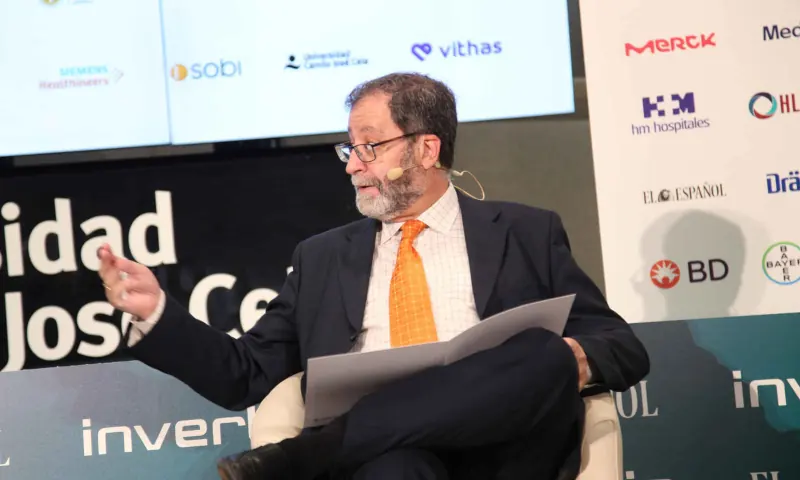
Dr. Francisco López Muñoz
Francisco López Muñoz, Professor of Pharmacology and Vice-Rector for Research, Science and Doctoral Studies at Camilo José Cela University, corresponding member of the Royal Academy of Medicine of the Basque Country and other national and international academies, and full member of the Royal European Academy of Doctors (RAED), examines major historical events that shaped the history of Spain in the articles “Los Galindos: Anatomy of an Institutional Failure. Criminological, Judicial and Victimological Lessons Half a Century Later”, co-authored with Francisco Pérez Fernández, Professor of Criminal Psychology and History of Psychology at Camilo José Cela University, in the latest issue of Logos, the scientific journal of the Civil Guard School; “Henry Morgan: From Notorious Privateer to Loyal Knight and Scourge of Pirates”, also published with Pérez Fernández in the latest instalment of the Pirates and Privateers series in Proa a la mar, the journal of the Royal Spanish Naval League; and “The Terrorist Attack in Plaza de la República Dominicana against the Civil Guard and the Paradigm Shift in the Fight against ETA”, published in the anniversaries section of the Academy of Military Sciences and Arts, of which he is a corresponding member.
In “Los Galindos: Anatomy of an Institutional Failure. Criminological, Judicial and Victimological Lessons Half a Century Later”, López Muñoz and Pérez Fernández analyse one of the darkest and most widely reported cases of late-Francoist Spain: the fivefold murder at the Los Galindos country estate in Paradas, Seville, in 1975. The justice system ultimately failed to resolve a case in which an accumulation of structural errors made it impossible to reconstruct a solid judicial truth. The article details how the early contamination of the crime scene, the absence of basic forensic protocols, discontinuity in the judicial investigation, contradictions between autopsies, weaknesses in the chain of custody and the proliferation of hypotheses without scientific filtering dismantled any possibility of clarification. Added to all this was a political and institutional context marked by outdated police and judicial structures, a degree of politicisation and an investigative model still anchored in the logic of the past.
In “Henry Morgan: From Notorious Privateer to Loyal Knight and Scourge of Pirates”, the two experts examine the figure of the celebrated Welsh adventurer who went from being one of the most feared buccaneers in the Caribbean to becoming a knight and Lieutenant Governor of Jamaica. On the question of whether he was a criminal, they point out that the boundary between privateer and pirate was blurred and depended on political perspective. To the British, he operated under an official letter of marque and was a hero; to the Spanish, he was a pirate deserving punishment. Following Spanish protests, Morgan was summoned to England, but he was ultimately acclaimed, knighted in 1674 and appointed a senior colonial official. In his later years he devoted himself to suppressing the buccaneers he had once commanded, acquired sugar plantations and won a libel case against the chronicler Alexandre Exquemelin. He died in Port Royal on 25 August 1688. The authors underline how his life illustrates the legal ambiguity of the period and how his figure was mythologised in both literature and film.
Finally, in “The Terrorist Attack in Plaza de la República Dominicana against the Civil Guard and the Paradigm Shift in the Fight against ETA”, the academic recalls one of the most serious and symbolic attacks in the history of the terrorist organisation, which killed 12 young Civil Guards aged between 18 and 25 and left almost 80 people injured. “The media described the attack as evidence of ETA’s operational capability in the second half of the 1980s. They highlighted the extreme violence used against a target made up mainly of young officers in training, in a densely trafficked area of the capital, and the profound emotional impact on the citizens of Madrid. From a strategic perspective, the attack demonstrated ETA’s tactical evolution towards actions designed to achieve major psychological and propaganda impact, sowing insecurity among the population and attempting to erode society’s confidence in the democratic State’s ability to protect it. However, the effect achieved was, to a large extent, the opposite, as the social response was marked by mass gatherings of condemnation, demonstrations of solidarity with the victims and a strengthening of the political and democratic consensus around the need to isolate the terrorist organisation socially and politically,” the expert explains.
 A recognised populariser of contemporary history, Spanish Golden Age literature, medicine and pharmacology, López Muñoz holds doctorates in Medicine and Surgery and in Spanish Language and Literature, is a specialist in Pharmaceutical Medicine and holds a diploma in Holocaust Studies from Yad Vashem’s International School for Holocaust Studies in Jerusalem. He is a researcher at the Hospital 12 de Octubre Research Institute in Madrid, a member of the Governing Board of the HM Hospitals Health Research Institute and of the Miguel de Cervantes Institute for Medieval and Golden Age Studies at the University of Alcalá de Henares, a member of the Science and Technology Council of the Community of Madrid, scientific adviser to the Ibero-American Committee on Ethics and Bioethics, a member of the Observation Committee of the Spanish Human Rights Observatory, of the Spanish Chapter of the Club of Rome, and an honorary member of the Ghandi-Mandela Foundation. He has participated in numerous research projects and is the author of monographs and articles in his fields of study. He has recently been appointed an honorary Kentucky Colonel and Honorary Civil Guard, coinciding with the 25th anniversary of the creation of this distinction, the force’s highest civilian honour, which is awarded only exceptionally; and on 20 March he was awarded the Medal for Merit in Cyber Defence by the Professional Association of New Technology Experts.