


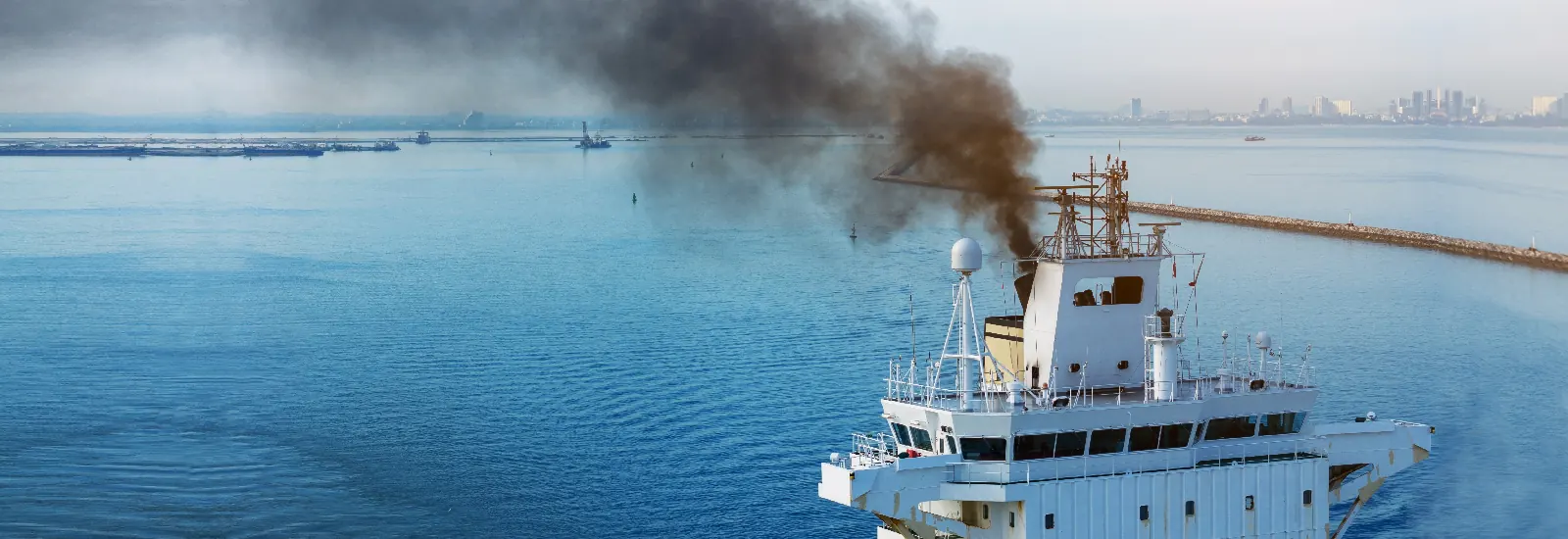
José María Baldasano, Professor of Environmental Engineering at the Polytechnic University of Catalonia, Nobel Peace Prize laureate as a representative of the Intergovernmental Panel on Climate Change, and full member of the Royal European Academy of Doctors (RAED), is a co-author, together with a group of researchers, of the study “Development of a high-resolution maritime emissions inventory for the Gulf of Mexico (GoM-HEI) based on AIS data”, published in the latest issue of the scientific journal Ocean Engineering, due to appear at the end of August. This is the first high-resolution maritime emissions inventory for the Gulf of Mexico. It was created to support environmental policy decisions, protect public health and preserve the Gulf of Mexico’s coastal ecosystems through accurate scientific data.
The study is based on one-minute-resolution vessel-tracking data from the international Automatic Identification System (AIS) covering the whole of 2022, and allocates emissions to a grid of approximately one square kilometre with daily aggregation. The inventory quantifies emissions of the main atmospheric pollutants generated by maritime traffic: nitrogen oxides (NOx), sulphur dioxide (SO₂), carbon monoxide (CO), black carbon (BC), particulate matter (PM₁₀ and PM₂.₅) and non-methane volatile organic compounds (NMVOCs). By reconstructing actual vessel activity from high-frequency AIS observations, GoM-HEI captures in detail the spatial and temporal variability of emissions along the region’s main shipping corridors, port areas and coastal zones.
The results show daily averages of 194 tonnes of NOx, 134 tonnes of SO₂, 110 tonnes of CO, 90 tonnes of PM₁₀, 83 tonnes of PM₂.₅, 3 tonnes of black carbon and 40 tonnes of NMVOCs. Emissions display a clear seasonal pattern: they decrease at the beginning of the year, rise sharply in spring and remain high until June, fall during the summer and early autumn, and rise again in late November and early December. Spatially, the highest concentrations occur along the corridors linking Houston-Galveston with ports in the northern Gulf, routes towards Veracruz and Coatzacoalcos, the channel leading to Progreso and the Yucatán Peninsula, and in the ports of Houston, Louisiana, Tampico-Altamira, Veracruz, Coatzacoalcos and Progreso themselves. Comparison of GoM-HEI with other global inventories reveals significant differences in both magnitude and spatial patterns. The regional inventory records higher annual totals for almost all pollutants and more faithfully captures actual shipping routes and port hotspots, which tend to be smoothed out or underestimated in global-scale products. The differences are statistically significant and arise mainly from the resolution of the activity data and the different estimation methodologies used.
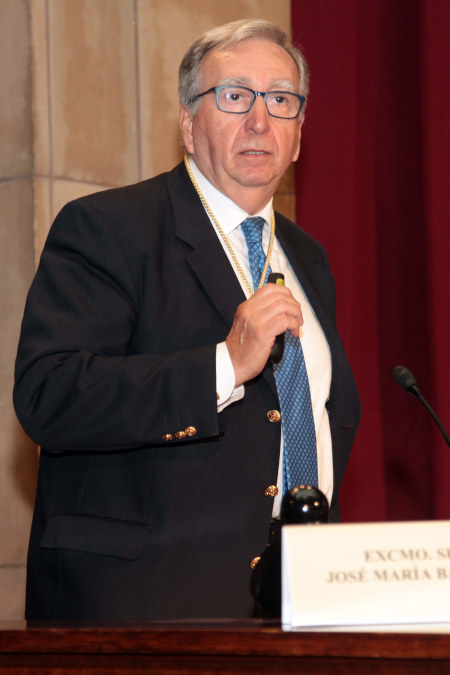
Dr José María Baldasano
The authors stress that regional inventories of this kind, built from high-frequency AIS data and assigned to a grid of approximately one kilometre, are essential for air-quality modelling, environmental management and the design of emission-control strategies in an area of intense maritime activity. The Gulf of Mexico already accounts for a substantial share of traffic through the main US and Mexican ports, and projects such as the Interoceanic Corridor of the Isthmus of Tehuantepec are expected to increase vessel volumes still further in the coming years. Although the inventory contains uncertainties inherent in estimating engine power from speed over ground rather than speed through water, and in the use of standardised emission factors, the researchers consider that it provides a robust and practical representation of regional patterns. The data are publicly available in the Zenodo repository.
Separately, the news portal NTN24, which focuses on the Spanish-speaking world, published a report on the climate crisis on 22 July in which Baldasano explains how Arctic warming is altering atmospheric circulation and encouraging extremely hot air from the Sahara to reach Europe, where temperatures of up to 44°C are already being recorded. According to the academic, this is compounded by the warming of the Mediterranean, whose temperatures are between two and three degrees above normal. The expert warns that the sea is absorbing a large proportion of the excess heat caused by rising greenhouse-gas concentrations, thereby helping to intensify heatwaves. The situation could worsen over the coming weeks and extend into September and October as heat accumulates and El Niño conditions develop.
Baldasano authored the “Report on Climate Change” debated by the Climate Emergency Committee of the Parliament of Catalonia. He also prepared the “King Jaime I Environmental Awards Report on Current Climate Change”, co-signed with José Luis Rubio and presented to the plenary session of the High Advisory Council for R&D&I of the Presidency of the Generalitat Valenciana. The academic also presented the study “Low-emission zones to improve air quality in cities” at the virtual event “Barcelona, low-emission zone”, organised by the newspaper La Vanguardia. Baldasano examined in depth the effects of the emissions reduction caused by pandemic-related mobility restrictions in articles such as “Covid-19 lockdown effects on air quality by NO2 in the cities of Barcelona and Madrid (Spain)”, in which he called for new urban-mobility policies after confirming an emissions reduction of between 50% and 62% in the two cities during March 2020.