

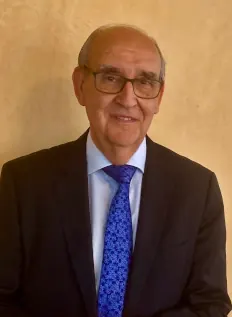
Mr. Antoni Garrell
Antoni Garrell, President of HM Hospitales and honorary member of the Royal European Academy of Doctors (READ), reflects on the profound changes that artificial intelligence is bringing about in work, learning, healthcare, cities and even the very conception of what it means to be human in the article “AI Opens a New Era for Humanity,” published on 6 June on the specialist portal Catalunya Económica. In his admission speech to the Royal Corporation, “The Second Digital Revolution: Are the Digital Economy and Artificial Intelligence Leading Us into a New Era for Humanity?”, delivered last November, the expert had already addressed the profound changes being generated by this technology, opening the transition towards a new digital era and highlighting both the opportunities and the challenges this entails in light of the effects of previous transformative revolutions.
In his article, Garrell warns that AI is already redefining professions, training processes and citizen participation, while technologies such as intelligent prostheses and nanorobots are expanding human capabilities and, at the same time, creating unprecedented ethical dilemmas. In industry and services, he argues, collaboration between people and machines is changing production and remote working; autonomous mobility and sustainable digital infrastructures are transforming urban life, particularly in the context of an ageing population. In this context, he notes, cybersecurity and digital governance are becoming essential pillars for protecting citizens, companies and institutions.
The author pays particular attention to the prospect of what he defines as artificial general intelligence capable of achieving self-awareness. Although current systems merely simulate understanding, major technology companies continue to work in that direction. A superintelligence with an identity of its own, capable of surpassing humans in information processing and adaptation, could create an unprecedented imbalance of cognitive power. In this regard, Garrell recalls Stephen Hawking’s warning that the development of full artificial intelligence could spell the end of the human race. Faced with such a scenario of competition and domination, he also raises the possibility of complementary coexistence that could accelerate the resolution of global problems such as climate change and complex diseases.
 These reflections are developed in his book “The Second Digital Revolution: A New Era for Humanity,” published last year. The work does not seek to offer definitive answers, but rather to open up debate on new ethical boundaries, the value of talent, algorithmic biases, the risk of allowing human cognitive abilities to atrophy by delegating too much to machines, and the need for digital and fiscal sovereignty, including the idea that robots should make a fiscal contribution to society. The academic concludes that history is not written in advance, since it is built day by day through decisions that may prove decisive. “A set of issues that must be placed within the framework of a deep conviction: history is not written. We create it every day through our decisions and actions. And the most powerful intelligence will never be that of machines, but that of a humanity capable of remaining true to its values,” he concludes.
Garrell is an industrial engineer from the Polytechnic University of Catalonia, holds a master’s degree in Management and Administration and pursued doctoral studies in Decision Support Systems. A specialist in innovation and the knowledge economy, he has developed an extensive professional career both in computational technology and in organisational and strategic management, and has held various executive positions in companies such as Arthur Andersen, La Caixa, the La Salle University and Technology Foundation and the Textile Design Foundation. Since 2021, he has chaired HM Hospitales. He has served on various boards of directors and advisory boards of companies and has held institutional positions such as President of the Circle for Knowledge and of the Executive Council of the Ramon Llull University Foundation. In the academic sphere, he has taught and lectured at international universities and is the author of more than 850 articles on technical, economic and opinion-related subjects, as well as author or co-author of around ten monographs on digital technology, multimedia and industry. He was also founder of the technology magazine “INPUT.” His two latest books are “Industry 4.0 in the Digital Society” (2019) and “Smart and Sustainable Products and Services” (2021).