

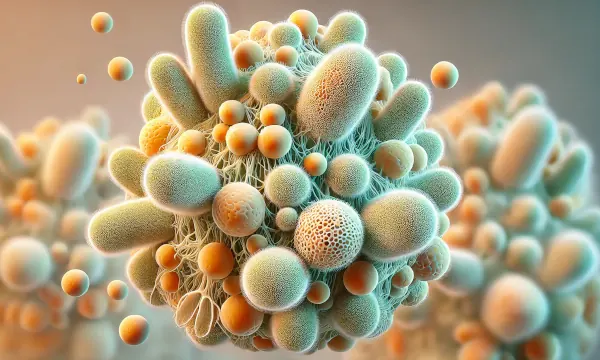
3D illustration depicting bacteria and yeast fungi
Manel Esteller, Professor of Genetics at the Faculty of Medicine of the University of Barcelona, researcher at the Catalan Institution for Research and Advanced Studies (Icrea), member of the Royal Academy of Medicine of Catalonia and of the European Academy of Cancer Sciences, and full member of the Royal European Academy of Doctors (RAED), highlights in an interview published on 27 June by the newspaper “La Razón” the importance of bacterial diversity in the intestine as one of the pillars of health today, on the occasion of World Intestinal Microbiota Day.
For the expert, the microbiota not only influences digestion and metabolism, but also educates the immune system, modulates brain activity through the gut-brain axis and contributes to the production of essential nutrients. In this regard, the academic explains, in conversation with journalist Eva S. Corada, that the most promising studies focus on analysing in depth the composition and heterogeneity of the microbiota, as well as advances in faecal microbiota transplantation to treat inflammatory bowel diseases. Bacterial diversity is a key indicator of health: a rich and varied microbiota confers a greater capacity to respond to stressors and dietary challenges, adapting to each stage of life.
Esteller explains in the interview that the microbiota evolves throughout life: it is scarcely diverse at birth, becomes rapidly enriched during childhood and adolescence, tends to become poorer and more uniform with age, but may regain richness in centenarians. This diversity in advanced age is associated with a more robust immune system, better brain health, and optimal nutrient use, factors that favour longevity. To preserve a healthy microbiota, the researcher recommends a varied diet rich in fibre, prebiotics, and probiotics, including those found in fermented foods such as fermented milk products. By contrast, he warns that monotonous, repetitive diets low in fibre and fermented foods drastically reduce bacterial richness, generating a more homogeneous and less resilient microbiota.
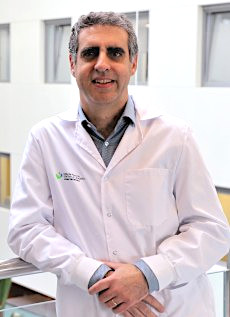
Dr. Manel Esteller
In addition to his work in epigenetics and oncology, Esteller explains that he and his team are also currently researching the interactions among environment, diet, and ageing, including studies of centenarians and, in turn, of other individuals who present with premature ageing syndromes such as progeria. His words reinforce the growing scientific consensus on the central role of the microbiota in the medicine of the future.
With more than 640 scientific publications and 150,000 citations, Esteller is the most cited biomedical scientist in the world. In the 2024 list by Stanford University and the consulting firm Elsevier, he appears among the top 2% of scientists worldwide. According to Research.com’s 2025 ranking, he holds first place in Spain in Medicine, while in Genetics he ranks second nationally in the same edition. For more than two decades, the academic directed the Epigenetics and Cancer Biology Programme at the Bellvitge Biomedical Research Institute and, later, at the Josep Carreras Leukaemia Research Institute. He is currently one of the principal investigators at the Sant Pau Research Institute in Barcelona. Among other distinctions, he has received the King Jaime I Award for Basic Research, the National Research Award of Catalonia, the Josep Trueta Medal for Health Merit and the Award of the Royal National Academy of Medicine.