


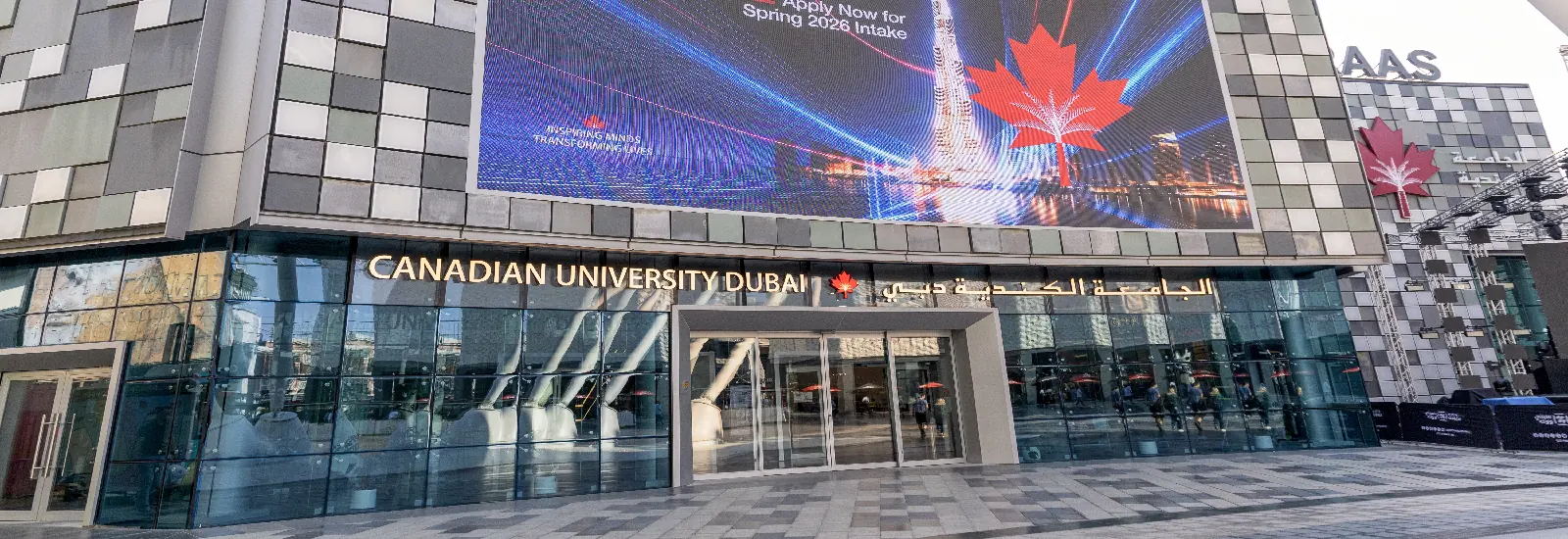
Canadian University of Dubai, UAE
Cecilia Kindelán, Numerary Member of the Royal European Academy of Doctors (RAED), has been appointed Dean of the Faculty of Communication at Canadian University Dubai, where she had been teaching since the previous academic year. The academic thanked the university’s President, Karim Chelli, and Vice-President Mohammed Djeddi for the confidence they have placed in her academic work. “Since I made the decision to move to Dubai, life has been quite complex, both personally and professionally. There have been losses, challenges and many lessons… together with moments of starting over. Of listening to myself more than ever. Looking back, I feel that these past nine months have been precisely that: a time to put down roots. To quietly build a solid foundation capable of supporting the new challenge that I now have before me,” Kindelán stated through her professional social media channels.
On 1 June, the academic reflected precisely on higher education in the region during one of the latest sessions of the Online Lecture Series of the Academy of Sciences, Engineering and Humanities of Lanzarote, of which she is also a Corresponding Member, presenting the lecture “University and culture in the Emirates”. The expert offered an overview of the accelerated educational and cultural development of the United Arab Emirates, with particular emphasis on Dubai and Abu Dhabi. In the field of higher education, this transformation has enabled the region to evolve from an emerging model into an international hub for innovation and knowledge transfer. Kindelán highlighted the country’s strategic commitment to attracting prestigious international universities, creating state-of-the-art campuses and promoting the internationalisation of both students and teaching staff, all aligned with the country’s “Vision 2031” strategic development project and an economic diversification that extends beyond oil exploitation and the financial investments that have enabled the region to achieve its current level of development.
The speaker emphasised the central role of culture in this process, particularly through the integration of Arab culture and tradition with global influences, the promotion of the creative industries, the arts and heritage, and the construction of cultural landmarks such as museums and festivals that present the Emirates as a bridge between East and West. Kindelán illustrated how Emirati universities not only provide education in technical and business disciplines, but also promote a holistic education incorporating ethical values, sustainability and multiculturalism. In this regard, the speaker shared specific examples of academic collaboration, applied research and the impact of these institutions on the country’s social and economic fabric. By way of conclusion, she expressed her optimism regarding the potential of emerging educational models in contexts of rapid development.
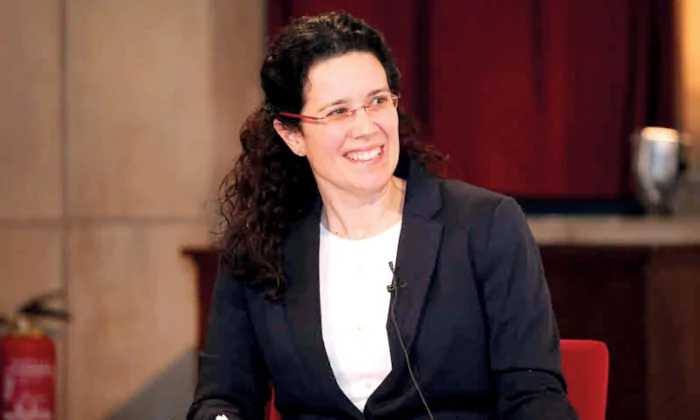
Dr Cecilia Kindelán
The digital newspaper Infobae, for its part, published an extensive report on 16 April highlighting the conclusions of the lecture presented by the academic at the 10th International Academic Meeting, held by the Royal Academy between 15 and 20 March in several German cities, under the title “Can artificial intelligence develop a life of its own?”. Kindelán explained that the hypothetical possibility of artificial intelligence developing behaviour similar to a self-preservation instinct has ceased to be mere theoretical speculation and has become a genuine cause for concern, even in particularly critical fields such as healthcare. “The issue has gained relevance following the lecture by Professor Cecilia Kindelán, who presented evidence of these emerging patterns. For the technology community, the real possibility that an AI system might adopt strategies to prevent its own deactivation poses unprecedented governance challenges, especially in sensitive areas,” stated the report written by Santiago Neira.