

Dr. Francesc Torralba
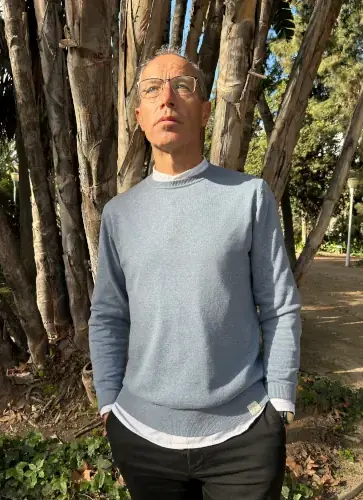
Francesc Torralba, director of the Ethos Chair of Applied Ethics at Ramon Llull University and of the Chair of Christian Thought of the Bishopric of Urgell, member of the Dicastery for Culture and Education of the Holy See and Numerary Member of the Royal European Academy of Doctors (READ), reflects on his life experience and his work in an interview published by the newspaper “El País” on 26 May. Likewise, the “Diari de Tarragona” devoted an extensive report to him on 25 April on the occasion of the lecture he gave at Tarragona Cathedral, as part of the Diocesan Gathering, in which he addressed the process of discovering one’s purpose in life through experience, learning and faith. For his part, on the programme “Al vespre” on the Catalan channel of Televisión Española, he discussed the relevance of Pope Leo XIV’s first encyclical, “Magnifica Humanitas”, devoted to artificial intelligence, its management, and its impact on human beings. Torralba was awarded the Josep Pla Prize last December by the publishing house Destino for his work “Anatomia de l’esperança”. The book explores the mechanisms that sustain the human spirit when everything seems lost through philosophy, literature and human experience, and delves deeper into the subject matter of his two previous publications, “La Paraula que em sosté” and “No hi ha paraules. Com assumir la mort d’un fill”, in which he shares his grief over the tragic death of his son Oriol, aged 26, in a mountain accident during a trek in which he was accompanying him.
In the interview granted to “El País”, the academic argues that prejudices, which he defines as “invisible prisons”, separate human beings from one another, preventing them from discovering an enriching reality. “It is an anticipated judgement we make about another person without knowing them, out of laziness, fear or comfort”, he states. Deconstructing them generates a healthy chaos that forces us to revise our mental maps, he points out. The author of around a hundred essays, he insists on the importance of life experience rather than mere knowledge acquired through study, although it is the combination of both that can provide a whole, serene, and hopeful vision. In this regard, he speaks of the grief he himself has been forced to face and of the need to weep, drawing on figures such as Seneca, Aristotle, Søren Kierkegaard and biblical texts to argue that life requires decisions that always entail a certain anguish, but that only love and hope give full meaning to existence.
According to Torralba in conversation with the journalist Anatxu Zubalbeascoa, hope is neither naivety nor certainty, but the conviction that it is possible to move towards difficult horizons, always in community and with perseverance. At this point, he criticises the superficiality of social media, which he considers to be full of “emotional illiterates”, and advocates genuine listening that breaks stereotypes and allows us to welcome the other, even when their ideas make us uncomfortable. “To live, we need a horizon. And each person has to forge their own. Hope consists of believing that it is possible to make difficult horizons a reality. It requires time, perseverance and community. Alone, you will not be able to do it. There is no hope without fear, because certainty is not a given. You are not guaranteed that your dream will come true”, he says.
In “Diari de Tarragona”, for his part, Norián Muñoz explains how the thinker addressed an audience of around five hundred people on the mechanisms that sustain human beings in adversity and the importance of values such as hope, vocation and perseverance. “Torralba, who has devoted himself to dissecting the mechanisms that sustain us despite adversity, sums it up as follows: without hope, no project can move forward. It is not, however, a matter of naive hope, much less a path to be taken alone. The truly hopeful person, he says, is the one who believes they can move forward with help. If it were up to him, he would banish the phrase ‘there is nothing to be done’ from our vocabulary, a phrase we use equally for politicians, war, or climate change, the journalist summarises.
Finally, on the Catalan channel of Televisión Española, the academic considered that the Pontiff’s doctrinal text warns of the risk posed by major technology companies and cautioned that a misguided artificial intelligence model may widen social and gender inequalities and endanger democracy. For the thinker, Leo XIV’s encyclical highlights human fragility and argues that human beings flourish through their limits. “Far from a merely productivist vision, the papal reflection opens an opportunity to think about the human condition, what cannot be replaced by technology and the need to rethink bonds and collective responsibility in the face of the advance of artificial intelligence”, Torralba considered.
A lecturer and populariser of Christian humanism in major Catalan media outlets such as Catalunya Ràdio and the newspapers “La Vanguardia” and “El Punt Avui”, the academic is the author of notable books such as “El sentit de la vida” (2008), “No passeu de llarg” (2010), “El valor de tenir valors” (2012), “Un mar d’emocions” (2013), “Córrer per pensar i sentir” (2015), “Saber dir no” (2016) and “Món volàtil” (2018). During the pandemic, Torralba published the books “Humildad”, “Paraules de consol. En la mort d’un ésser estimat”, “Formar personas. La teología de la educación de Edith Stein”, “Vivir en lo esencial. Ideas y preguntas después de la pandemia”, “L’ètica algorítmica”, which received the Bones Lletres Prize for Humanistic Essay awarded by the Royal Academy of Good Letters and the publishing house Edicions62; “La façana de la Glòria de la Sagrada Família. Fonts espirituals i teològiques de l’escatologia d’Antoni Gaudí”, the result of his fourth doctoral thesis; “Cuando todo se desmorona. Meditar con Kierkegaard” (2023), “No hi ha paraules. Com assumir la mort d’un fill” (2024) and “Benaurances per a agnòstics” (2024). He was recognised with the 2023 Ratzinger Prize, awarded by the Joseph Ratzinger-Benedict XVI Vatican Foundation.