

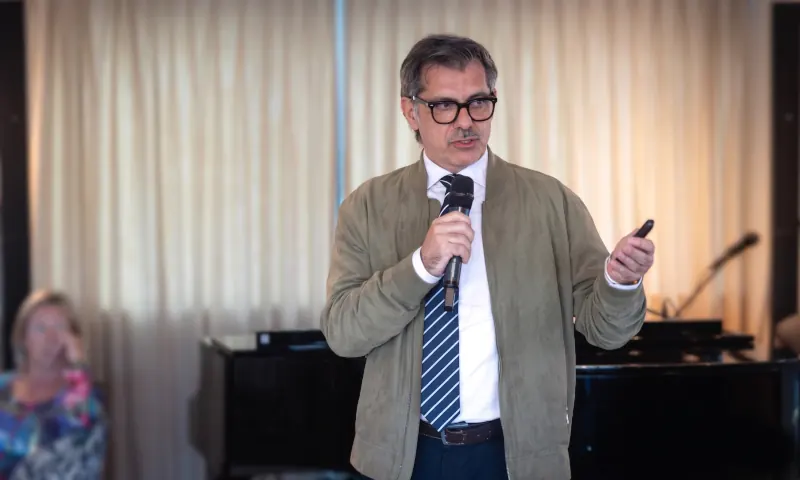
Rafael Urrialde, speaking at the 10th International Meeting of the RAED
Rafael Urrialde, lecturer in the Department of Genetics, Physiology and Microbiology at the Complutense University of Madrid and in the Department of Pharmaceutical and Health Sciences at CEU-San Pablo University, president of the Scientific Committee of the Spanish Society of Sports Medicine, secretary of the Spanish Nutrition Foundation, Honorary Member of the Spanish Academy of Nutrition and Food Sciences and Numerary Member and Vice-President of the Royal European Academy of Doctors (READ), presented the lecture “Food and Climate Sovereignty: the New Fronts of the 21st Century” at the 10th International Academic Meeting that the Royal Corporation held between 15 and 20 March in various German cities under the general title “The Rhine as a Current of Knowledge: Cross-Border Dialogues”. In his address, he explained how food, climate and health are transforming the globalised world and issued an urgent call to act with an integrated vision before the synergistic effects of climate change and food insecurity worsen irreversibly.
“Food sovereignty is an axis that is acquiring increasing relevance and may clearly be affected by the climate crisis, these being two of the most decisive existing fronts. These two aspects act synergistically, amplifying risks to human health, biodiversity, and the stability of food systems. From scientific and informational perspectives, the impacts of climate change appear to be leading to a higher prevalence of allergies, the development of mycotoxins, an increase in pathogens, and reduced food availability and accessibility, while also highlighting the role of sustainable food and the urgent need to reduce food loss and waste. A strategic agenda should be approved based on innovation, food and nutrition education, public health policies and agronomic adaptation as pillars to guarantee safe, healthy, sustainable, satisfactory, sufficient and supportive food, with food sovereignty”, the expert summarised.
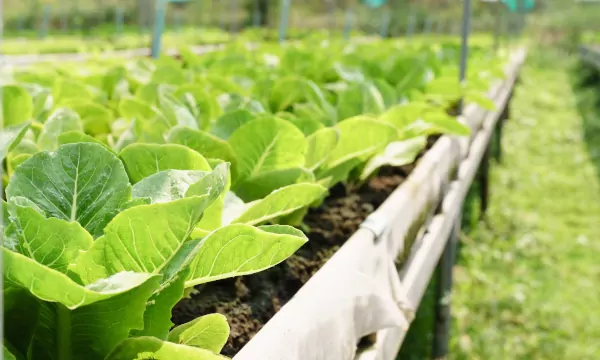
Urrialde emphasised this bidirectional relationship between climate change and food, since not only does food production generate greenhouse gas emissions, but global warming also affects food safety, quality and availability. Rising temperatures also favour the proliferation of pathogens, increase the production of mycotoxins by fungi and raise the risk of food allergies by intensifying allergens in plants and pollen, as well as altering flowering and ripening cycles, water availability and rainfall patterns, thereby endangering agricultural and livestock production, he explained.
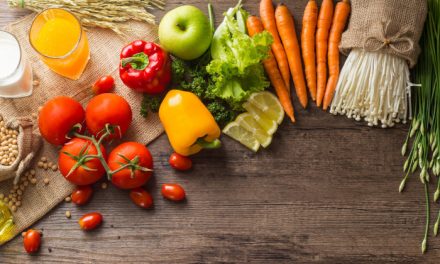
 Faced with this new reality, the expert presented the framework of so-called 8S Food as an integrating approach that defines food as safe, healthy, sustainable, satisfactory, sufficient, social, supportive and sovereign. This is a model he has presented at numerous international scientific forums. In this regard, he identified the popular Mediterranean diet as a practical example of this approach. Its updated pyramid incorporates not only the recommended foods but also sustainability criteria for production, prioritising agricultural and livestock systems with lower environmental impact and greater efficiency. He also urged public administrations to implement a strategic agenda that combines technological innovation with food and nutrition education, health policies, agronomic adaptation, circular economy actions, and the efficient use of resources.
A recognised expert in food regulation, Urrialde is the author or co-author of scientific publications on nutrition education. He was Head of Health and Food Safety at Puleva Food, Director of the Health and Food Area at the Spanish Consumers’ Union, technical coordinator of the magazine “Ciudadano”, Director of Health and Nutrition at Coca-Cola Iberia, analysis technician at the Institute of Refrigeration of the Spanish National Research Council, and collaborator of the Chair of Plant Physiology at the Faculty of Biological Sciences of the Complutense University of Madrid.