

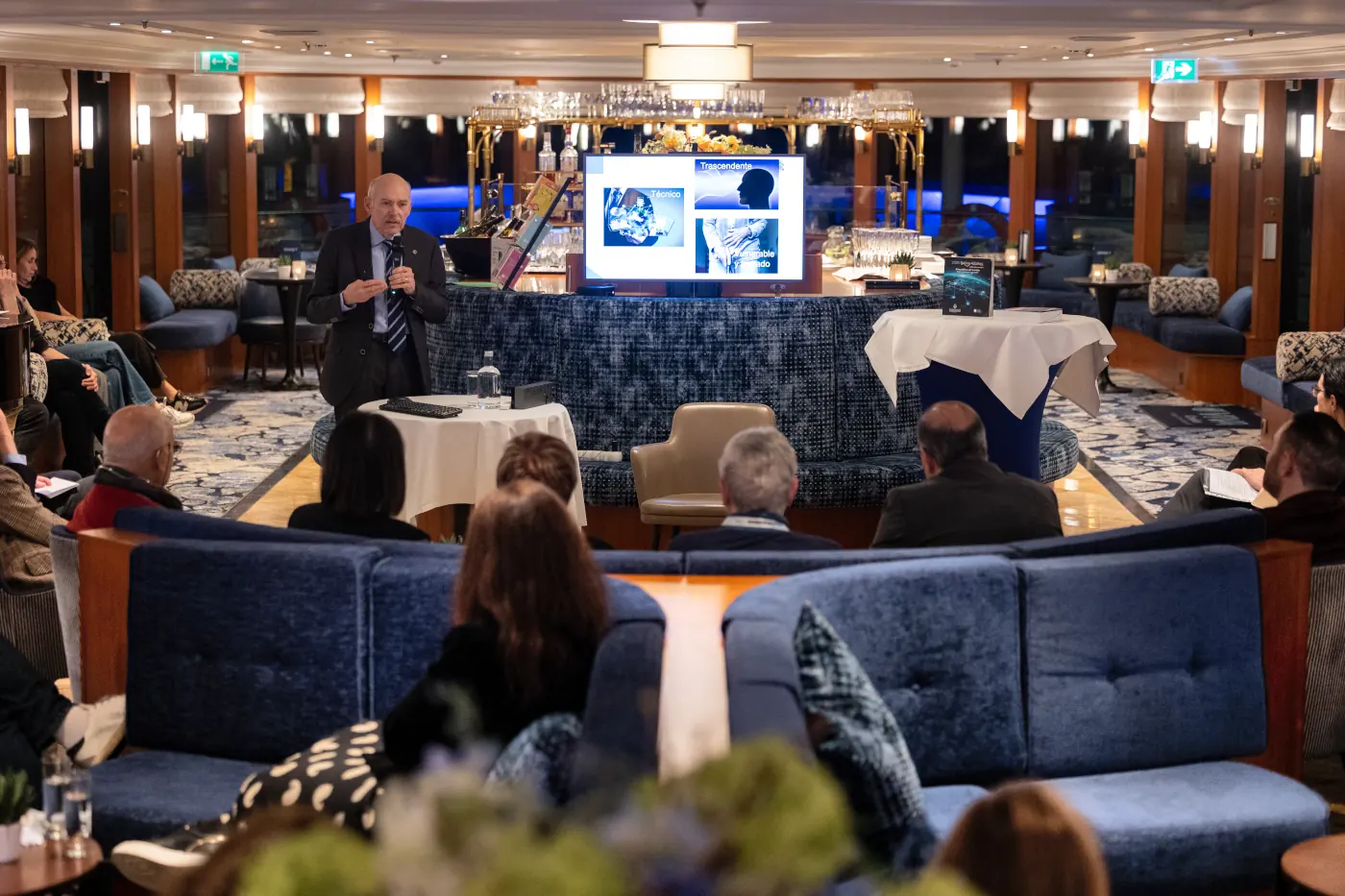
Dr. Lluís Giner, during the presentation of his paper at the X International Academic Meeting of the RAED
Lluís Giner, Professor and Dean of the Faculty of Dentistry of the International University of Catalonia, President of the Conference of Deans of the Faculties of Dentistry of Spain and Numerary Member of the Royal European Academy of Doctors (READ), addressed the emergence of biotechnology and the implications of human enhancement and transhumanism in the lecture “Transformative education. Notes for a reassessment of the dialogue between humanism and technology”, which he co-authored with fellow experts María Victoria Roque and Ignacio McPherson and presented during the 10th International Academic Meeting held by the Royal Academy between 15 and 20 March in several German cities under the general title “The Rhine as a current of knowledge: cross-border dialogues”.
For the academic, in a world marked by the rapid progress of biotechnology and its ambivalence, a profound examination is required within the scientific community, prioritising two central pillars of humanism: the unique dignity of the human being and its qualitative difference from the rest of reality. Speaking on behalf of the three authors of the study, Giner warned that although scientific and technological advances in this field can improve the human condition, their unlimited use may also lead to the instrumentalisation of human beings and nature, blurring the boundaries between species and between living beings and inanimate structures. In this regard, he contrasted the postulates of Jeremy Rifkin and Norbert Wiener, which illustrate this tendency to equate the biological with the cybernetic, with those of Martin Heidegger and José Ortega y Gasset, who uphold the human being as a technical being, a transcendent being, and a being vulnerable by nature.
The speaker focused on the debate surrounding human enhancement, noting that although the desire to overcome limitations such as illness, ageing or suffering is as old as humanity itself, its risks may go so far as to distort humanity itself. Giner cited the report “Beyond Therapy” (2003) by the United States Council on Bioethics, which warns that the pursuit of happiness may turn procreation into manufacturing, life into chemistry, or longevity into a selfish obsession. This reference document distinguishes between therapy — restoring health — and enhancement — increasing capacities beyond what is normal — although the transhumanism gaining ground within the scientific community blurs this line by advocating continuous interventions that could lead to human-machine hybridisation.
For Giner, this new fragmented approach has serious practical consequences, especially in healthcare and education, where suffering is equated solely with physical pain, forgetting its ethical, social and spiritual dimensions. At this point, he insisted that technoscientific progress, however powerful it may be, does not exhaust the richness of the human being, since life is not something added to the person; it is the person itself. For this reason, he called for a renewed humanism that engages in dialogue with technology without submitting to it.
 For the authors of this study, human enhancement must be integral and must not be reduced to technical or genetic interventions. It is necessary to reject transhumanist utopias that promise to overcome the ontological finitude of the human being. The person must always be treated as such, never merely as an organism or a client, excluding any form of instrumentalisation. “It is not a question of halting technological progress, but of orienting it through a profound dialogue with philosophy and integral anthropology, so that scientific progress does not end up diluting precisely what it seeks to improve: the human condition,” the expert concluded.
A graduate in Medicine and Surgery from the Autonomous University of Barcelona and a PhD from the University of Barcelona, Giner has various postgraduate qualifications and specialisations in the field of dentistry, including the Postgraduate Degree in Oral and Maxillofacial Prosthetics, the Postgraduate Degree in Temporomandibular Joint Disorders and Stomatology, and the Master’s Degree in Bioethics, among others. Throughout his research and teaching career, he has directed and co-directed more than 34 doctoral theses, two of which received international recognition, as well as an industrial doctorate with recognition and competitive public funding. Since 1991, he has made more than 500 contributions to scientific congresses and delivered around 50 presentations as an invited speaker. He also holds five patents, has participated in five competitive projects, more than 100 research contracts, and five teaching innovation projects. Giner was admitted as a Numerary Member of the READ with the speech “Teeth: from eating to showing off. Evolution of dental materials and social changes”, in which he stressed the importance of healthy teeth — and, naturally, teeth free from nicotine — not only for health, but also for personal aesthetics. Last June, he was admitted to the International College of Dentists.