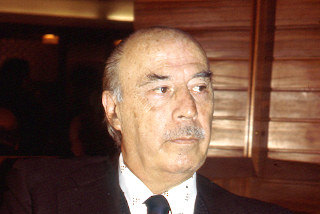



Dr. Joaquín Bautista-Valhondo
Joaquín Bautista-Valhondo, Professor at the Barcelona School of Industrial Engineering of the Polytechnic University of Catalonia and full member of the Royal European Academy of Doctors (READ), as well as President of its Technological Sciences Section, addresses parliamentary representativeness in various Spanish autonomous communities in the articles “Data Set: CyL/2026.T1 on the allocation of seats among constituencies in the Cortes of Castile and León (2026–2030 Legislature),” “Data Set: ARA/2026.T1 on the allocation of seats among constituencies in the Cortes of Aragon (2026–2030 Legislature)” and “Data Set: CAT/2024.T1 on the allocation of seats among constituencies in the Parliament of Catalonia (2024–2028 Legislature),” compiled by the Prothius Chair of Industrial Organization of the Polytechnic University of Catalonia. The academic recently published in the journal “Dirección y Organización,” issued by the Association for the Development of Industrial Engineering, the article “Analysis of the Disproportionality in the Distribution of Power among Territories. The Case of the Parliament of Catalonia,” in which he also analysed the representation of Catalan citizens in the regional chamber under the current electoral model, distributed among the four constituencies corresponding to its four provinces.
The expert presents the results obtained from applying eight different seat allocation methods (Hamilton, Adams, Dean, Hill, Webster, Jefferson, the Belgian model and the minimax-[e] model). In the case of the Catalan Parliament, he points out that the current seat allocation system generates notable territorial disproportionality, favouring the smaller provinces at the expense of Barcelona. The proportional quota corresponding to each territory would be 99.1 of the 135 seats for Barcelona, 14.45 for Tarragona, 13.84 for Girona and 7.61 for Lleida. However, the current law assigns 85 seats to Barcelona, 18 to Tarragona, 17 to Girona and 15 to Lleida. In other words, the most populous province loses around 14 seats compared with what would correspond to it by population, while the three smaller ones are clearly favoured. The author also presents historical series from 1981 to 2024 showing how this disproportionality has been maintained or even aggravated over time, especially in favour of the provinces of Girona, Tarragona and Lleida.
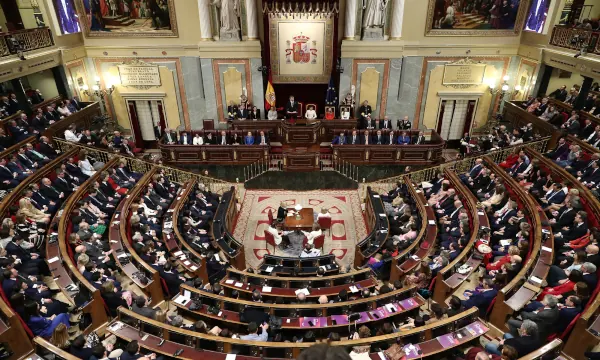
Ministry of the Presidency. Government of Spain, via Wikimedia Commons. Source document dated 3 February 2020.
In the article devoted to the Cortes of Castile and León, Bautista-Valhondo concludes that the electoral system generates significant territorial disproportionality, benefiting the smaller provinces and clearly penalising Valladolid. In this case, the proportional quota of seats for each province would be: 18.08 for Valladolid, 15.27 for León, 12.36 for Burgos, 11.24 for Salamanca, 5.65 for Zamora, 5.47 for Ávila, 5.43 for Palencia, 5.42 for Segovia, and 3.08 for Soria. However, the Electoral Law of Castile and León currently assigns 15 seats to Valladolid, 13 to León, 11 to Burgos, 10 to Salamanca, 7 to Zamora, Ávila, Palencia and Segovia, and 5 to Soria. This means that Valladolid loses about three seats compared with its population weight, while the smaller provinces, especially Soria, Zamora, Ávila and Palencia, are clearly favoured.
Finally, in the case of Aragon, the strictly proportional quota of seats corresponding to each of the three provinces would be: Zaragoza, 49.04; Huesca, 11.31; and Teruel, 6.66. However, the current electoral law assigns 35 seats to Zaragoza, 18 to Huesca and 14 to Teruel, for a total of 67 representatives. This means that the most populous province loses almost 14 seats compared with its demographic weight, while Huesca and Teruel are heavily overrepresented. All three articles are available in the Futur repository of the Polytechnic University of Catalonia and on the Prothius website.
Bautista-Valhondo is the author of monographs such as “Decision Models and Tools,” “Game Theory in Competitive and Collaborative Environments,” “Metaheuristics in Engineering” and “Engineering Project Planning,” four reference works in his field published by Dextra Editorial and the Association for the Development of Industrial Engineering. Although the four books are aimed primarily at a knowledgeable readership, their informative tone makes them accessible to anyone interested in the subjects they address.