


Santiago Castellà, President of the Port of Tarragona and of Barcelona-Catalunya Centre Logístic, Director of the Tarragona Smart Mediterranean City Chair and of the Zigurat–University of Barcelona Master’s Degree in Smart City Management, Secretary-General of the Pro Royal European Academy of Doctors Foundation and full member of the Royal European Academy of Doctors (READ), addressed at the 10th International Academic Meeting held by the Royal Corporation between 15 and 20 March in various German cities under the general title “The Rhine as a Current of Knowledge: Cross-Border Dialogues” the challenge posed to today’s adult generations by the change of era ushered in by the technological revolution driving the development of artificial intelligence. The academic presented the paper “The Decline of Europe’s Universal(izable) Proposal: the Human Being Reduced from Narrative to Data,” in which he analysed the profound crisis affecting Europe’s universal proposal and, with it, the human condition itself in the 21st century.
“The profound technological changes we are experiencing, beyond giving rise to new social, political and economic realities in a prevailing geopolitics of chaos, entail much more than that: surely the most transcendent change of Era ever experienced by humanity, one in which the human condition itself also requires new definitions. The end of historically and symbolically constructed narratives, through the passage from myth to logos, now becomes obsolete, inefficient and irrelevant in a new reality built upon or reduced to data. Thus, the analysis of what is happening to us becomes a melancholic, fearful and stirring account for a generation that resists being the last Enlightenment generation of narrative, in order to become the first humanists of data,” the expert began in his reflection.
For Castellà, we are living through the most transcendent change of era in history: an accelerated transition from the world of narrative, built over centuries through myth, reason, and the great Enlightenment narratives, towards a new universe reduced to data, where everything becomes processable information. This shift, he argued, is rendering obsolete the old grammars of power based on territories, symbols and ideologies, giving way to a geopolitics of chaos dominated by the virtual, algorithms and what he defined as an emerging techno-oligarchy.
The speaker considered the 20th century to have been an unfinished period that began with Albert Einstein’s theory of relativity and ended symbolically on 11 September 2001, and that after the fall of the Berlin Wall and the supposed end of history, reality proved to be far more chaotic and complex. In this context, he argued, the generation of digital immigrants feels agean unfinished period that began with Albert Einstein’s theory of relativity and ended symbolically on 11 September 2001, and that, after the fall of the Berlin Wall and the supposed end of history, reality proved, vulnerable and fearful, especially after having witnessed episodes such as the pandemic, the climate crisis, cyber insecurity and the erosion of the certainties inherited from the past. “The cultural and ideological instruments with which it interpreted the world are no longer useful, and it finds itself defenceless in the face of new digital realities,” he noted.
Castellà concluded with the conviction that Europe, which for decades embodied the most ambitious project of universality, welfare, democracy, rights, and social cohesion, now sees its model collapsing under illiberal forces, populisms, and the harsh competition from powers that do not share its values. In this new era, the European Union project appears fragile, demographically weak, and weighed down by its regulatory zeal in a world that demands speed and flexibility. Faced with this, he calls for what he defines as a new humanism of data in order to confront the digital age without renouncing the essence of European humanism.
Holding a doctorate in Public International Law from the University of Barcelona, Castellà served for 25 years as a professor in the Department of Public Law at Rovira i Virgili University, where he was also Dean of the Faculty of Legal Sciences, Vice-Rector for External and International Relations, and Director of the Master’s Degree in Environmental Law, the Master’s Degree in Global Immigration Management, the Master’s Degree in International Development Cooperation and the Master’s Degree in International Criminal Justice. He currently combines his responsibility as Director of the Tarragona Smart Mediterranean City Chair with the direction of the Zigurat–University of Barcelona Master’s Degree in Smart City Management. Castellà is also Scientific Director of the Observatory on the Forced Disappearances of Minors and Academic Director of the seminar “International Humanitarian Law in Today’s World,” organised by Rovira i Virgili University, the Catalan International Institute for Peace and the Tarragona Assembly of the Red Cross, and is a regular collaborator of the Centre for Legal Studies and Specialised Training of the Government of Catalonia and of the International Criminal Bar Association. In political life, he is First Secretary of the PSC in the city of Tarragona.
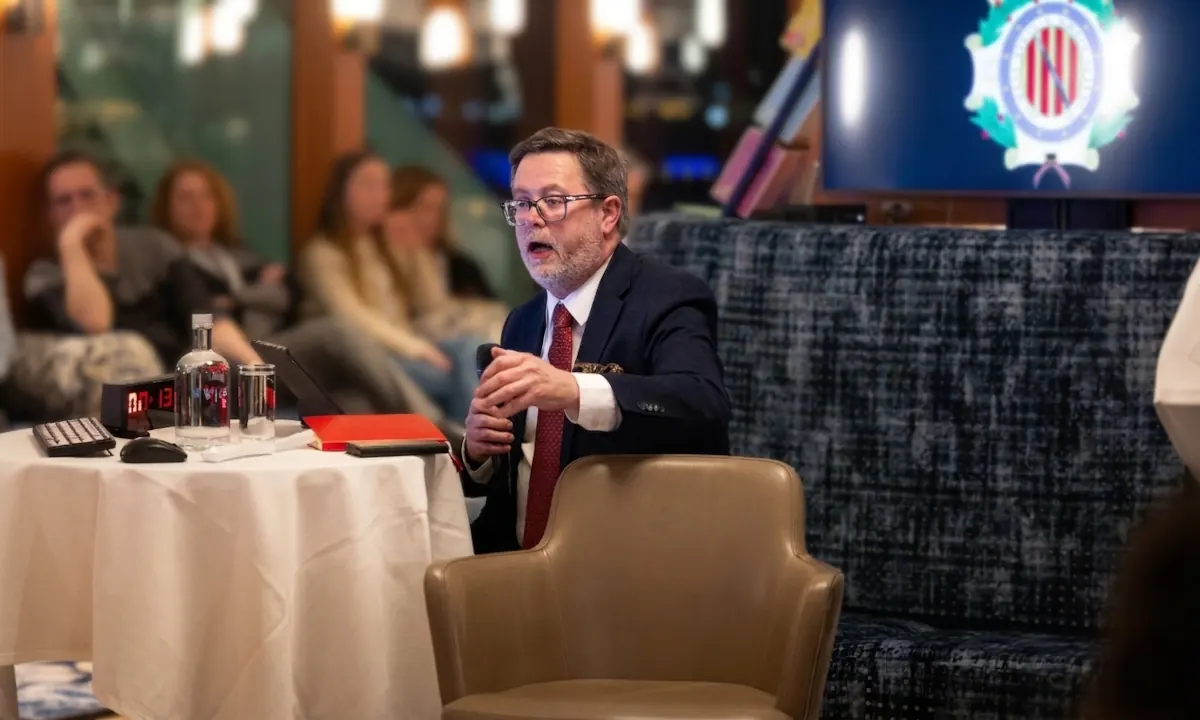
Dr Santiago Castellà