

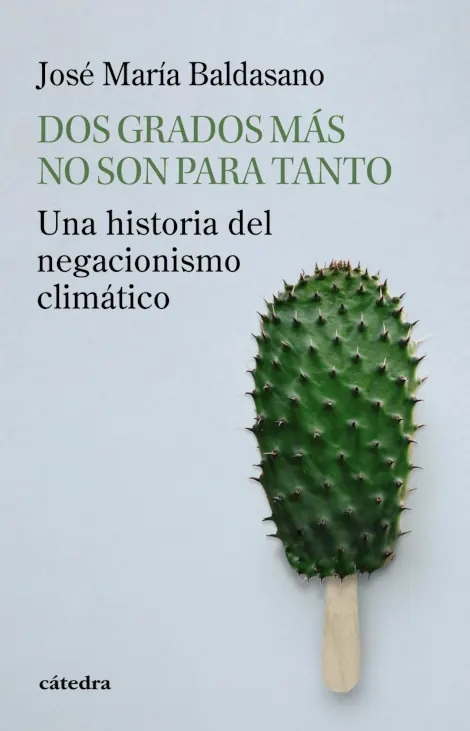
José María Baldasano, Professor of Environmental Engineering at the Polytechnic University of Catalonia, Nobel Peace Prize laureate as a representative of the Intergovernmental Panel on Climate Change, and a Numerary Member of the Royal European Academy of Doctors (READ), has given three interviews to the newspapers «La Vanguardia» and «La Razón», as well as to the EFE—subsequently reproduced by numerous Spanish and Latin American outlets—following the recent presentation of his latest popular science book, «Two Degrees More Are Not a Big Deal. A History of Climate Denial» (Cátedra). In it, he explores the controversial history of climate-change denial, consistently driven by political and commercial interests. He also introduces recently coined concepts such as retardism and technological neutrality, and calls for collective responsibility in the face of the climate emergency.
 In the 20 October edition of «La Vanguardia», Baldasano explains to the renowned journalist Antonio Cerrillo that since the 19th century there has been scientific certainty about the relationship between atmospheric carbon dioxide levels and global temperature, following the research of Nobel Prize–winning chemist Svante August Arrhenius. From that point onward, he notes, communication strategies by companies responsible for warming sought to deny or cast doubt on scientific findings. «Until 1990, the denialist movement was largely corporate, driven by fossil fuel companies. But from the 1990s onward, climate change ceased to be solely a scientific issue and also became a political one. A key factor was the fall of the Berlin Wall in 1989. From a Western perspective, Russian communism had been defeated and a new enemy had to emerge. This was the moment when the neoliberal economic movement—already emerging since the late 1970s—expanded far beyond business economics to become a component of political ideology. A new enemy was sought onto which the consumption model and radical capitalist model could be projected», he explains.
In the 12 December edition of «La Razón, Baldasano focuses on how denialist strategies have evolved over the decades—from explicit denial to retardism, with messages claiming that emissions exist but can be offset through technological alternatives for capture. He rejects this as false, prioritizing evidence. «The combustion of fossil fuels has carcinogenic effects, in addition to causing respiratory, cardiovascular, cerebral, and reproductive system problems. There are also global and long-term effects of climate change from heatwaves, droughts, and the like, as well as extreme weather events such as the 2024 DANA. Floods have always existed, but climate change made it 15–20% more intense than it would otherwise have been. And there are also significant indirect health effects», he asserts.
Finally, in the EFE interview published on 26 December, Baldasano argues that climate should be treated as a matter of State rather than as an arena for political confrontation, though he acknowledges this is difficult given the divergent ideological approaches of political actors in Spain. «It is not a matter of belief, but of data analysis. Addressing the consequences of climate change is far more economically efficient than waiting for extreme climate events, as in the case of the 29 October 2024 DANA in Valencia. The evolution of the current climate crisis requires political action, and denialism seeks to delay it as long as possible in order to continue living in the civilization of fossil fuels», he concludes.
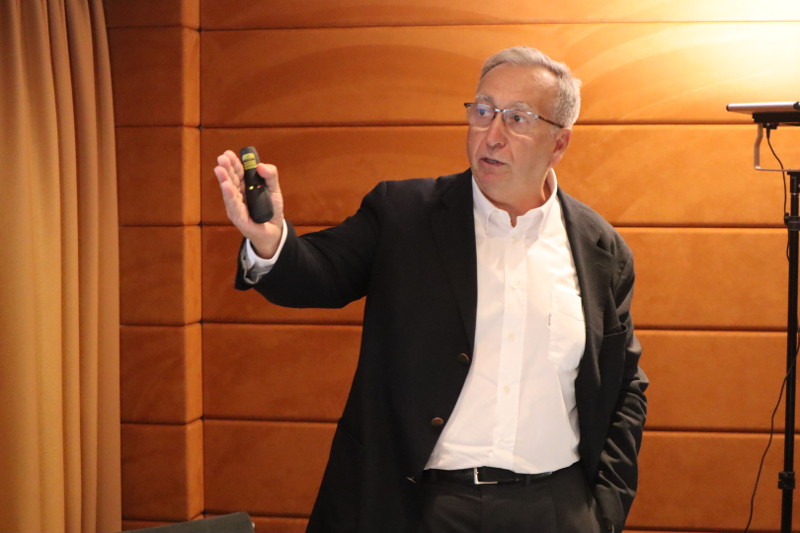
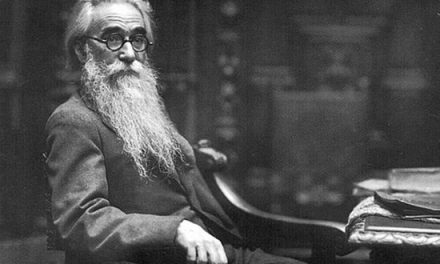
Dr José María Baldasano
«Climate denialists and skeptics want us to believe that the entire issue of global warming is an idea dreamed up by a group of scientists determined to destroy the economy and society. However, the roots of scientific thought on Earth’s temperature and its causes stem from the development of knowledge throughout the 19th and 20th centuries. The reason for recounting this journey through scientific understanding of how the Earth’s atmosphere and climate system function is that many denialist myths, lies, and hoaxes are based on a biased, manipulated, and falsified use of that knowledge,»” Baldasano explains in the presentation of the monograph. «Climate denialism is fundamentally an economic, ideological, political, social, and media phenomenon that rejects or underestimates the scientific consensus on current climate change and its consequences, with the primary aim of allowing humanity to continue within the civilization of fossil fuels», he adds.
Baldasano is the author of the «Report on Climate Change» debated by the Climate Emergency Commission of the Parliament of Catalonia, and he also co-authored—together with José Luis Rubio—the «Report of the King Jaime I Awards for Environmental Protection on Current Climate Change», presented to the plenary session of the High Advisory Council for Research, Development and Innovation of the Presidency of the Generalitat Valenciana. He also presented the study «Low-Emission Zones to Improve Urban Air Quality» at the virtual forum «Barcelona, Low-Emission Zone», organized by «La Vanguardia». Baldasano further examined the effects of emission reductions resulting from mobility restrictions during the pandemic in articles such as «Covid-19 lockdown effects on air quality by NO₂ in the cities of Barcelona and Madrid (Spain),» in which he called for new urban mobility policies after documenting emission reductions of between 50% and 62% in these two cities during March 2020.