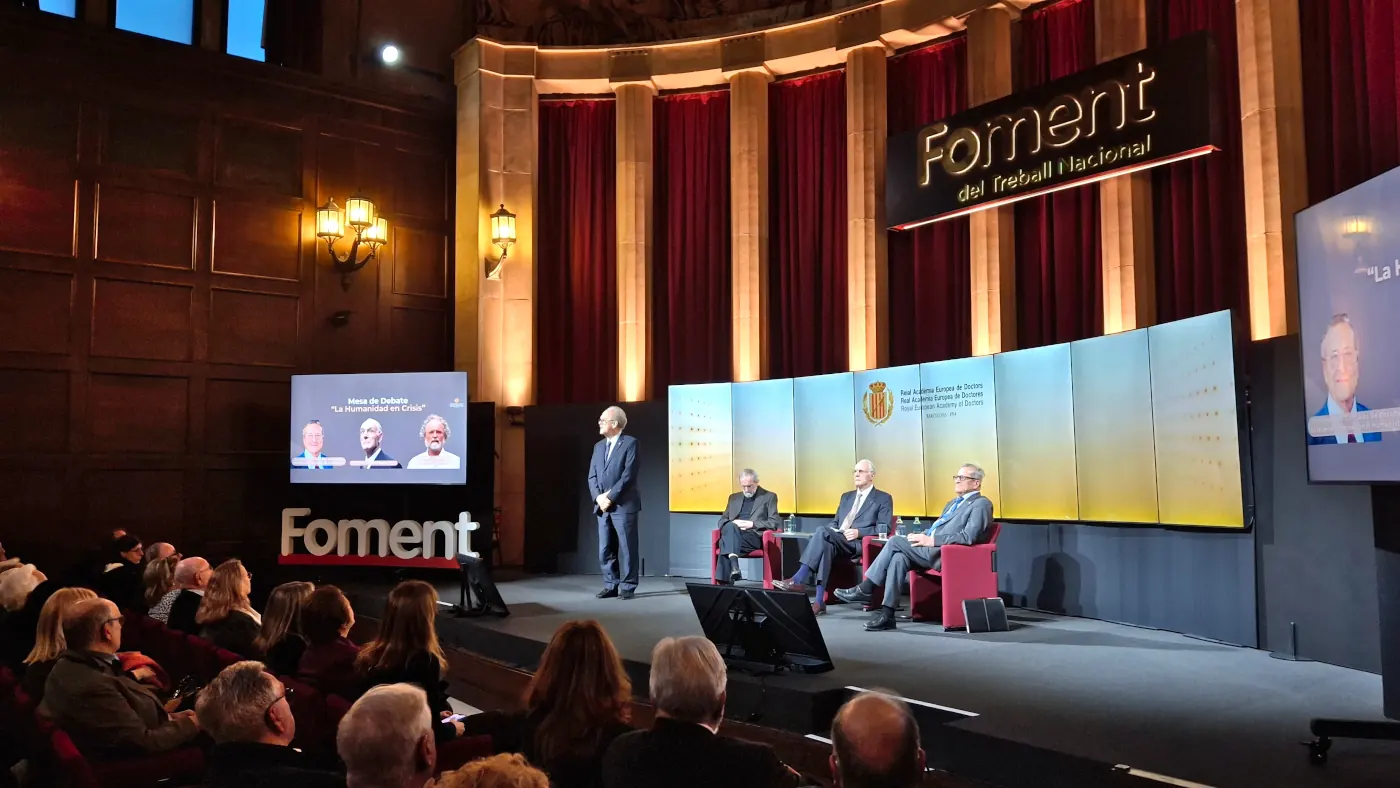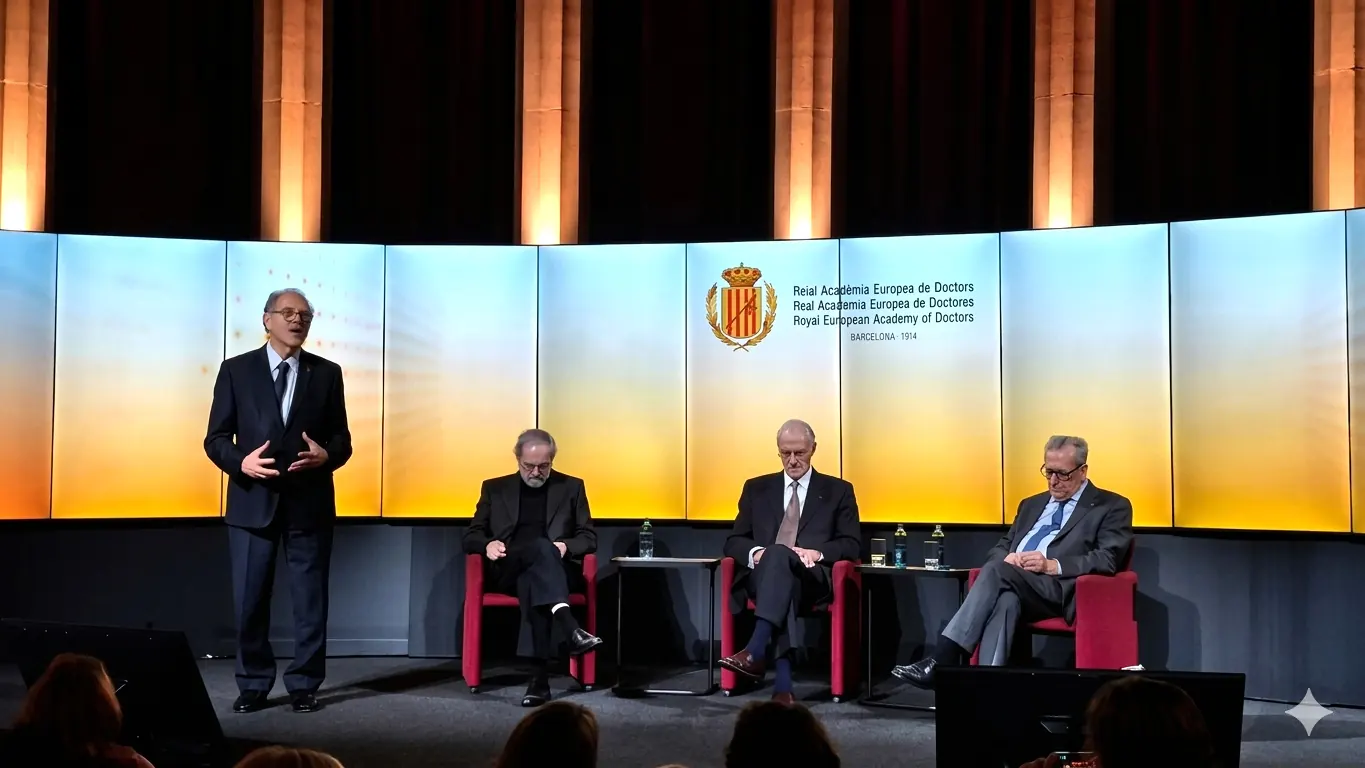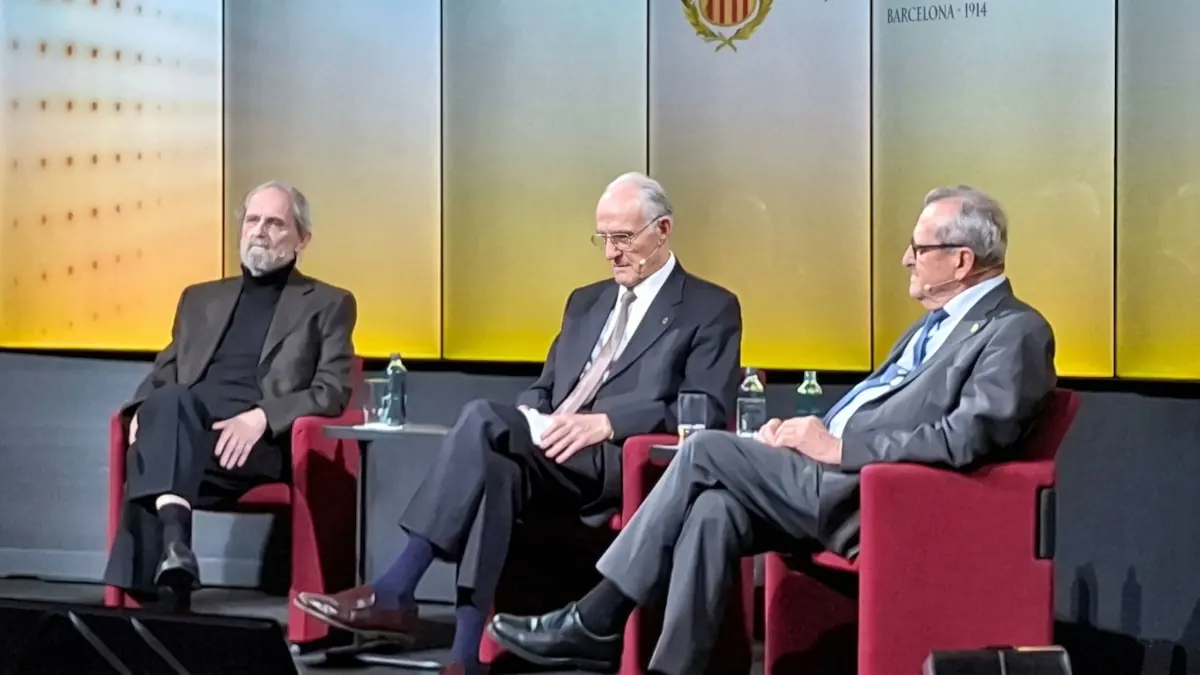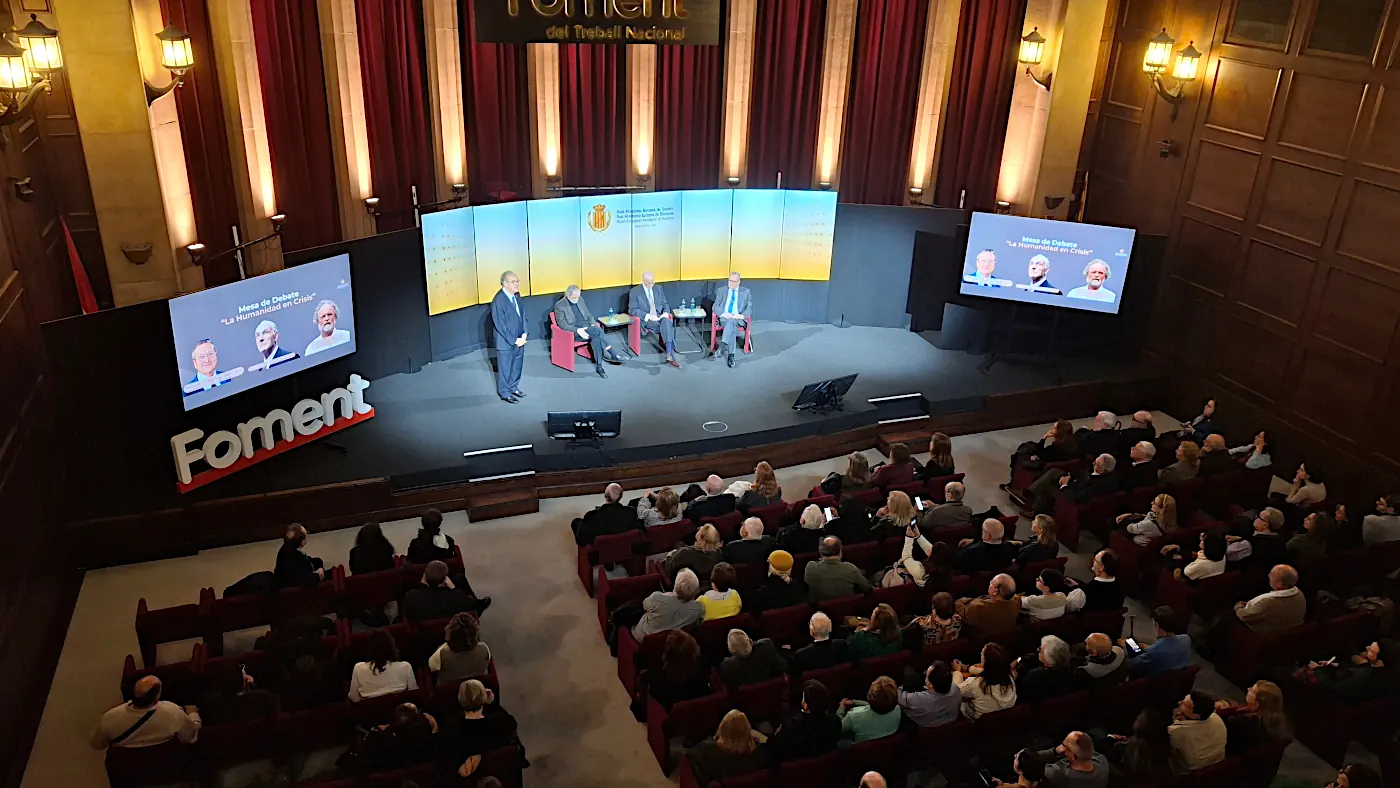


Cristóbal Colón Palasí, founder of the business and social project La Fageda and Honorary Member of the Royal European Academy of Doctors (READ); Francisco González de Posada, Professor of Physical Foundations at the Polytechnic University of Madrid and Honorary Member of the READ; and Manuel Sans Segarra, President of the Senior Section of the Official College of Physicians of Barcelona and Full Member of the READ, led the academic session “Humanity in Crisis”, held on March 6 at Foment del Treball, the Academy’s academic venue. The three speakers addressed the current existential crisis, particularly evident among adolescents and young people—generations growing up in a context of profound technological transformation, cultural uncertainty and increasing existential disorientation.
The panel discussion approached the notion of crisis as a central category for understanding the historical moment that civilization is experiencing. Far from reducing it to a circumstantial phenomenon or to a succession of economic, social or psychological difficulties, the experts examined the crisis as a structural reality that simultaneously affects culture, the individual, work and the spiritual dimension of human beings, starting from a general reflection on the very concept of crisis. In its deepest sense, they agreed, crisis is not merely rupture or collapse, but also transition, transformation and the possibility of redefinition. However, according to the three scholars, the current crisis is characterized by an accumulation of destabilizing factors that generate collective disorientation: technological acceleration, the weakening of shared cultural references, institutional fragility, geopolitical uncertainty and the progressive loss of horizons of meaning.
Colón Palasí, González de Posada and Sans Segarra explored the existential dimension of the crisis as an experience of loss of meaning, inner fracture or disconnection between the individual and their vital environment. In this regard, they examined its triggering factors—such as digital hyperstimulation, social isolation, the weakening of family and community bonds, competitive pressure and cultural relativism—as well as its clinical and behavioral manifestations. Among its principal risks they pointed to the increase in self-harming behaviors and suicide, particularly among adolescents and young people, a serious problem that must be addressed not only from medicine and psychology but also from education, culture and the broader structure of society.
Colón Palasí approached the current crisis from an economic and labor perspective, noting that the prevailing productive model generates social exclusion and leaves many people outside traditional employment systems. Drawing on his own entrepreneurial experience, strongly characterized by social inclusion, he proposed models of responsible enterprise capable of integrating vulnerable individuals into the labor market. In his view, part of the solution to the human crisis lies in building more inclusive economic organizations centered on human dignity.
For his part, González de Posada focused his analysis on a cultural and epistemological perspective, arguing that contemporary society is experiencing a fragmentation of knowledge: extreme specialization makes it difficult to obtain a comprehensive view of human problems. At this point, he defended the need to recover humanism and dialogue among disciplines, integrating science, philosophy and culture. According to his approach, understanding the crisis of humanity requires a historical and critical perspective on scientific and social development.
As for Sans Segarra, he argued that the current crisis of humanity is not only material or economic but also a crisis of consciousness and values. In his view, scientific and technological progress has advanced more rapidly than the ethical and spiritual development of human beings. The expert emphasized that many people live with existential emptiness, anxiety and a loss of meaning, reflected in growing social and psychological problems. To confront this situation, he proposed recovering a more integral vision of the human being that combines science, spirituality and reflection on the purpose of life.
The three scholars emphasized the importance of the educational system in shaping character and resilience in order to face the challenges of the present and those that will arise in the future, particularly considering the anticipated influence of artificial intelligence in redefining human responsibility and the need to revalue the human factor in the workplace. Their reflections did not avoid the religious and spiritual dimension, integrating medical, philosophical, economic and humanistic perspectives into an articulated and rigorous vision.
Trained in Psychology at the Autonomous University of Barcelona, Colón began his professional career in several psychiatric centers in Zaragoza, Martorell and Salt. In 1982 he founded the cooperative La Fageda in Olot as a response to the living conditions in former psychiatric institutions. The project combines productive activities—farming, gardening, dairy and jam production, and guided visits—with a comprehensive support model that includes employment, training, housing, leisure activities and psychosocial assistance. The uniqueness of La Fageda has attracted national and international interest and is studied in business schools such as IESE, ESADE and Harvard University. The project receives thousands of visitors each year and is recognized as a successful case of social economy and person-centered management. Throughout his career, Colón has received numerous institutional distinctions, including the Creu de Sant Jordi, the highest distinction awarded by the Government of Catalonia, in 2009, as well as the recent honoris causa doctorate from the University of Girona.
González de Posada is an engineer and holds a doctorate in Civil Engineering (Roads, Canals and Ports) from the Polytechnic University of Madrid, a degree in Philosophy and Letters from the Pontifical University of Salamanca, and a degree in Physics from the Complutense University of Madrid. He received the Medal of Honor for the Promotion of Invention and also served as Rector of the University of Cantabria. He is a Full Member of the Royal Academy of Doctors of Spain and a member of the World Academy of Art and Science. He is also a Corresponding Member of the Royal Academy of Fine Arts of Cádiz, the Royal Academy of Fine Arts of San Fernando, and the Royal Academy of Sciences, Fine Arts and Letters of Écija, and an Honorary Member of the Academy of Medical Sciences of Cantabria, the Royal Academy of Valencian Culture, the Royal Academy of Medicine and Surgery of Cádiz, and the Royal Academy of Medicine of the Canary Islands. He is also a member and currently presides over the Academy of Sciences, Engineering and Humanities of Lanzarote.
Finally, Sans Segarra was a pioneer in the use of laparoscopy in general surgery, former Head of Digestive Surgery at the Bellvitge University Hospital, Professor of General and Digestive Surgery at the Faculty of Medicine and Health Sciences of the University of Barcelona, and recipient of the Professional Excellence Award of the Official College of Physicians of Barcelona. After studying the experience of one of his patients who had recovered from a state of clinical death, he became interested in investigating this phenomenon from a strictly scientific perspective. Since then, he has documented five clinical cases of patients in a state of clinical death who recovered life in collaboration with his medical team. He has presented his knowledge in an accessible manner in his recent works “Supraconsciousness: Life After Life” and “Ego and Supraconsciousness: Seeking the Meaning of Life.”