

Dr. Javier Junceda
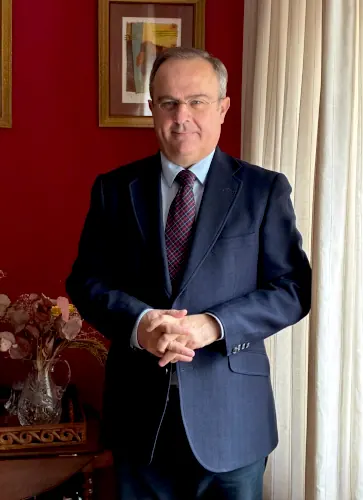
Javier Junceda, a renowned jurist, former Dean of the Faculty of Law at the International University of Catalonia and elected full member of the Royal European Academy of Doctors (READ), explains in the article “A Shared Legal Space,” published on the specialist portal Confilegal on 11 March, the origin of the Hispanic American Legal Studies Space, a forum for dialogue and debate between Spanish and Hispanic American jurists on current issues in the profession, which he himself is promoting together with other distinguished jurists from both sides of the Atlantic and which held its first meeting virtually on 29 January. Its meetings will be held in a hybrid format, both online and in person, the latter in Junceda’s own law offices.
“For three decades, I had been toying with the idea of setting up a Hispanic American legal initiative that understood both the letter and the music, as I like to say. For years, there have been very worthwhile proposals advanced by academia on both sides of the Atlantic, but perhaps without looking too deeply into the practice of law. Even the language used on these platforms pursues that more theory-focused goal, which is all very well if the aim is to nourish accreditations and fatten résumés. Talking about this matter with the great Argentine jurist Carlos Balbín, first while walking through Buenos Aires, and later doing the same in Oviedo, dispelled my doubts: ‘I think there is room to offer programmes that combine more theoretical and practical content, and that provide students with resources that can be used in their daily work.’ Carlos thought, as I did, that law is based on classical or modern theoretical constructs, which any jurist worthy of the name must be able to bring onto the playing field in a courtroom or an office. But we also both believed that remaining solely in the doctrinal sphere leaves a jurist with quite a lot still missing if they are to round out their professional performance, especially if they practise some of the legal professions,” he begins by explaining.
Junceda highlights academic and institutional initiatives aimed at this objective, stressing the role of legal forums and networks that promote dialogue between legal professionals, and points out that globalisation, digitalisation and new regulatory challenges make it essential to move beyond strictly national views of the profession, opting instead for coordinated solutions and common standards capable of strengthening international cooperation, modernising legal systems and consolidating a more efficient and cohesive framework in the Ibero-American world. Now a reality, the Hispanic American Legal Studies Space held a new session on 19 March titled “Constitutional Horizons in Hispanic America.” Joining it was fellow READ academician Daniel Berzosa, Professor of Constitutional Law and Fundamental Rights at CUNEF University, the Institute of Stock Exchange Studies, and the IE Law & Business School, and a member of the Global Academy and the Scientific Council of the international collective Citizens pro Europe.
In addition to Junceda, the founding faculty includes the aforementioned Carlos Balbín, Professor of Administrative Law at the University of Buenos Aires and administrative judge, and Jorge Danós, Professor of Administrative Law at the Pontifical Catholic University of Peru and practising lawyer, who are regarded as the foremost authorities in administrative law in Argentina and Peru, respectively. They will be joined by the distinguished Peruvian jurists Mario Castillo and Francisco Miró-Quesada, the Mexican José María López Padilla and the American Anthony Rionda. The group is working on incorporating prominent professional figures from Chile and Paraguay.
 Founder and Director of Junceda Abogados, the elected academician is a full member of the Royal Institute of Asturian Studies, where he chairs the Commission on Law, Social and Economic Sciences, and a full member of the Royal Asturian Academy of Jurisprudence, a corresponding member of the Royal Academy of Jurisprudence and Legislation of Spain and of the North American Academy of the Spanish Language, and an honorary member of the Peruvian Academy of Law. He is a member of the Barcelona Arbitration Court, of the Arbitration Court of the European Arbitration Association, based in Madrid, and of the Arbitration Court of the Pontifical Catholic University of Peru. Since 2016, he has also been a member of the Commission on Urban Planning and Territorial Organisation of the Principality of Asturias, chosen from among experts of recognised prestige, and a member of the Advisory Council of the Spanish Association of Urban Planning Law.
He has served as an expert on 18 parliamentary committees on legislative reforms and has drafted various bills, legislative proposals, and regulatory provisions. He is the author or co-author of more than two hundred legal works, some of which have served as the basis for judicial rulings by the Constitutional Court of Chile, the Supreme Court of Peru and courts in Bolivia. He has received mentions in the Luis Sela Sampil Awards for doctrinal articles of the Faculty of Law of the University of Oviedo, and on two occasions in the prestigious Financial Studies Award (1992 and 2012), organised by the Centre for Financial Studies in Madrid. He is also a member of 14 editorial boards of Spanish and international legal journals. He has been recognised as doctor honoris causa by six foreign universities and as honorary professor by six others. He has served as a director, speaker, or lecturer in more than 50 training programmes held in Spain and Ibero-America.