

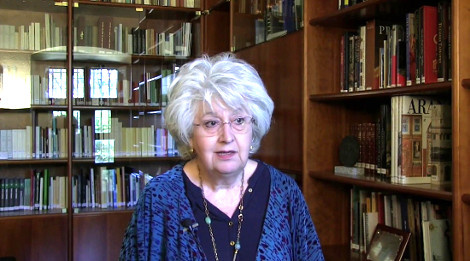
Dra. Teresa Freixes
Teresa Freixes, Jean Monnet ad personam Professor, President of the international organisation Citizens pro Europe, Vice-President of the civic platform Sociedad Civil Catalana and full member and Vice-President of the Board of Governors of the Royal European Academy of Doctors (READ), reflects on current Spanish and international political affairs in the articles “Dante, Habermas and Constitutional Patriotism,” “The Two Shores,” “Narrative in Time of War” and “The Right to Singular Financing,” published on the specialist portal Artículo 14 and the digital newspaper The Objective between 22 March and 5 April.
In “Dante, Habermas and Constitutional Patriotism,” the expert jurist reflects on the meaning of democracy through the decisive figure of the German philosopher and sociologist Jürgen Habermas. “From this perspective, the democratic constitutional State has been a paradigm with a universal vocation. In this regard, Habermas’s dialogue with Joseph Ratzinger in the work ‘Between Reason and Religion. Dialectics of Secularisation’ is significant. And the influence that Habermas’s thought has exerted on the intellectual conception of the process of European integration and in the sphere of legal interpretation carried out by constitutional courts, as a binding ethical paradigm, is also relevant, although this has not always been accompanied by another constitutional concept enshrined in some systems, namely that of militant democracy, implying the rejection, even legal rejection, of those who introduce practices contrary to constitutional values,” she notes.
For her part, in “The Two Shores,” the Vice-President of the Royal Academy focuses on the debate surrounding the Spanish conquest of America and the “genocide” denounced by some governments. “The genocide… alleged by some… every armed conflict, and they acknowledge this themselves, entails death and violence, because of rejection of the outsider and, in those specific cases, also because of internal quarrels. The Spanish, both in Peru and in Mexico, were able to take control of the territory due to the internal civil war that already existed among the different ethnic groups and communities even before their arrival. The help given by the Tlaxcalans and other indigenous tribes to Hernán Cortés (Totonacs, Huejotzincas, Texcocans, Cholultecs or Otomíes) against the Aztecs is well known, due to the tyranny exercised by the latter over the former, thus favouring the taking of Tenochtitlan by the Spanish and, let us not forget, their allies, although all this seemed to be capitalised on by Cortés and his men. It is also necessary to remember that the Inca realm had subjected numerous communities (Cañaris, Chachapoyas, Huancas, Chancas or Aymaras, among others), some under a regime of slavery, which was normal at that time and should not be viewed through today’s standards, since the Tahuantinsuyo was an expansionist empire and the civil war between the clans of Huáscar and Atahualpa was skilfully exploited by Francisco Pizarro to neutralise resistance to the conquest,” she explains.
Freixes devotes “Narrative in Time of War” to the recovery of the slogan “No to war” by the Government of Pedro Sánchez, denouncing what she sees as its populist character. “The media are filling us with anti-war messages. ‘No to war’ is repeated everywhere in a supposedly pacifist tone, reviving the slogan coined at the time of the Iraq war, which was also then the victim of an interested narrative, since, something that most citizens today do not know, Spain did not intervene in combat in that war, although it did give political and diplomatic support to it. Spain did join, in 2003, after the fall of Baghdad, the Plus Ultra Brigade, made up of Spanish soldiers and military personnel from El Salvador, Honduras, Nicaragua and the Dominican Republic, under UN mandate (Resolution 1483) with the aim of contributing to security in its area of responsibility, supporting reconstruction and the restoration of basic services, and facilitating the Iraqi political transition. Now, all that remains is to add ‘NATO no, bases out’ to show the world the underlying do-goodism of our official policy. But it is better for us to believe that we violated everything that could be violated in the past, because that suits us in the present,” she states.
 Finally, in “The Right to Singular Financing,” the academic focuses on the recent communication campaigns concerning the financing model that the State Government is negotiating with the Catalan Generalitat. “The controversy has arisen for various reasons and has gone so far as to lead to the filing of complaints by Junts and some media personalities, on the basis that subliminal propaganda is being used regarding government action and that it is taken for granted that the contributions from this ‘singular’ model can be counted on with great ease. Institutional advertising states that this only requires a political agreement, which is presented as imminent. So imminent, in fact, that they go around saying that, with the recent changes in the Government, Madrid now looks more favourably on Catalonia having its own system to which, according to them, it is entitled. They forget, and do not report anywhere, that for this to happen it would be necessary to reform the Constitution, which does not provide for a singular model for Catalonia, but rather places this autonomous community within the general financing regime,” she concludes.