


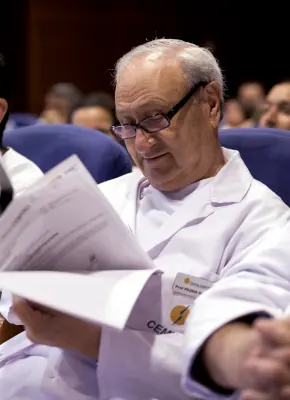
Dr. Pedro Guillén
Pedro Guillén, founder and president of Clínica Cemtro, president of the Doctor Pedro Guillén Foundation, Extraordinary Professor and Honorary Dean of the Catholic University of Murcia and Honorary Member of the Royal European Academy of Doctors (READ), announced on 24 April in the specialised publication “Diario Médico” that he intends to apply partial cellular reprogramming in Spain to treat knee osteoarthritis. This innovative technique, developed and already approved by the Japanese healthcare system, uses human cells to regenerate damaged tissues, primarily in joints, thereby avoiding aggressive treatments such as prosthetic implants. The academic provided further details on the technique and its use in an extensive report published in the media channels of the Royal National Academy of Medicine, of which he is also an academician, on 28 April.
“We are witnessing a scientific and healthcare milestone, because these cells can be obtained from adult tissues and converted into different types of cells with the potential to repair damaged tissues: our living cells themselves are instruments for healing, regenerating and changing human life. The origin of this technology dates back to 2006, when the Japanese scientist Shinya Yamanaka succeeded in reprogramming adult cells by introducing a series of genes known as Yamanaka factors. This discovery, which earned him the Nobel Prize in 2012, demonstrated that cells can go back in their development,” the expert explained to the Academy of Medicine’s channels.
In Japan, the health authorities granted marketing authorisation for two medical products derived from this technology, enabling two therapies to be launched in the country: one to address ischaemic cardiomyopathy and another to treat certain cases of Parkinson’s disease for which other treatments offer no response. Guillén, however, has advocated applying these reprogrammed cells to repair damaged joint tissues. “Living cells become instruments for healing, regenerating and changing human life. It is like returning a specialised adult cell to a youthful and versatile state,” he explained in “Diario Médico”, while warning, however, that this is still an emerging technology whose clinical results must be confirmed.
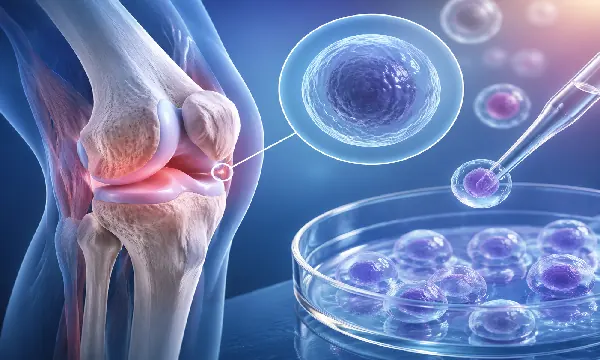 “In early stages, joint degeneration could be reversed, as could certain muscle injuries or sarcopenia associated with ageing. We are in the final stage of adjusting the dose and number of applications in the knee,” he added. In the longer term, Guillén foresees the use of this type of therapy in other cardiovascular, liver and neurological diseases in which cellular degeneration or necrosis also occurs. “The fact that the first treatments have taken two decades to reach patients highlights the difficulties involved in translating scientific knowledge into clinical practice. The need to guarantee safety is unquestionable, but this case invites reflection on the agility of regulatory frameworks and the ability of healthcare systems to incorporate high-impact innovations within reasonable timeframes,” concluded the renowned traumatologist, urging the administration to streamline its procedures.
The introducer of arthroscopy in Spain, Guillén, is also a member of the National Academy of Surgery of Spain, the Royal National Academy of Pharmacy, the European College of Sports Traumatology and the Spanish Committee of Sports Medicine, as well as an honorary member of the Arthroscopy Association of North America. He has received some of Spain’s highest civil distinctions, such as the Medal for Merit at Work, the Grand Cross of the Order of the Second of May and the Medal of Honour for the Promotion of Invention, among other top-level awards. In the field of teaching and research, he promotes the Pedro Guillén Chair of Regenerative Medicine.