

Dr Mariàngela Vilallonga
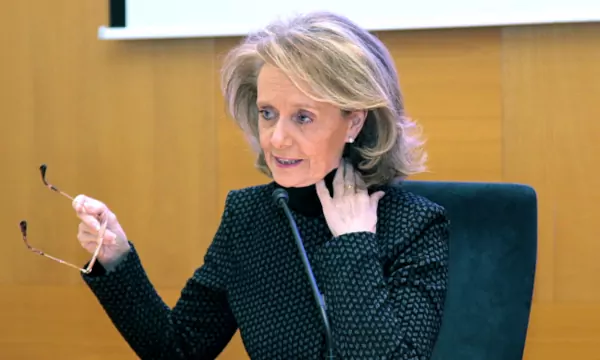
Mariàngela Vilallonga, Emeritus Professor of Classical Philology at the University of Girona, President of the Prudenci Bertrana Foundation and full member of the Royal European Academy of Doctors (READ), was one of the prominent figures in the special feature that “Cultura|s,” the supplement of “La Vanguardia,” devoted on 17 April to the celebration of Sant Jordi and to the relationship between writer parents and writer children, through the testimony of several literary families. In conversation with journalist Cesca Castellví, the academic reflects in an extensive feature on literature and intergenerational influences together with her son, Borja. Last year, Vilallonga published “Retrat interior,” a collection of poems written between Girona and New York from 2003 to 2009; Borja Vilallonga, also a writer and historian, is the author of the novel “El Tigre,” among other works.
The author explains that, from the moment her son was born, she read him a poem by Josep Carner every night, convinced that those words could only do him good. “They also lived in a literary nest, where Mercè Rodoreda wrote ‘Viatges i flors,’ which Borja remembers as ‘overflowing with books.’ ‘All of that creates a context,’ he says: ‘you can cling to it or not. I clung to it because I had a predisposition,” the journalist explains from her meeting with mother and son. “Sheltered by the books at home, literary vocation often emerges among our authors’ children as a playful gesture. In Borja’s case, the vocation appeared very early, Mariàngela explains. Before he began to write, he created different worlds and drew their characters. Later, he devised a diary of Romanyà, complete with news, illustrations and the whole circuit of production and sale,” the feature continues.
Mariàngela and Borja reflect on advice, influences, and the weight of the surname, noting that much of their work could not be understood without this intense relationship between them. “For Mariàngela and Borja, the exchange is always reciprocal and intense. ‘She reads absolutely everything I write. I am interested in an honest opinion, and she gives it to me. Sometimes we also have detailed conversations,’ Borja explains. ‘We are mother and son, but we are also friends. Borja surpasses me in everything: in writing, in reading and in the interpretation he makes of the world. That is why I ask him for advice,’ Mariàngela notes,” Castellví concludes.
Moreover, on 9 April, the academic presided over the Bertranada at Girona Cathedral, a cultural gathering commemorating the 120th anniversary of the publication of “Josafat” by Prudenci Bertrana. The evening brought together the audience and participants in a space deeply linked to the novel’s universe, in a proposal that combined conversation, reading, projection, and artistic intervention. The initiative was organised by the Cathedral Chapter, the Prudenci Bertrana Foundation, Edicions de la Ela Geminada and the City Council of Girona, and sought to be a shared celebration of one of the seminal works of 20th-century Catalan literature.
Vilallonga also presented on 11 April in Cadaqués the latest literary itinerary of the Maria Àngels Anglada–Carles Fages de Climent Literary Heritage Chair of the University of Girona, entitled “The Cadaqués of Anna Maria Dalí,” together with the person responsible for the edition, Blanca Sala. The publication makes it possible to discover the iconic town of Empordà through the writings of Salvador Dalí‘s sister and to uncover her literary sensibility. The academic also took part in the presentation of “L’àngel que em mira,” a novel by Marta Pasqual about invisible ties with childhood. The event was held on 10 April in Llagostera.
After her period as Minister of Culture of the Government of Catalonia between March 2019 and September 2020, a post for which she resigned from the vice-presidency of the Institute of Catalan Studies, Mariàngela Vilallonga resumed her teaching activity until her retirement three academic years ago. In 2016, she was awarded the Creu de Sant Jordi, the highest distinction granted by the Generalitat, for her research into the Latin humanistic literature of the Crown of Aragon. She was also appointed adviser to the publishing group Grup62.