

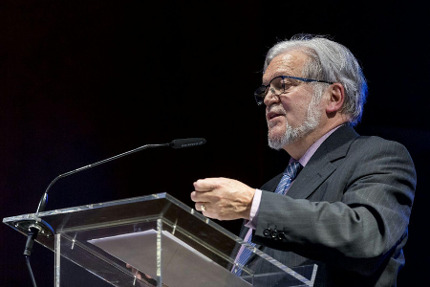
Dr. Joaquín Callabed
Joaquín Callabed, President of the Club of Social Pediatrics, Corresponding Member of the Real Academia de Medicina de Cataluña and the Real Academia de Farmacia de Cataluña, and Full Member and Vice President of the Health Sciences Section of the Royal European Academy of Doctors (READ), is the subject of an interview published on November 29 in the digital edition of “La Vanguardia”, of whose readers’ community he is an active member. In the interview, he discusses several aspects of his latest publication, “Goya’s Views on Childhood”, as well as some of his studies on the renowned Aragonese painter.
In conversation with journalist Claudia Fuentes, the expert reflects on the social relevance of the work of Francisco de Goya, to the point of suggesting that, were the artist alive today, he would continue to denounce through his paintings the injustices affecting the most vulnerable—especially children. The President of the Club of Social Pediatrics recalls that the painter did not idealize childhood, but rather portrayed with stark realism the poverty, inequality, and suffering of children in his time. From this critical perspective, he draws a parallel with today’s reality, still marked by child poverty and child abuse, and argues that these problems remain unresolved challenges for society. For the academic, Goya’s sensitivity and social commitment would lead him today to continue using art as a form of denunciation and as a call for attention to injustices that, despite the passage of centuries, have not disappeared—if anything, they have merely been nuanced or transformed.
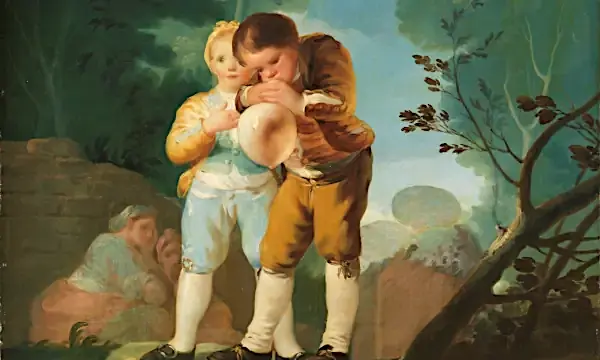
“I believe that everything he perceived as unequal in his time, he would still see today, albeit with different nuances. War, poverty… in Spain there are many areas where child poverty still exists. There is still child abuse, and that too he could continue to paint today. I believe he would not confine himself to the major cities; he would go to the outskirts and continue to portray social and everyday themes,” he notes. Prior to this latest publication on the painter, Callabed had written numerous articles on Goya’s figure and work, many of them in the digital edition of La Vanguardia, and had also delivered several lectures on the subject. A year ago, at the READ, he addressed this same topic starting from the painter’s well-known tapestry cartoons—a set of works painted between 1775 and 1792 for the Royal Tapestry Factory of Santa Bárbara, in which Goya depicted scenes of children’s games, portraits of children from the nobility, and socially themed works that combine the joy of childhood with a sharp denunciation of the inequalities of his time.
 Regarding his interest in Goya—and more broadly in painting—from a field such as pediatrics, Callabed explains that a medical leave due to a back problem led him to take some classes with the Catalan Watercolorists’ Association. “I spent some time there, very comfortably, and I have held a few watercolor exhibitions. I like to stress that one thing is to paint a picture and another is to be a painter,” he explains. From there, appreciating the visual arts and relating them to his interest in the humanities and history in a broad sense was a natural progression. The Aragonese origin of the legendary painter and his own knowledge of the region, as well as shared ancestry, were additional factors that led him to focus on Goya’s work.
As for the genesis of the book in particular, he points to the people and circumstances that helped him along the way. “Some time ago, the President of the Royal Academy of San Luis organized a Goya-themed tour in Zaragoza. We are good friends, and since he knew I was a pediatrician and that I had already published articles on Goya, he suggested that I speak about childhood in his works. I did so, and it was very well received by the public, so I began to give more lectures on the topic. The information kept growing, and the book emerged. Goya has been extensively studied—his wars, the majas… but very few have focused on this aspect. Goya is a son of the Enlightenment, and it holds that the child is a unique individual who deserves individualized treatment. Goya paints, among other things, children’s games, but he does not see them merely as play; he also offers critique. We see barefoot children, ringworm on their heads, poverty, war… and he paints it all,” he concludes.