

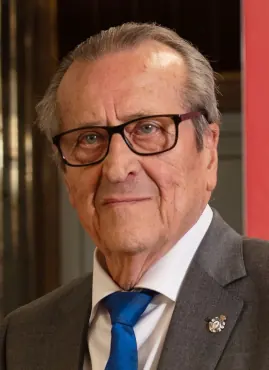
Dr. Francisco González de Posada
Francisco González de Posada, Professor of Physical Foundations at the Polytechnic University of Madrid and Honorary Member of the Royal European Academy of Doctors (READ), has devoted the lectures “Xavier Zubiri (1898-1983): Developments in the Philosophy of Reality at the International Summer University of Santander” and “Zubiri (1898-1983) and the Philosophy of Reality” to the figure of the renowned philosopher Xavier Zubiri. He has delivered them in recent months at various academic forums, including the International Summer University of Santander and the Centre for Mountain Studies, with the support of the Cantabrian Society of Historians of Spanish Philosophy. The expert has also addressed Zubiri’s work in the series devoted to “Current Cosmology,” which he offers as part of the Summer Courses at the University of Cantabria.
Within the framework of the “2nd Open Seminar”, held under the title “Philosophers of Cantabria and Philosophical Modernity in Spain” at the Centre for Mountain Studies on 26 March, the READ Honorary Member highlighted Zubiri’s role in the development of contemporary Spanish philosophy, leading a group of thinkers who were particularly aware of the need to restore a philosophical tradition of their own. This work highlighted the Basque philosopher’s connection with the International Summer University of Santander, analysing how Zubiri’s thought was integrated into the intellectual landscape of that time and offering a detailed view of his theoretical contributions in a local academic setting.
Xavier Zubiri studied Theology and Philosophy with Juan Zaragüeta and José Ortega y Gasset. He was ordained a priest in 1921 and, five years later, became Professor of History of Philosophy at the Complutense University of Madrid from 1926 to 1935. He moved to Rome, where he left the priesthood and married. In 1942 he taught at the University of Barcelona, but left his chair two years later to live in Madrid. His philosophy is distinguished by a new idea of reality and had a major influence on liberation theology and contemporary philosophies of praxis. He was a prolific author and, during his lifetime, published landmark works such as “Nature, History, God” (1944), a collection of articles published in journals; “On Essence” (1963), in which he sets out his metaphysical conception of reality centred on the idea of substantivity; and the three volumes of “Sentient Intelligence”, published in 1980, 1982 and 1983, the year in which he died.
 In his two lectures, González de Posada contextualised Zubiri’s intellectual evolution, highlighting his time in Freiburg, where he met Edmund Husserl and Martin Heidegger, and in Berlin, where he coincided with Albert Einstein and Max Planck. These influences led him to break with traditional ontology and to take an interest in fields such as mathematics, physics and biology. The expert underlined Zubiri’s continuing relevance beyond philosophical fashions, his integration of physics and metaphysics and his influence on the intellectual landscape of Santander, where he became part of its academic environment, stressing his role as the founder of a philosophy of reality that is dynamic, respectful and aligned with contemporary science.
González de Posada is a civil engineer and PhD in Civil Engineering from the Polytechnic University of Madrid, and is a graduate in Philosophy and Letters from the Pontifical University of Salamanca and in Physical Sciences from the Complutense University of Madrid. He was awarded the Medal of Honour for the Promotion of Invention and was also rector of the University of Cantabria. He is a Numerary Member of the Royal Academy of Doctors of Spain and a member of the World Academy of Art and Science, Corresponding Member of the Royal Academy of Fine Arts of Cádiz, the Royal Academy of Fine Arts of San Fernando and the Royal Academy of Sciences, Fine Arts and Letters of Écija, and Honorary Member of the Academy of Medical Sciences of Cantabria, the Royal Academy of Valencian Culture, the Royal Academy of Medicine and Surgery of Cádiz and the Royal Academy of Medicine of the Canary Islands. He is a Numerary Member and President of the Academy of Sciences, Engineering and Humanities of Lanzarote.