

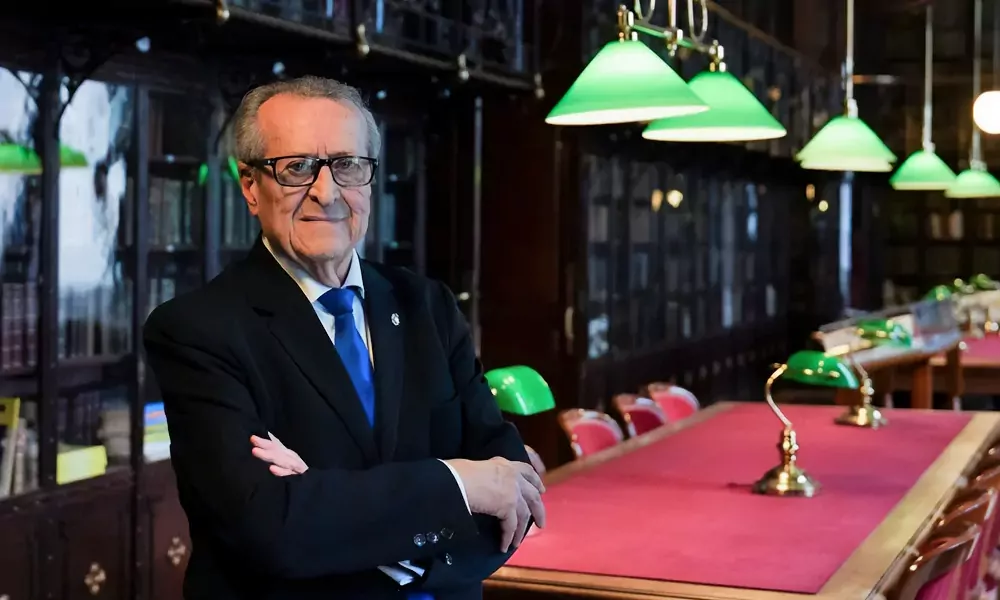
Dr. Francisco González de Posada
Francisco González de Posada, Professor of Physical Foundations at the Technical University of Madrid and Honorary Academician of the Royal European Academy of Doctors (READ), offered a profound reflection on the cosmos from a theological perspective, articulating the relationship between the physical universe and the notion of God in the lecture «The Universe and God», delivered last September in the Aula Magna of the Faculty of Economics at CEU San Pablo University in Madrid as part of the «Sustainability Insights Live» series, aimed at both students and the general public. The talk, subtitled «From Cosmic Origins to the Responsibility of Caring for Creation», was a reformulation of a lecture the academic has presented in various forums across Spain over recent years and, on this occasion, was accompanied by a discussion led and moderated by Paul Gordon, Professor of Social Doctrine of the Church, Contemporary History, and Literature at the institution. González de Posada also directs the summer course held by the University of Cantabria in the town of Laredo entitled «Cosmology: Science and Philosophy».
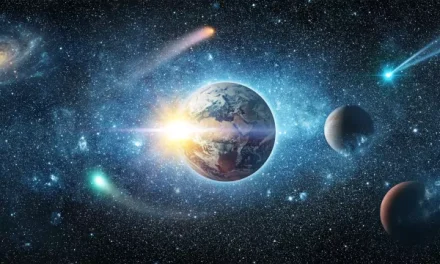
The speaker began his presentation by addressing fundamental questions about the nature of the universe, its origin, and how the scientific and philosophical issues that remain unresolved in this regard are intrinsically connected to the religious idea of creation. To this end, he structured his talk by first presenting the observable universe, including basic concepts of what we mean by our universe and how modern science has characterized its structure and evolution, reviewing historical categories of thought from Aristotle to Isaac Newton, and exploring topics such as the uniqueness of the universe and the problem of its origin and eternity. In a second part, he shifted his focus toward a theological interpretation of creation, examining the idea of a creative act that gives meaning to the universe from a religious perspective. Drawing on references to traditional concepts of Christian theology, the speaker discussed how the notions of God and the universe can be understood in dialogue, articulating interpretations that reconcile scientific knowledge with faith.
 «We know a great deal about our universe—that is, the universe about which physics dares to speak with knowledge—but we also know that we are profoundly ignorant. In fact, this was the very first problem posed by science and philosophy: to ask what the whole is, what the universe is, what cosmology is. To ask what the smallest thing is—matter—and what everything that exists is made of. The universe is an object of science, but its existence inevitably leads to a metaphysical question that science alone cannot answer», the expert explained. From there, González de Posada sought to build bridges between disciplines traditionally kept apart, such as physics, philosophy, and theology, inviting the audience to contemplate the cosmos not only as an object of scientific study but also as a realm in which the deepest questions of meaning, cause, and existence are projected.
The discussion following the main lecture allowed for interaction with the audience, addressing questions and comments on the convergence between science and theology, as well as the role of reason and faith in understanding the existence of the universe. In his concluding remarks, the Honorary Academician of the READ underscored the importance of considering both scientific advances and the great metaphysical questions that have accompanied human thought since its origins.
González de Posada is a civil engineer and holds a PhD in Civil Engineering from the Technical University of Madrid, a degree in Philosophy and Letters from the Pontifical University of Salamanca, and a degree in Physics from the Complutense University of Madrid. He has been awarded the Medal of Honor for the Promotion of Invention and also served as Rector of the University of Cantabria. He is a Full Member of the Royal Academy of Doctors of Spain and a member of the World Academy of Art and Science; a Corresponding Member of the Royal Academy of Fine Arts of Cádiz, the Royal Academy of Fine Arts of San Fernando, and the Royal Academy of Sciences, Fine Arts and Humanities of Écija; and an Honorary Academician of the Academy of Medical Sciences of Cantabria, the Royal Academy of Valencian Culture, the Royal Academy of Medicine and Surgery of Cádiz, and the Royal Academy of Medicine of the Canary Islands. He is also a member and serves as President of the Academy of Sciences, Engineering and Humanities of Lanzarote.