


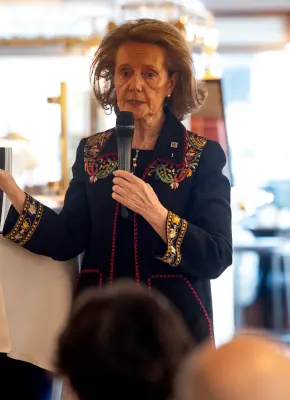
Dra. Mariàngela Vilallonga
Mariàngela Vilallonga, Emeritus Professor of Classical Philology at the University of Girona, President of the Prudenci Bertrana Foundation and full member of the Royal European Academy of Doctors (READ), turns her attention to the figure of the much-missed Mercè Rodoreda, to whom she has devoted a large part of her research and of whose life and literary work she has become one of the foremost experts, in the article “Mercè Rodoreda’s Romanyà”, published on the specialist portal La Mira by journalist Mar Camps. The academic explains her relationship with the author from the time Rodoreda returned from exile in 1971 and settled in Romanyà de la Selva together with Carmen Manrubia a year later, before acquiring the house El Senyal in 1979. While still a child, she used to accompany Rodoreda and Manrubia when they went shopping at her father’s tailoring and clothing shop, Josep Vilallonga, and would chat with her mother, who was a reader of Rodoreda.
Vilallonga deepened her relationship with the renowned author and, after her death, bought the house where she had lived with Manrubia, since the latter had fallen into ruin. The academic preserved the house and garden with as few alterations as possible, maintained their original spirit, replanted trees that had died, kept objects such as mirrors and Manrubia’s creations from the basement, in the hope that one day it might become a house-museum, and sought to promote a cultural centre in Romanyà linked to Rodoreda. For Vilallonga, the landscape of the Gavarres deeply marked the writer’s later work. There, she completed “Broken Mirror” and “Travels and Flowers,” wrote her final novel, “How Much War, How Much War,” and revised “Death in Spring.”
Moreover, on 30 May the academic led the round table organised by the Maria Àngels Anglada–Carles Fages de Climent Literary Heritage Chair of the University of Girona, which she herself has directed since its creation in 2004, together with the Museum of Medieval History of Castelló d’Empúries, held in the Chapel of Santa Clara in that town under the title “Carles Fages de Climent and the Brothers Ramón and Luis Ruiz Contreras.” The session, part of the cycle “Fages de Climent and His Contemporaries,” featured the participation of the experts Joan Ferrerós, Joan Manel Soldevilla and Carles Fages, in addition to Vilallonga herself.
Ramón Ruiz was a priest, educator, Doctor of Law, writer and member of the Society of Jesus. His bibliography was enormous, especially in education, with more than 370 works. He also stood out as a translator of monumental works. His brother Luis Ruiz, for his part, was a writer, journalist, theatre critic, playwright and translator. His most prolific decade ran from 1895 to 1905, a period during which he founded several journals. An active member of the Madrid Press Association from 1896 and perpetual secretary of the Royal Academy of Fine Arts of San Fernando, he was a notable secondary figure of the Generation of ’98. As the participants analysed, both brothers maintained a close relationship of neighbourhood and friendship with Carles Fages de Climent.
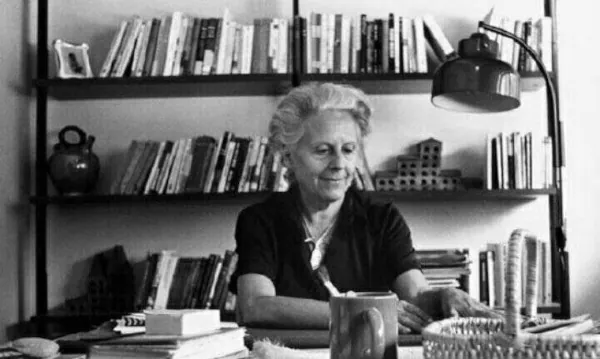
Mercè Rodoreda
Mariàngela Vilallonga has also featured in recent weeks in various interviews in local media such as Ràdio Vilablareix, Ràdio Capital and Domenys Ràdio, in which she has discussed her latest academic and cultural activities, as well as her recent public presentations of her work “Retrat interior” (Proa), a collection of poems written between Girona and New York between 2003 and 2009.
After her period as Minister of Culture of the Government of Catalonia between March 2019 and September 2020, a post for which she resigned from the vice-presidency of the Institute of Catalan Studies, Mariàngela Vilallonga resumed her teaching activity until her retirement three academic years ago. In 2016, she was awarded the Creu de Sant Jordi, the highest distinction granted by the Generalitat, for her research on Latin humanistic literature of the Crown of Aragon. She was also appointed adviser to the publishing group Grup62.