

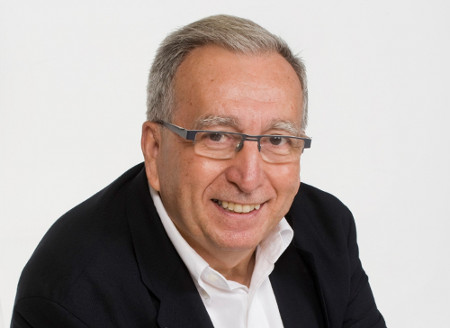
Dr José María Baldasano
José María Baldasano, Professor of Environmental Engineering at the Polytechnic University of Catalonia, Nobel Peace Prize laureate as a representative of the Intergovernmental Panel on Climate Change, and Numerary Member of the Royal European Academy of Doctors (READ), reflects on the growing rejection of scientific findings on the climate crisis and its effects in the articles “Así ha evolucionado el negacionismo de la industria de los combustibles fósiles para impedir la acción climática”, published on 31 October in the specialised outlet The Conversation and subsequently picked up by several Spanish and Latin American media outlets, and “La Administración Trump asume el negacionismo climático como política oficial del Gobierno de EE.UU.”, published in El Periódico in its 18 November edition.
In The Conversation, the expert explains how the fossil fuel industry—aware since the 1950s of the climatic impact of its products—developed a systematic strategy of denial, concealment, and information manipulation, questioning the validity of scientific studies and presenting alternative scenarios that rejected industrial CO₂ emissions as a driver of global warming. Over time, denialism evolved, moving away from explicit denial and instead focusing on discrediting climate solutions such as renewable energy and shifting responsibility onto citizens. Adding to all this, Baldasano notes, are greenwashing campaigns through which companies present themselves as environmental allies while continuing to exploit fossil fuels.
“Surveys consistently show that a significant share of the population continues to doubt the reality and significance of today’s climate change. The World Economic Forum has concluded that misinformation is now one of the major global risks. In a recent report, the International Panel on the Information Environment states that the greatest barrier to climate action may not be a lack of scientific knowledge, but rather the ‘worldwide spread of misinformation that undermines public trust and political will’,” Baldasano concludes.
 In El Periódico, the expert explains that the climate policy of Donald Trump’s Administration in the United States has taken a radical turn toward scientific denialism. Baldasano describes how the government has sidelined the fight against climate change, downplaying the widely accepted scientific evidence on global warming and promoting policies that favour fossil fuels over renewable energy. This approach has led to measures such as withdrawing from international commitments like the Paris Agreement and openly questioning climate science, even in international forums where phenomena such as rising sea levels and heatwaves are already affecting numerous countries.
International experts and leaders have sharply criticised these positions, which contrast with the scientific consensus and with the priorities of other governments—especially in Europe—that insist on strengthening climate action. Washington’s strategy has therefore caused widespread alarm due to its possible negative impact on international negotiations and on global capacity to limit warming to safe levels. Political polarisation within the United States further complicates the implementation of more ambitious environmental policies, in a context where civil society and academic sectors press to maintain and reinforce measures against the climate crisis.
Baldasano authored the “Informe sobre cambio climático” (Report on Climate Change) debated by the Climate Emergency Committee of the Parliament of Catalonia, as well as the “Informe de los Premios Rey Jaime I de Medio Ambiente sobre el Actual Cambio Climático”, co-signed with José Luis Rubio and presented before the plenary of the High Advisory Council on R&D&I of the Presidency of the Generalitat Valenciana. He also presented the study “Las zonas de bajas emisiones para mejorar la calidad del aire de las ciudades” during the virtual conference «Barcelona, zona de bajas emisiones», hosted by «La Vanguardia». Baldasano thoroughly examined the effects of reduced emissions during mobility restrictions imposed because of the pandemic in articles such as «Covid-19 lockdown effects on air quality by NO2 in the cities of Barcelona and Madrid (Spain)», where he called for the implementation of new urban mobility policies after confirming that emissions had dropped between 50% and 62% in both cities during March 2020.