

-

- Dr Rafael Urrialde
-
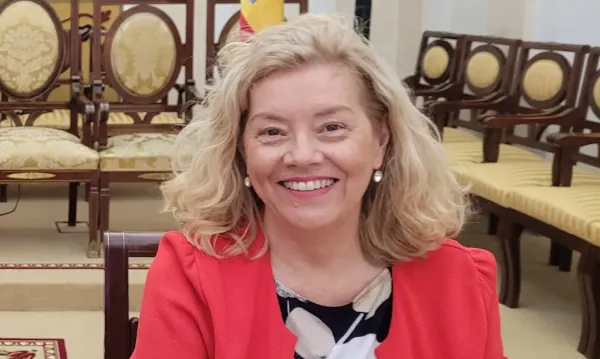
- Dr Marcela González-Gross
Rafael Urrialde, Professor in the Department of Genetics, Physiology and Microbiology at the Complutense University of Madrid and in the Department of Pharmaceutical and Health Sciences at CEU-San Pablo University; President of the Scientific Committee of the Spanish Society of Sports Medicine; Secretary of the Spanish Nutrition Foundation; Honorary Academician of the Spanish Academy of Nutrition and Food Sciences; and Numerary Member and Member of the Governing Board of the Royal European Academy of Doctors (READ), together with Marcela González-Gross, Professor of Nutrition and Exercise Physiology and Director of the Department of Health and Human Performance at the Faculty of Physical Activity and Sport Sciences of the Polytechnic University of Madrid, President of the Spanish Nutrition Society, Corresponding Member of the Royal National Academy of Pharmacy, and Numerary Member of the READ, presented on October 8 the study “EnComCol (School Canteen Survey)” on diet, nutrition and healthy lifestyles among boys and girls aged 6 to 11 and young people aged 12 to 17.
Prepared with the collaboration of the Spanish Nutrition Society and the Polytechnic University of Madrid through its Research Group on Food, Nutrition, Exercise and Healthy Lifestyles, the report determines that the use of the school canteen may influence the eating behavior of children, since boys and girls between 6 and 11 years of age who use this service may have greater knowledge about healthy eating than those who do not. Likewise, children who attend the school canteen also eat more frequently throughout the day: 81% of those who use it have five meals a day, compared with 73% of those who do not eat in educational centers. As for habits related to eating, the study also finds that television is very present during children’s and adolescents’ meals: 29% of Spanish minors watch television every day during every meal, rising to 32% among those over 12 years old.
In fact, the survey reveals an eating behavior that clearly differs between the 6–11 and 12–17 age groups, with the use of the school canteen appearing as a possible determining factor. A clear difference is that the use of the school canteen may condition the eating behavior model. For this reason, since it is mainly used by the 6–11 age group, a 50% quota was established to determine whether it is a social determinant, while in the 12–17 age group its use was randomized, confirming that it is very low and therefore would not act as a possible social determinant.
“The school canteen is a critical factor in food and nutritional education for children and young people. It is there where, in addition to being fed, they can receive part of their education in healthy habits. The data show differences between those who attend and those who do not: children who do not go to the school canteen and only receive nutritional information during school hours seem not to have the same level of food education as those who do participate in this environment. Moreover, it is essential to maintain these habits when they stop going to the canteen, since during adolescence we observe what we might call an abandonment of healthy routines that can lead to negative consequences in the future,”
explained Urrialde during the presentation.
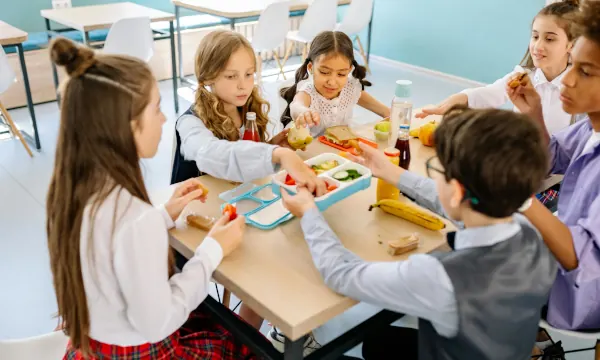 Regarding their perception of their own diet, 48% of children aged 6 to 11 consider theirs to be fairly healthy, as do 45% of young people aged 12 to 17, without major differences between those who attend the canteen and those who do not. However, there is a greater impact of canteen use when it comes to engaging in sports, with organized physical activity being more common among those who eat at school (79%) than among those who do not (72%). This trend is even more pronounced among younger children (6–11 years), with a 12-point difference (80% versus 68%). These data may indicate that greater awareness of educational values related to healthy eating can also influence lifestyle behaviors.
“The data show that children and adolescents who meet the daily recommendation of 60 minutes of moderate to vigorous physical activity have a better body composition. At younger ages, exercise also contributes to more complete and balanced motor development. We know that healthy behaviors tend to reinforce each other: those who engage in regular physical activity are less likely to smoke or drink alcohol and maintain a more balanced diet. They are also more receptive to understanding that health does not depend on a single habit, but on the combination of all of them,”
added González-Gross.
The objective of the report is to determine whether there are differences between daily food and beverage consumption and the corresponding nutritional intake of this population, depending on whether or not they use the school canteen service and whether they attend public, charter or private schools. All of this is analyzed according to the six possible daily eating occasions. Thus, EnComCol aims to become a national reference for understanding the eating and nutrition habits of this population and their social determinants, providing up-to-date and reliable information to help define strategies and projects adapted to the real needs of children and young people in Spain, even taking into account the six territorial areas where one thousand dietary records were collected, half for each age group.