


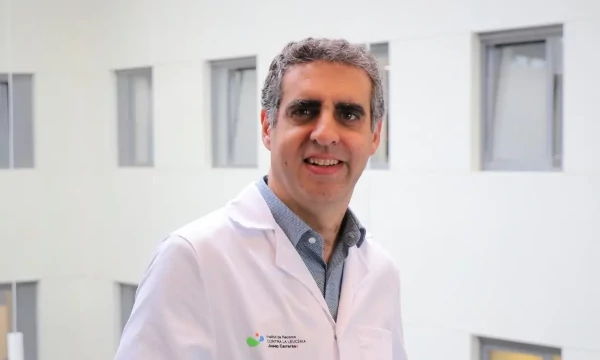
Dr. Manel Esteller
Manel Esteller, Professor of Genetics at the Faculty of Medicine of the University of Barcelona, researcher with the Catalan Institution for Research and Advanced Studies (ICREA), Academician of the Royal Academy of Medicine of Catalonia and of the European Academy of Cancer Sciences, and Numerary Member of the Royal European Academy of Doctors (READ), has joined the Sant Pau Research Institute (IR Sant Pau) in Barcelona as one of its leading researchers. In an official statement, the institute explains that his incorporation is part of its strategy to attract and retain top local scientific talent, as well as a specific plan approved by its Board of Trustees to encourage the recruitment of ICREA researchers. Likewise, the institute aims to provide an environment of excellence that enables researchers to build world-class careers without having to relocate abroad, reaffirming its commitment to scientific progress and to the development of Catalonia in this strategic field.
“Esteller is one of the most internationally recognized scientists in the fields of epigenetics and oncology. His pioneering work has been crucial for understanding how epigenetic mechanisms—processes that regulate gene expression without altering DNA sequences—influence the development of cancer and other complex diseases. His incorporation strengthens the critical mass of scientific talent at IR Sant Pau and will drive research in areas such as applied epigenetics, translational oncology, and personalized medicine. His leadership and experience in creating international networks will help attract competitive funding and high-level researchers, consolidating the institute as a European benchmark in biomedical research,” the statement reads.
Esteller’s research focuses on the mechanisms involved in controlling genetic activity—epigenetics—applied to the study of human diseases, primarily cancer. His results have not only helped decipher the molecular basis of many pathologies but have also led to the development of new diagnostic biomarkers and innovative therapies. The Josep Carreras Institute, for its part, is dedicated to promoting, developing, transferring, managing, and disseminating research, scientific and technological knowledge, teaching, and training in the fields of leukemia, other malignant hematological diseases, and cancer in general. It currently comprises 40 research groups studying the epidemiological, preventive, clinical, translational, and basic aspects of cancer.
With more than 640 scientific publications and over 150,000 citations, Esteller is the most cited biomedical scientist in the world. In the 2024 ranking by Stanford University and Elsevier, he appears in the top 2% of scientists worldwide. According to Research.com (2025 edition), he ranks first in Spain in Medicine, and second in Genetics nationally in the same report. For more than two decades, the academician directed the Epigenetics and Cancer Biology Program at the Bellvitge Biomedical Research Institute (IDIBELL) and later led the Josep Carreras Leukemia Research Institute. His numerous recognitions include the Rey Jaime I Award for Basic Research, the National Research Award of Catalonia, the Josep Trueta Medal for Healthcare Merit, and the Royal National Academy of Medicine Award.

Instituto de investigación del Hospital de la Santa Creu i Sant Pau