


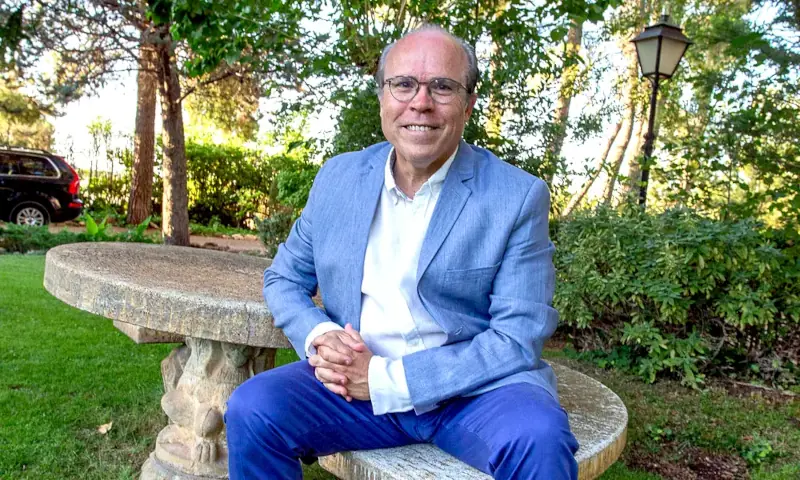
Dr. Javier López-Galiacho
Javier López-Galiacho, Associate Professor of Civil Law at the Rey Juan Carlos University, Director of Compliance and Sustainability at Fomento de Construcciones y Contratas (FCC), President of the Association of Friends of Spain’s Historic Theatres and of the Mazzantini Forum, and Numerary Member of the Royal European Academy of Doctors (READ), reflects on the limits of the right to privacy in his article “Letters That Should Not Be Published: Reflections on the Disclosure by Isabel Preysler of Vargas Llosa’s Private Letters”, published on 14 November on the specialised platform Confilegal. In addition, he devoted his popular radio segment on Radio Albacete—one of the stations of Cadena Ser—broadcast on 30 October, to the anniversary of the DANA storm that claimed the lives of more than two hundred people, mainly in Valencia and Castilla-La Mancha, with special emphasis on the tragedy experienced in the Albacete municipality of Letur.
In Confilegal, the academic criticises Isabel Preysler’s decision to publish the private letters written to her by Mario Vargas Llosa without the consent of either the author or his heirs, arguing that it constitutes an unlawful intrusion into fundamental rights, as such correspondence remains protected both by the author’s moral rights and by the right to privacy. López-Galiacho recalls that the Constitution explicitly safeguards privacy and the secrecy of communications, and argues that revealing private correspondence breaches these guarantees. He also cites the law that develops this constitutional protection, which explicitly considers it a harmful act to publish personal writings of an intimate nature without permission.
From the standpoint of intellectual property, the academic maintains that letters are written works, which means that Vargas Llosa retains moral rights over them, even after his death. López-Galiacho also warns that the heirs could claim part of the profits resulting from their publication. For the jurist, publishing these letters is not merely a legal issue, but an ethical one: it represents a betrayal of the implicit pact of confidentiality between the writer and the recipient, turning something intimate into a spectacle. The columnist cites the example of Emilia Pardo Bazán and Benito Pérez Galdós, whose correspondence was preserved rather than published out of respect for the intimacy revealed in their letters. “Letters, like embraces, are not lent. They are kept,” he concludes.
In his radio segment, the academic recalls the tragedy suffered a year ago in this municipality in the Sierra del Segura, which is now striving to recover normality after the devastation caused by the floods that claimed the lives of six residents. López-Galiacho describes how, in addition to restoring its natural and scenic value, Letur seeks to recover its cultural identity and local economy. Residents are committed to reviving rural tourism, mountain traditions and community life as drivers to relaunch the town. This revitalisation is seen as an opportunity to project a greener future based on sustainability and respect for the environment.

De PxHere
“Water tried to erase its history, but could not overcome the soul of its people. Because in Letur, as in stone, there is memory. And every wound becomes a carved scar, a testimony of resilience. The town, like the stonemason, does not give up: it raises its future from the rubble, chisels hope into every corner, and reminds us that life, like stone, is shaped through effort, community, and love,” the academic argues in a heartfelt reflection.
López-Galiacho has served as Director of the Colegio Mayor San Pablo in Madrid, Secretary-General and Head of the Law Division at the Cisneros Foundation of the Complutense University of Madrid, and Director of the Official Master’s Programme for Admission to the Legal Profession at the CEU San Pablo University School of Law, where he also served as trustee. He has a long-standing commitment to culture and, in addition to being a researcher, writer and columnist in several media outlets, he is the author of several books and an extensive body of research in the fields of civil law, good corporate governance, foundations, sustainability and business ethics. On 31 May he was named Distinguished Son of Castilla-La Mancha by the Regional Government for his outstanding academic and professional work and for his firm commitment to culture and heritage, exemplified by his initiative to preserve the Teatro Circo de Albacete, an emblematic venue of the performing arts.