


Unfinished decolonization: Portuguese Timor and the interruption of independence (1950-1975)
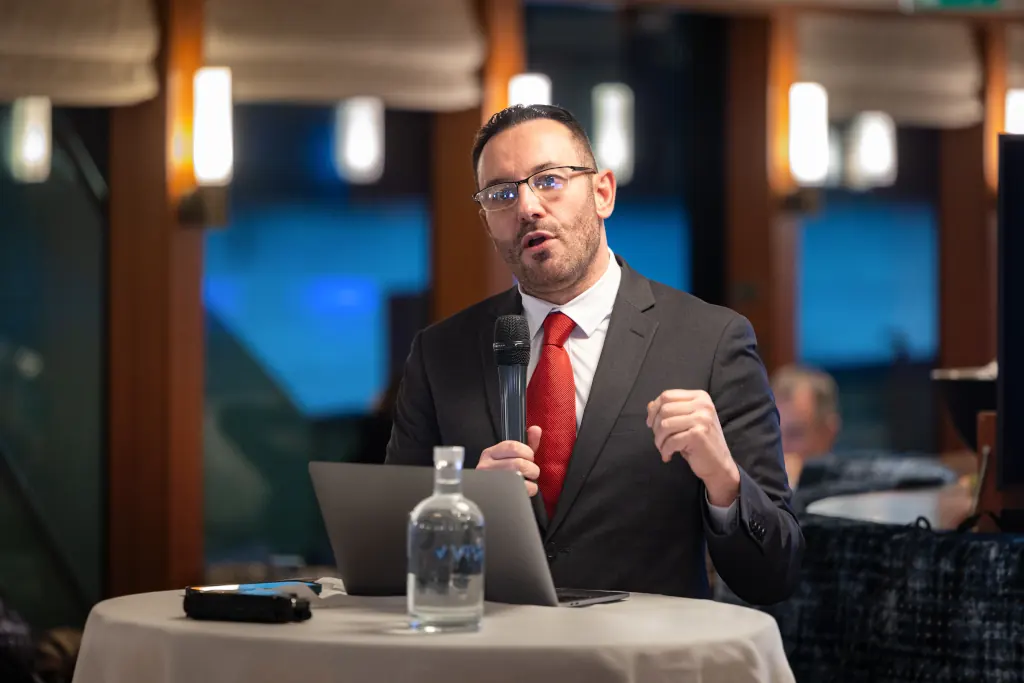
Ignacio Bonasa, President and founder of Liderarte Talent Management and Corresponding Member of the Royal European Academy of Doctors (READ), advocates a new model of business and political leadership in order to build more sustainable, cohesive and humane organisations and societies, in the lecture “Leading with soul in times of uncertainty: leadership as a vital challenge for a new era”, which he presented during the 10th International Academic Meeting held by the Royal Academy between 15 and 20 March in several German cities under the general title “The Rhine as a current of knowledge: cross-border dialogues”. For the expert, in a world marked by institutional fragility, polarisation, technological acceleration and collective emotional fatigue, traditional leadership focused on results, control and efficiency has shown its limits.
In his address, Bonasa argued that leadership can no longer be reduced to a technical or strategic function: it has become a vital challenge that requires sustaining lives, rebuilding trust and generating meaning. Faced with exhausted teams, disconnected talent and organisations that operate without inspiration, a model of leadership with soul becomes essential. Not as a vague spiritual concept, but as a profound coherence between purpose, conduct, values and ethical responsibility. This approach integrates competence and humanity, results and care, strategy and compassion. According to the author, the soul of leadership lies in the core coherence between what one thinks, feels, decides and does. It is about leading while recognising people as whole subjects, with history, vulnerability and aspirations, and not as mere resources.
The academic set out the key dimensions of this leadership with soul: self-knowledge and self-governance to manage one’s own limits and biases and decide with clarity; ethical coherence and exemplarity to align discourse and practice, acknowledging mistakes; care and well-being so that people can develop without deteriorating; deep listening and dialogue to foster trust in polarised environments; inspiration and shared meaning to connect daily work with a greater purpose; and social responsibility and systemic vision to consider impact beyond the organisation. Bonasa argued that this type of leadership generates healthier organisational cultures, increases psychological safety, reduces professional exhaustion and strengthens cohesion. Its impact extends beyond the business sphere, as it influences society by shaping forms of coexistence, equity, and intergenerational responsibility.
 The author framed this model within what he defined as a new era without solid points of reference, in which mistrust, uncertainty, and technological immediacy erode the legitimacy of leaders. In response, he argued that the challenges of the 21st century require leaders to sustain the tension between effectiveness and humanity, manage diversity, assume emotional responsibility, and maintain coherence in a world of constant exposure. In his conclusions, the academic emphasised that societies aspiring to confront the major contemporary challenges will need conscious leaders who reconcile power and conscience. These are not heroic figures, but references of humanity who exercise responsibility with depth and humility.
An expert in training, motivation and talent development, Bonasa has extensive experience as a business manager and leader of human teams. He has served as President of BBVA Dinero Express, CEO of BBVA Portugal, Regional Director of BBVA in Barcelona and in Asturias and Cantabria, Regional Director of Argentaria in Castile and León, Asturias and the Canary Islands, Regional Director of Banco Exterior de España, President of Grupo TEOT, General Manager of Caja Rural de Aragón, Associate Director of Grupo Actúa, and President and founder of several real estate companies. MBA from Icade and PDG from IESE, he has been recognised with prestigious awards such as the Legal Essay and Research from the Classroom Award and the BEX Best Idea of the Year Award. Bonasa joined the Royal Academy on 14 January with the speech “Organisations with soul: the new paradigm of humanistic leadership in the 21st century”, in which he proposed a radical shift in the way leadership and business management are conceived, placing human teams at the centre and replacing the profit and loss account as the focus of corporate strategy.