

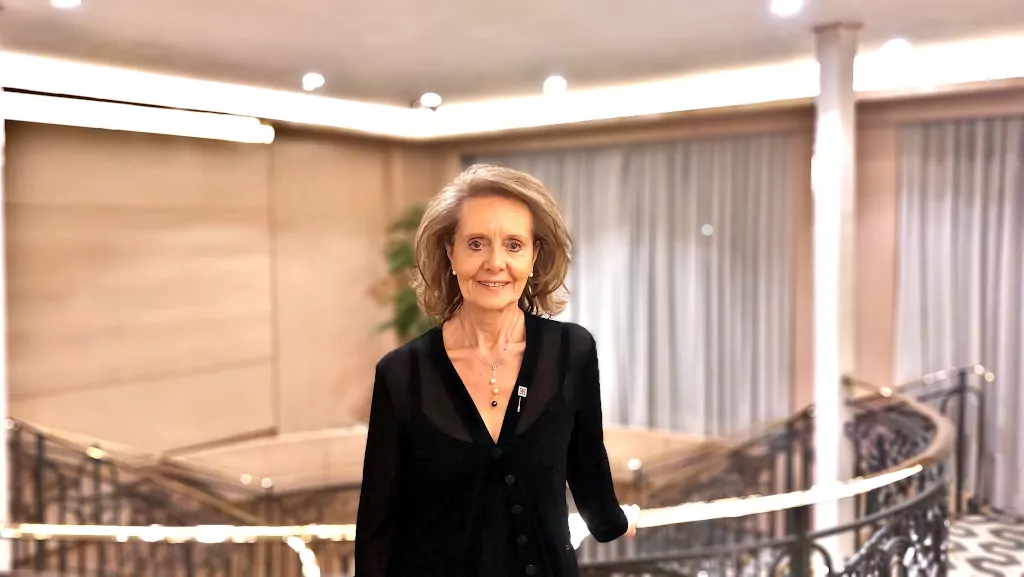
Dra. Mariàngela Vilallonga
Mariàngela Vilallonga, Emeritus Professor of Classical Philology at the University of Girona, President of the Prudenci Bertrana Foundation and a Numerary Member of the Royal European Academy of Doctors (READ), defends the value of the humanities, the role that the Catalan language should play and the importance of maintaining an ongoing dialogue with the classics in an extensive interview published in “La Revista” of the Ateneo de Acción Cultural. Beyond her extensive career as a researcher and as one of the leading experts on the life and work of Mercè Rodoreda, Vilallonga has recently presented the book “Retrat interior” (Proa), a collection of poems written between Girona and New York between 2003 and 2009.
In her conversation with journalist Lluïsa Massó, the academic explains that Latin remains relevant in education despite its marginalisation in current curricula, as it connects students with the cultural origins of Europe and with the modern languages derived from them. For Vilallonga, reading classical authors such as Virgil and Horace allows for a deeper understanding of the human condition across time. In her view, Greco-Latin texts preserve universal wisdom that fosters critical thinking and helps to understand the cultural foundations of contemporary society. In this sense, she advocates for a stronger presence of the humanities in education, while acknowledging that the current system tends to fragment knowledge. She also warns of the challenges facing the Catalan language, including social pressure from other languages, immigration and the impact of social media.
Regarding her experience as Consellera de Cultura of the Government of Catalonia, she recalls it as a particularly intense period marked by the political crisis following the 2017 referendum, social protests and the onset of the COVID-19 pandemic. Despite the difficulties, she considers it a public service she undertook with loyalty to the country and to Catalan culture. The philologist also highlights her work in promoting literary heritage and her connection to Rodoreda, an author she has helped disseminate, even on social media, by publishing daily quotations.
The interview concludes with a Latin aphorism that summarises her vision of intellectual work: “Gutta cavat lapidem, non vi sed saepe cadendo” (the drop hollows the stone not by force, but by constant falling), a metaphor for perseverance which, according to Vilallonga, also defines dedication to study and culture. “It is a praise of persistence, of resilience, as they say nowadays. I used to mention it in the first class of each course to students, so they would apply it to their studies, encouraging them to study daily rather than the day before the exam, because a heavy rain does not hollow the stone,” she explains.
After her term as Minister of Culture of the Government of Catalonia between March 2019 and September 2020—a position for which she stepped down from the vice-presidency of the Institute of Catalan Studies—Mariàngela Vilallonga resumed her teaching activity until her retirement three academic years ago. In 2016, she was awarded the Creu de Sant Jordi, the highest distinction granted by the Generalitat, for her research in Latin humanistic literature of the Crown of Aragon. She was also appointed member of the board of the publishing group Grup62.