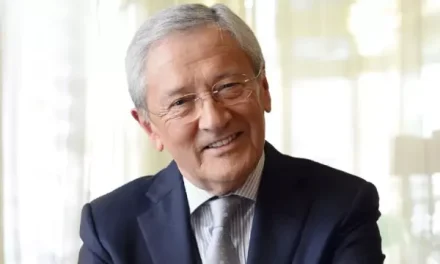


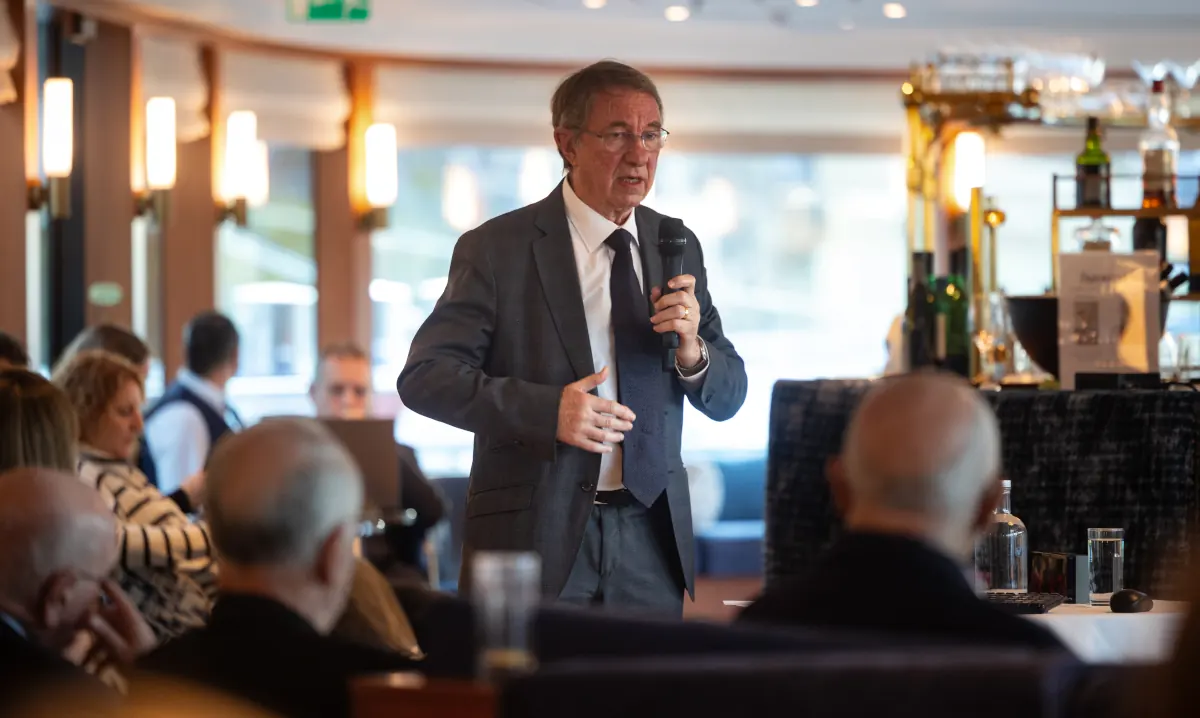
Dr. Carlos Grau
Carlos Grau, Professor of Economics and Business Organisation at the University of Barcelona and Numerary Member of the Royal European Academy of Doctors (READ), called for the European project to be relaunched towards a true political union, inspired by the visionary spirit of the founders of a new and prosperous Europe that would overcome the division and destruction of the Second World War, in the lecture “A message of hope for the European Union”, which he delivered during the 10th International Academic Meeting held by the Royal Academy between 15 and 20 March in several German cities under the general title “The Rhine as a current of knowledge: cross-border dialogues”.
The expert recalled that, following the war’s destruction across the continent, British statesman Winston Churchill proposed the idea of the United States of Europe in 1946. For their part, those regarded as the fathers of the European Union, such as Jean Monnet, Robert Schuman and Konrad Adenauer, succeeded in putting these postulates into practice beyond mere theorising through the creation of the European Coal and Steel Community (1951) and the Treaty of Rome (1957), which laid the foundations for European integration. This enabled Europe, decades later, to achieve historic milestones such as the elimination of internal tariffs, the free movement of goods, people and capital, and the creation of the euro in 2002. These advances transformed a Europe in ruins into one of the world’s most important economic blocs.
 However, Grau pointed out that the ultimate objective, political union, as well as fiscal harmonisation measures, remain pending. In this regard, he cited the 2012 financial crisis as an example, as it revealed the limitations of the European project: a lack of real solidarity between states, resistance to instruments such as Eurobonds, the weakness of the European Parliament and the predominance of national interests. In this respect, he identified the resurgence of nationalisms as the greatest obstacle to this long-awaited union, and explained how Brexit, the rise of the far right and tensions in countries such as Hungary and Poland illustrate this risk. “After 80 years without war on the continent, new generations with no direct memory of the conflict, together with migration, economic and sovereignty crises, have fuelled Eurosceptic parties and exclusionary discourses. These movements threaten free movement, common migration policy, the stability of the euro and fundamental rights,” he stated.
Despite the obstacles, Grau advocated an optimistic discourse thanks to the emergence of new leaders capable of conveying the enthusiasm and concrete advantages of Europeanism, as well as the legacy of the economic achievements and peace secured. To this end, the academic called for overcoming nationalist short-termism and recovering the founding ambition of the European Union at a time when the project appears to have stalled and to be weighed down by the bureaucracy and regulations that mark its day-to-day reality. He appealed for inspiring leadership and a gradual cultural shift to convince citizens that Europe is stronger, more prosperous and safer when united.