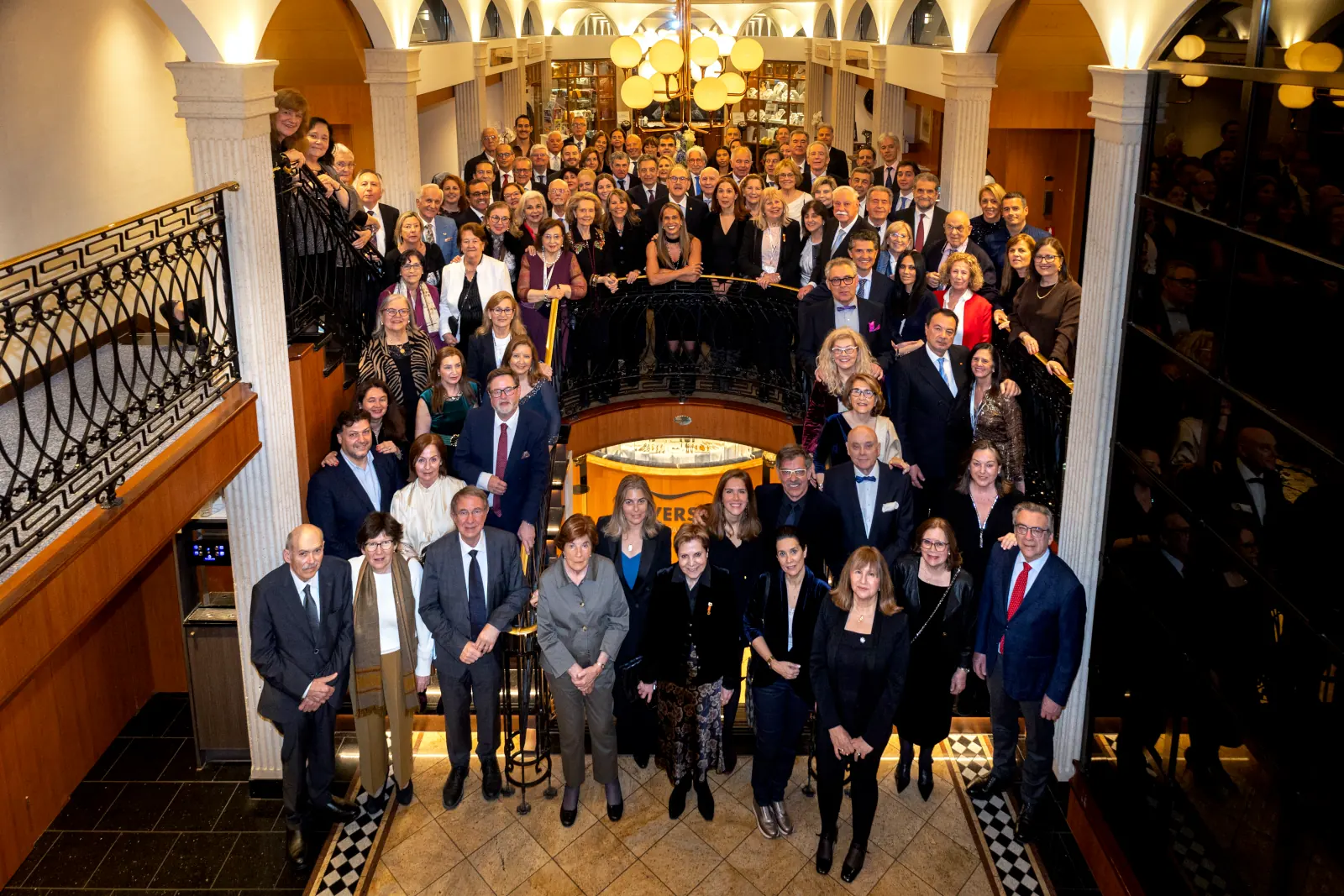


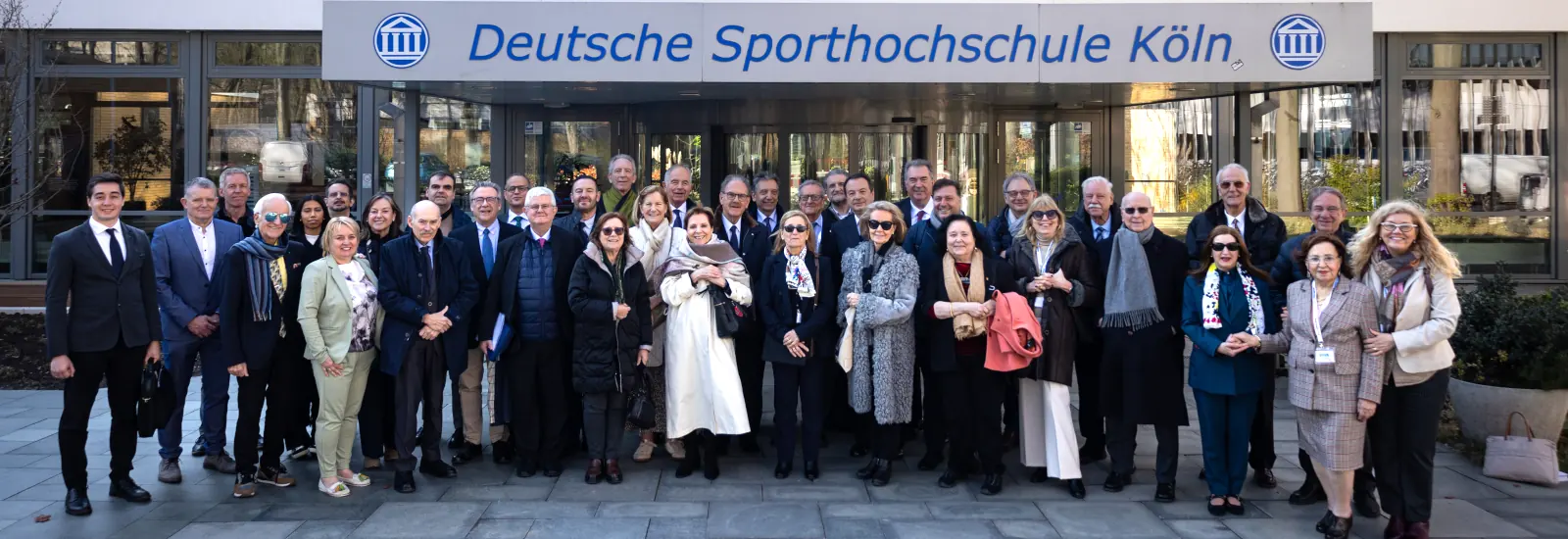
The Royal European Academy of Doctors (READ) held its 10th International Academic Meeting aboard an exclusive river cruise along the Rhine under the overarching title “The Rhine as a Current of Knowledge: Cross-Border Dialogues.” The event took place between 15 and 20 March, bringing the academic community to the German cities of Frankfurt, Mainz, Boppard, Bonn, Cologne and Koblenz. The academic sessions were held over five days, during which speakers delivered their presentations in the short format—approximately 15 minutes—adopted in recent national and international meetings. In addition, a large academic delegation participated in a joint academic event organised by the Royal Corporation together with the German Sport University Cologne.
Academics and accompanying guests also enjoyed numerous cultural visits throughout the programme, including the iconic Iron Bridge in Frankfurt; the historic centre of Mainz; the Lorelei, one of the most emblematic stretches of the Rhine; the centre of Boppard, declared a World Heritage Site by UNESCO for its ancient Roman walls, the Electoral Castle, the Romanesque Church of St. Severus and its picturesque half-timbered houses; the Beethoven Museum and the composer’s birthplace; and the Roman legacy of Koblenz, among many other attractions.
Following the opening of the event by the President of the Board of Governors, Alfredo Rocafort, the scientific programme began with contributions from Ignacio Buqueras, who presented “Civil Society and the Political Class”; Maria Àngels Calvo, who delivered “Biosecurity and Biopolitics: A Geopolitical Reading of Migration from the One Health Perspective”; Montserrat Casanovas, with “Impacts of Donald Trump’s Economic Policy”; and Esther Subirà, who spoke on “Territorial Ageism and European Reconfiguration: The Blue Banana Facing the Challenge of Irrelevance.” They were joined by Juan María Díaz and Ana María Díaz with “Alternative Dispute Resolution Mechanisms Outside State Jurisdiction” and “AI in Creative Thinking: Benefits and Drawbacks,” respectively.
In the second session, Josep Alet presented “The AI Paradox of 2026: From Generic Technology to Situated Capability”; Lluís Giner spoke on “Transformative Education: Notes for a Reassessment of the Dialogue Between Humanism and Technology”; Joaquim Gironella delivered “Complex Systems Medicine: A New Paradigm. Medicine as a Pluricausal Biological System”; Francisco González de Posada presented “The Current Geopolitical (Dis)Order and Its Hidden Variables for Understanding the Future”; and Frederic Borràs addressed “From Globalisation to Fragmentation: Implications for Europe.” The session concluded with Santiago Castellà and his presentation “What Is Happening to Us? The Decline of Europe’s Universal(izable) Proposal: Being Reduced from Narrative to Data.”
The third session was opened by Jaume Llopis with “Purpose as a Driver of Sustainable Innovation.” This was followed by José María Simón Castellví, who spoke on “How AI Contributes to Restoring Health and Maintaining Quality of Life During Human Ageing.” Francesc Miralles presented “Systemic Sustainability: From ‘Laudato Si’ to Socio-Ecological Systems”; Fermín Morales addressed “The Rise of Artificial Intelligence: Is Privacy Still Possible?”; Paula Plaza delivered “The Creative Odyssey: From the Brush to AI, Tracing Shifts in the Artist’s Mental Paradigm”; Manuel Sans Segarra presented “Health in Today’s Society”; Óscar López spoke on “Testamentary Will in Life and Death (An Approach to the Concept of Will and the So-Called Living Will)”; and finally Ignacio Bonasa delivered “Leading with Soul in Times of Uncertainty: Leadership as a Vital Challenge for a New Era.”
The fourth and final session featured Rafael Urrialde with “Food and Climate Sovereignty: New Frontiers of the 21st Century”; Carlos Grau with “A Message of Hope for the European Union”; Mariàngela Vilallonga with “Studia Humanitatis”; Víctor Canivell with “What to Do in the Face of the Quantum Apocalypse, Where All Internet Privacy Will Be Lost”; and Aquilino García with “New Drugs for Weight Control and Reduction.” They were joined by Rocío Naveja, who presented “What Has Been Lost in the Classroom: Recovering the Deep Humanistic Meaning of Education.”
At the German Sport University Cologne, the Royal Academy was represented by Jaume Antich with “Generative Artificial Intelligence: Machines That Make Decisions”; José María Bové with “Fractured Eurasia: Russia’s Repositioning”; Cecilia Kindelán with “Can Artificial Intelligence Have a ‘Life’ of Its Own?”; Marcela González-Gross with “Health, Ageing and Quality of Life in the Age of Longevity”; José Ramón Calvo with “Health Challenges in the European Union in the Age of AI”; David López with “Educating to Lead in Algorithmic Times: The New Leadership Education”; and the session concluded with Fernando Méndez presenting “The European Union’s Regulatory Competence in the Field of Land Registry.”
10th International Academic Meeting page