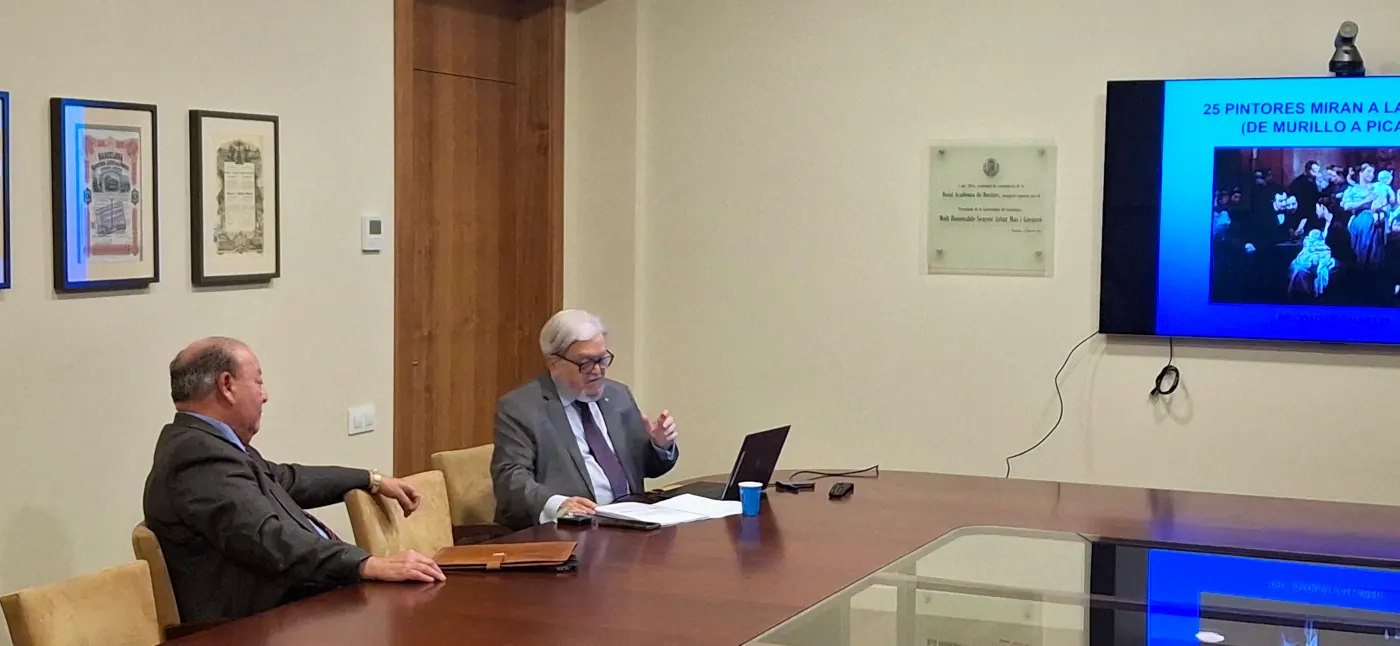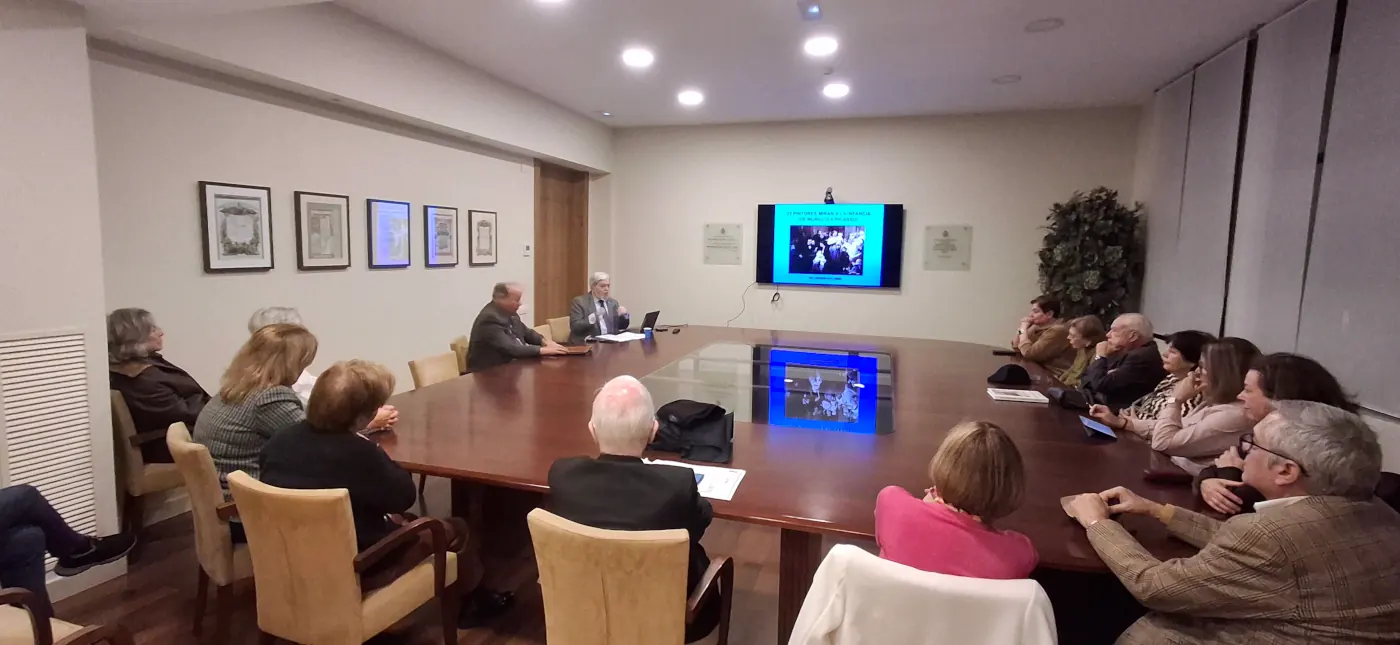


On December 17, the Royal European Academy of Doctors (RAED) held the session «25 Painters Look at Childhood: From Murillo to Picasso», led by Joaquín Callabed, President of the Social Pediatrics Club, Corresponding Academician of the Royal Academy of Medicine of Catalonia and of the Royal Academy of Pharmacy of Catalonia, and Numerary Academician and Vice President of the Health Sciences Section of the RAED, together with José Mateo Ycardo, a communicator in the field of Social Sciences and author of several books in his areas of study.
Through 25 iconic paintings by Spanish and European artists from the period after the 18th century depicting childhood within its family and social environment, the two experts presented the evolution of how childhood has been understood and analyzed throughout the modern and contemporary eras. This journey ranged from the English, French, and German Enlightenment—with figures such as John Locke, David Hume, Voltaire, Denis Diderot, Jean-Jacques Rousseau, and Johann Heinrich Pestalozzi—within whose historical context children acquired rights and a new social status, to the contemporary perspective. Along this trajectory, the child came to be regarded as a unique individual-person deserving of individualized and personalized treatment, as clearly reflected in the painting of each period, which shows growing interest in education, health, play, and maternal and family bonds.
«Childhood attains a new social consideration and is clearly reflected in artistic representation from the 18th and 19th centuries onward, after long periods in which it was scarcely present. The scientific advances and the sanitary, social, and educational improvements brought about by the Enlightenment had an impact on childhood and are reflected in the art of the time—in schools, child labor, the role of wet nurses, and institutions dedicated to maternal and child health. The 18th and 19th centuries in France, as well as in England and Germany, mark an important moment in the artistic representation of childhood as a reflection of the society of that time, in which children are considered citizens, persons with rights, and are progressively provided with educational and health measures,» the speakers explained.
Callabed and Mateo Ycardo began their analysis with «An Old Woman Delousing a Child and a Little Dog» by Bartolomé Esteban Murillo, considered a pioneer in Spanish painting for portraying children enjoying freedom, and continued with «The Croup» by Francisco de Goya, which in a free Romantic style depicts the drama of a father attempting to remove diphtheria plaques from his son’s throat. The session also featured Luke Fildes’s «The Doctor», representing dramatic Victorian social realism; Ludwig Knaus’s «In School», a scene of school life rendered with German critical realism; Jan Verhas’s «The Little Painter», portraying a young artist; Albert Anker’s «The Little Brother», also in a realist style; and William-Adolphe Bouguereau’s «Love of Childhood», in an academic French style.
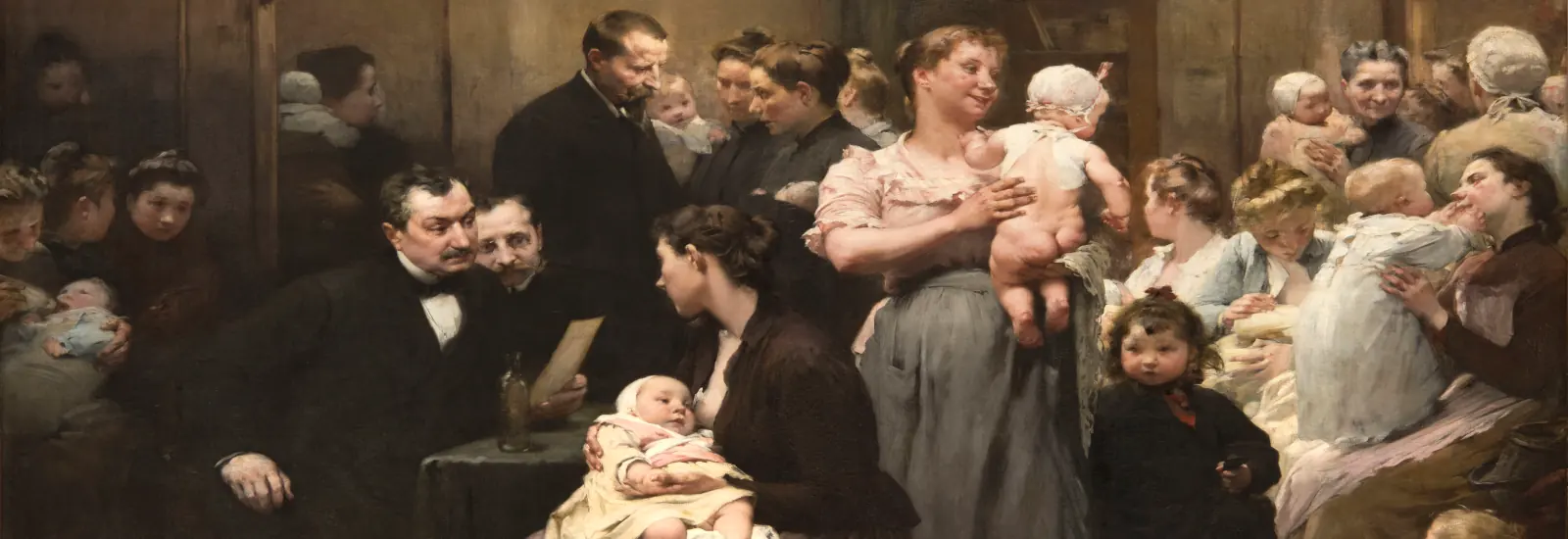
Among the painters with a naturalist aesthetic who depicted childhood, the speakers highlighted Jean-François Millet, whose «First Steps» reflects his love for the countryside and for children; Jules Bastien-Lepage, whose «Little Shepherd» denounces the widespread child labor of the time; Virginie Demont-Breton with «Children on the Beach»; Jean-Eugène Buland and «Parental Love»; and Jean-Jules Geoffroy with «The Milk Drop in Belleville by Dr. Variot», which explains the historical origins of this important maternal-child health institution, created by Léon Dufour in Fécamp (Normandy) and disseminated worldwide by Gaston Variot in 1906 at an international congress in Paris.
In the realm of Impressionist painting, the selected works were «The Cradle» by Berthe Morisot, «The Child’s Bath» by Mary Cassatt, and «Child Vaccination» by Anna Ancher. From Nordic naturalist realism, the experts presented «Children on the Beach» by Albert Edelfelt and «Motherhood» by Carl Larsson. These were joined by the renowned Norwegian Expressionist Edvard Munch with «The Sick Child.» Beyond artistic movements, the presentation concluded with Spanish painters Joaquín Sorolla and «After the Bath» a delicate and intimate childhood scene, and Pablo Picasso with “Pink Maternity.”