

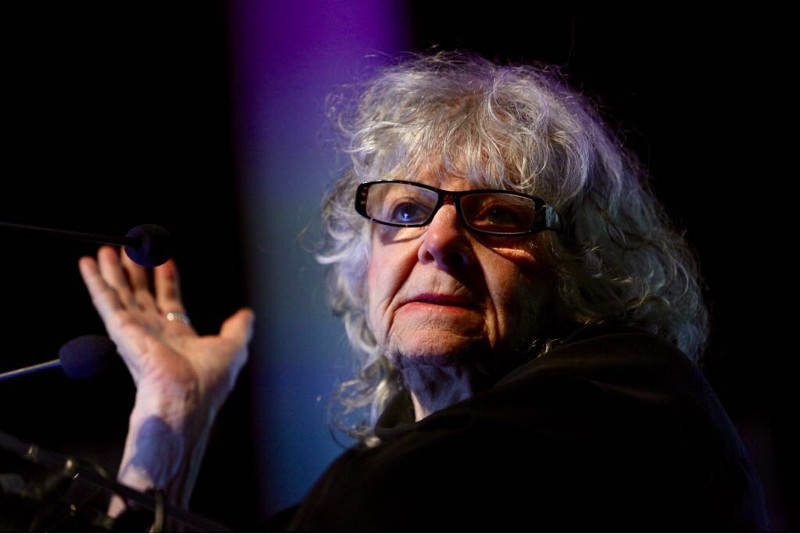
Dr Ada Yonath
The Board of Governors of the Royal European Academy of Doctors (READ), on behalf of the entire academic community, deeply mourns the loss of its honorary member Ada Yonath, winner of the 2009 Nobel Prize in Chemistry, who died on 31 August at the age of 87. The Weizmann Institute, where she pursued her professional career for decades, stated that her work helped pave the way for the development of more advanced antibiotics and the fight against antibiotic-resistant bacteria, one of the most pressing medical challenges of the 21st century. In her memory, the Royal Corporation reproduces the heartfelt tribute paid to her on the specialist portal 65ymás by José Ramón Calvo, corresponding member of the Royal Academy of Medicine of the Basque Country, full member of the READ and President of its Institute for International Cooperation, who also chairs the Medical Committee of the Cuídate+ section.
Ada Yonath (1939–2026): The Grandmother Who Deciphered the Ribosome
On 31 August, Professor Ada Yonath, winner of the 2009 Nobel Prize in Chemistry and the first Israeli woman to receive a Nobel Prize, died in Israel at the age of 87. To the world, she was the scientist who deciphered the structure of the ribosome. To us, who had the privilege of being her friends for fifteen years, she was much more: living proof that resilience, perseverance and a fighting spirit can overcome any adversity.
A Complex Life
She was born on 22 June 1939 in the Geula neighbourhood of Jerusalem, into a Jewish family that had arrived from Zduńska Wola, Poland, in 1933. Her father, Hillel, a rabbi from a rabbinical family, ran a grocery shop; her mother, Esther, had received no formal education. They lived in overcrowded conditions, with three families sharing a four-room flat. At the age of five, in one of her first experiments, she stacked furniture to measure the height of the balcony: she fell and broke her arm. She always told the story with a smile: “the results of that experiment remain unknown.”
Her father died when she was eleven. From then on, she worked cleaning, babysitting and giving private lessons to help her mother, who encouraged her to continue studying. She attended the prestigious Beit HaKerem school and later Tichon Hadash in Tel Aviv, where she paid her tuition by teaching mathematics to other pupils. She graduated in Chemistry from the Hebrew University of Jerusalem in 1962, earned her doctorate at the Weizmann Institute in 1968 and completed her training in Pittsburgh and at MIT. In 1970, she founded Israel’s first protein crystallography laboratory at the Weizmann Institute.
Persistence as a Method
Her great scientific achievement began in the late 1970s, when she set out to do something the scientific community considered impossible: determine the three-dimensional structure of the ribosome, the cell’s protein factory. “They called me a dreamer,” she recalled. She made 25,000 attempts before obtaining the first ribosome crystals in 1980, drawing inspiration from the hibernation of polar bears and extremophile bacteria from the Dead Sea. She developed a new technique, cryo-biocrystallography, involving the ultra-rapid freezing of biological crystals. In 2000, her teams in Rehovot and Hamburg succeeded for the first time in determining the complete structure of the two subunits of the bacterial ribosome; the following year, they showed how antibiotics bind to it, opening the way to combating resistant bacteria. In 2009, she received the Nobel Prize in Chemistry together with Venkatraman Ramakrishnan and Thomas Steitz. She was the fourth woman in history to win the Nobel Prize in Chemistry and the first in 45 years.
The Importance of the Discovery
Her discovery, the result of extraordinary tenacity, led her to battle the scepticism of colleagues and the incomprehension of officials who cut her funding because she was “wasting resources” on something that “everyone knew was impossible.” And yet, she made a fundamental contribution to understanding how the ribosome, the cellular machine that manufactures proteins, works, and opened up a crucial path towards designing more precise antibiotics.
By revealing the structure of the ribosome, it became clearer how bacteria could be attacked without harming human cells, why certain antibiotics act on them and why some stop working when resistance develops. This knowledge encouraged the rational design of new-generation antibacterial drugs and changed the way treatments against resistant bacteria are researched, at a time when the indiscriminate and widespread use of antibiotics — including in animals and plants — has turned bacterial resistance into a serious problem.
Put simply, Ada Yonath helped move science from “testing compounds” to understanding in detail the biological target of antibiotics. This transition is extremely valuable in medicinal chemistry because it enables molecules to be designed on a sound scientific basis rather than solely through trial and error. Her mastery of X-ray crystallography also made it possible to observe highly complex biological structures, something essential to modern structural chemistry. Her contribution was decisive because she connected the structure of the ribosome with the rational design of antibiotics: a door that remains open for medicine.
An Uncomfortable Conscience
But Ada never confined herself to the laboratory. On many occasions, she confronted the Government of Israel, openly disagreeing with its actions on certain issues. Days after receiving the Nobel Prize, she called for the release of all Palestinian prisoners: “Holding prisoners only increases the motivation of the other side.” A Likud member of parliament accused her of lacking “a sober view of the conflict”; true to herself, she did not retract her words. She remained critical of the occupation of the Palestinian territories until the end of her life and often defended the views of her first cousin, psychiatrist and anti-occupation activist Ruchama Marton. She was humility personified: she said that she did not enter the laboratory thinking “I am a woman who is going to conquer the world,” but simply “I am a scientist.”
Barcelona, 2019
In February 2019, we invited her to Barcelona for the first City and Science Biennial, organised by the City Council. On 11 February, International Day of Women and Girls in Science, she opened the event before more than 300 students alongside another dear friend, Nobel Prize-winning physicist Jerome Friedman, also an honorary member of the READ. “If you have questions to ask and science can answer them, do not hesitate and do not ask permission: start researching,” she told them. When girls asked whether anyone had ever told her she could not be a scientist because she was a woman, she replied: “Do not listen to anyone, only to yourselves, and study science without fear.” And her lectures always ended with a sentence addressed to the girls in the room: “If anyone tells you that you cannot be a woman, a mother, a grandmother, a scientist and win the Nobel Prize, it is not true. I did it.”
The Best Grandmother in the World
She had a large head of curly hair, and a saying became popular in Israel: “curly hair means a head full of ribosomes.” The year after her Nobel Prize, a wig styled with her curls became famous during the Israeli carnival. She found it very amusing and often ended her talks with a caricature of herself with that hairstyle and a photograph of the note her granddaughter Noa wrote to her when she won the Nobel: the award for the best grandmother. Of all the honours she received — the Israel Prize, the Wolf Prize, the L’Oréal-UNESCO Award, dozens of honorary doctorates — the one she valued most was that: the best grandmother award given to her by her granddaughter.
Her daughter, Dr Hagit Yonath, a physician at the Sheba Medical Center specialising in internal medicine and human genetics, inherited her vocation. Her granddaughter Noa, who at the age of five invited her to her kindergarten to explain to the children how the ribosome works, remains a testament to her tenderness. Her mother Esther, who raised her alone after her father’s death, and her sister Nurit were the source of her strength.
In Private
In private, Ada was charming, tender and extremely funny. Laughing with her was a gift; her humour, her humility, her ability to listen, her innate curiosity… We remember now, as sadness slightly clouds our eyes, the long conversations we shared about so many subjects, or how she sought resources through the lectures she gave so that she could personally fund her doctoral students. Fifteen years of friendship, during which we travelled with her and with Hagit, and in which the anecdotes we shared could fill an entire book, are not enough to describe a person like her; but they are enough to know that today the world is much poorer without her.
Rest in peace, dear Ada. Thank you for teaching us that it is possible to be everything at once: a woman, a mother, a grandmother, a scientist and a Nobel Prize winner. You did it, and you did it all well. We will miss you very much.