

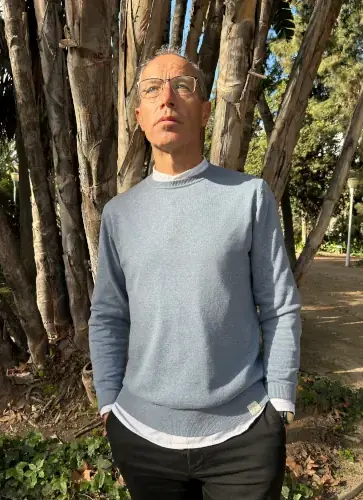
Dr. Francesc Torralba
Francesc Torralba, Director of the Ethos Chair of Applied Ethics at Ramon Llull University and of the Chair of Christian Thought of the Bishopric of Urgell, member of the Dicastery for Culture and Education of the Holy See and full member of the Royal European Academy of Doctors (READ), is featured in the well-known interview in the “La Contra” section of “La Vanguardia” in its 24 March edition, on the occasion of the publication of the Spanish translation of “Anatomy of Hope” (Destino), the work that won the latest Josep Pla Prize. The book explores the mechanisms that sustain the human spirit when all seems lost through philosophy, literature and human experience, and delves further into the subject matter of the academic’s two previous publications, “La Paraula que em sosté” and “No hi ha paraules. Com assumir la mort d’un fill”, in which he shares the grief over the tragic death of his 26-year-old son Oriol in a mountain accident during a crossing in which he was accompanying him.
“Even for a believer, in extreme situations, the concept of God falters. Hope is the struggle against adversity, a transversal and necessary human value for developing any project in your life, because you have no guarantee that it will end well. Then you are left with nothing. And if you also do not have a god to sustain you, the void arrives,” reflects the academic in conversation with journalist Ima Sanchís. Torralba maintains that the great lesson of life is learning to lose, because sooner or later one loses health, youth, loved ones and, finally, one’s own life. And faced with this inescapable reality, he defends humility as an essential virtue.
From his vital and intellectual learning, he concludes that hope is not born from speeches or slogans, but from testimony shared in community. He stresses that this hope is neither expectation nor self-deception, but rather a wager without guarantees: trusting amid uncertainty, while recognising one’s own limits. Torralba also criticises what he defines as the verbal incontinence of today’s society, which offers opinions on the pain of others without having experienced it, and the existential weariness caused by the lack of purpose. He illustrates the importance of giving meaning to life with a real case from an ethics committee: a 90-year-old widower stopped eating in a nursing home until he was given seeds to plant; that small purpose restored his will to live.
Moreover, the thinker addresses the figure of Antoni Gaudí and the completion of the Basilica of the Sagrada Familia in his latest articles for the newspaper “El Punt Avui.” In “The Tower of Jesus Christ,” he explains the symbolism of the temple’s verticality, which is already the tallest in Christendom. “Verticality is essential in the Sagrada Familia and symbolically expresses two movements in the symbolic sphere: the descent of God to earth, His coming down to our level to show us who He is and, at the same time, the elevation of the human being above worldly concerns. The tower has a symbolic function quite analogous to that of the staircase and the column. It allows us to take distance from the low earth, in the words of Àngel Guimerà, and rise to the high earth, the land of pure thoughts and noble values. The symbolism of the tower, through its height, evokes a spiritual meaning. By its vertical position, it evokes its will to unite heaven with earth, the transcendent with the immanent. The fact that it contains the bell tower symbolises the call to prayer,” he explains.
In “Gaudí and Eugeni d’Ors,” meanwhile, he recalls some of the reflections of the author of Glossari on the architect from Reus. “Eugeni d’Ors places Antoni Gaudí in a visionary position, suggesting that his ideas on architecture are ahead of his time. Rather than being a simple representative of the currents of his period, Xènius sees in Gaudí someone who anticipates a new way of building and conceiving space, in which architecture is part of a larger symbolic system. For Eugeni d’Ors, Antoni Gaudí creates a new architecture of the future in which art, technique and spirituality are in perfect harmony. Eugeni d’Ors highlights the individualistic and unique character of Antoni Gaudí, who does not submit to the prevailing trends or influences of his time. In this sense, the Catalan architect appears as an iconoclast, someone who, although connected to his tradition and local culture, goes beyond the limits imposed by any artistic school,” he notes.
 A teacher and communicator of Christian humanism in major Catalan media outlets such as Catalunya Ràdio and the newspapers “La Vanguardia” and “El Punt Avui,” the academic is the author of notable books such as “El sentit de la vida” (2008), “No passeu de llarg” (2010), “El valor de tenir valors” (2012), “Un mar d’emocions” (2013), “Córrer per pensar i sentir” (2015), “Saber dir no” (2016) and “Món volàtil” (2018). During the pandemic, Torralba published the books “Humility,” “Paraules de consol. En la mort d’un ésser estimat,” “Formar personas. La teología de la educación de Edith Stein,” “Living in What Is Essential. Ideas and Questions after the Pandemic,” “L’ètica algorítmica,” which was awarded the Bones Lletres Prize for Humanistic Essay granted by the Royal Academy of Good Letters and the publisher Edicions62; “La façana de la Glòria de la Sagrada Família. Fonts espirituals i teològiques de l’escatologia d’Antoni Gaudí,” the result of his fourth doctoral thesis; “When Everything Falls Apart. Meditating with Kierkegaard” (2023), “No hi ha paraules. Com assumir la mort d’un fill” (2024) and “Benaurances per a agnòstics” (2024). He was recognised with the Ratzinger Prize 2023, awarded by the Vatican Foundation Joseph Ratzinger-Benedict XVI.