

Dr. Daniel Berzosa
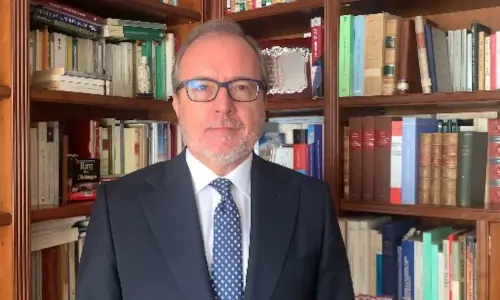
Daniel Berzosa, Professor of Constitutional Law and Fundamental Rights at Cunef University, the Institute of Stock Market Studies and the IE Law & Business School, a member of the Global Academy and the Scientific Council of the international collective Citizens pro Europe, and a full member and member of the Governing Board of the Royal European Academy of Doctors (RAED), delivered the opening lecture “The 1978 Spanish Constitution: Is It Still in Force?” on 15 July at the Summer Courses organised by the Complutense University of Madrid in San Lorenzo de El Escorial under the title “The 1978 Constitution: In Intensive Care or Already in Palliative Care?”. In his lecture, he defended the full legitimacy of the Constitution, not only as a formal text but as an effective rule that limits and structures power. Other prominent representatives of the judiciary, academia, politics and journalism also took part in the event. Directed by Manuel Almenar, a judge of the First Chamber of the Supreme Court, the meeting was sponsored by the Foundation for the Judiciary and Telefónica. Separately, the jurist reflected on the recent reform of the Criminal Code regarding the treatment of insults against the Crown on the programme Audiencia abierta on Spanish Television, broadcast on 18 July.
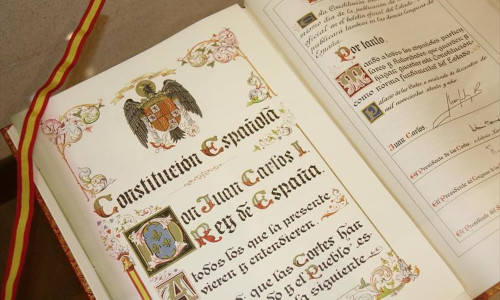
The expert argued that the continuing force of the Constitution is not measured by its mere presence in the Official State Gazette, but by its capacity genuinely to govern power and to be applied every day. In this regard, he drew on Karl Loewenstein’s classification, which distinguishes between normative, nominal and semantic constitutions, to conclude that Spain’s 1978 Constitution remains normative thanks to the daily work of judges, whom he describes as the invisible flying buttresses of the rule of law. Berzosa traced the history of constitutionalism from Aristotle and Domitius Ulpianus to John Locke, Montesquieu, Alexander Hamilton and James Madison, stressing that the 1978 text was born of consensus between former enemies, not from the imposition of a victor. He also highlighted the central importance of Articles 1 and 2: Spain as a social and democratic State governed by the rule of law, popular sovereignty, and the unity of the nation compatible with the autonomy of its nationalities and regions.
Berzosa nevertheless acknowledged current tensions and erosion, generated to a large extent by breaches of the separation of powers, such as the politicisation of the General Council of the Judiciary, excessive use of decree-laws, frictions within the territorial model and certain interpretative drifts. However, he considered that the Constitution has successfully overcome the most serious crises of recent decades and that its greatest achievement is the normality of fundamental rights and the subjection of power to the law. The continuing validity of a Constitution, he concluded, is not irreversible: it depends on the fidelity of judges, institutions and citizens. And he maintained that as long as the conviction remains that power must be subject to law, the Constitution will continue to breathe.
 On Spanish Television, meanwhile, the academic explained the reform eliminating the specific criminal offence of insulting the Crown, although it does not remove the protection of the right to honour, privacy or personal image of any member of the Royal Family, with freedom of expression taking precedence. “What the reform does is place everyone on the same legal footing, which does not mean leaving the Crown unprotected. The European Court of Human Rights had already ruled that, in a constitutional democracy, no other distinction should be established,” the jurist noted.
Berzosa is a member of the United States Society of Diplomacy and Political Science, coordinator of the International Observatory for the Regulation of Public Sector Entities at the University of Santiago de Compostela, a member of the organising committees of the World Law Congress meetings held in Cartagena de Indias in 2021 and Madrid in 2019, and the author of books and scientific articles published in prestigious journals. He is also a recognised communicator on legal and political science issues in Spain’s leading media outlets.