

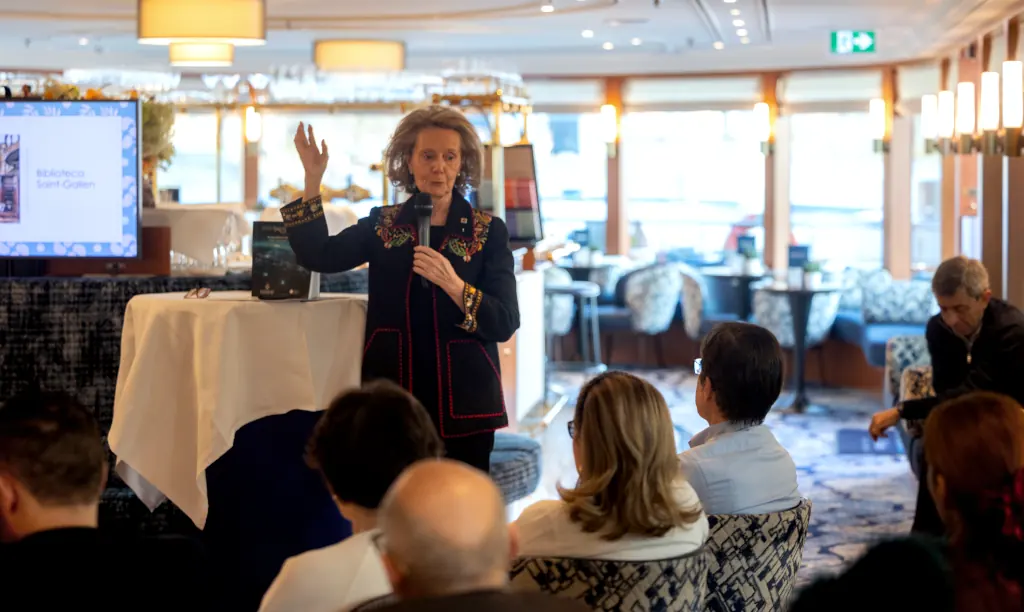
Dr. Mariàngela Vilallonga, during her presentation at the 10th International Academic Meeting of the RAED on the Rhine, Germany
Mariàngela Vilallonga, emeritus professor of Classical Philology at the University of Girona, president of the Prudenci Bertrana Foundation and full academician of the Royal European Academy of Doctors (RAED), presented at the 10th International Academic Meeting held by the Royal Corporation between 15 and 20 March in several German cities under the general title “The Rhine as a current of knowledge: cross-border dialogues” the lecture “The ‘Studia Humanitatis’”, in which she presented the educational and intellectual programme that nourished the Italian and European Renaissance.
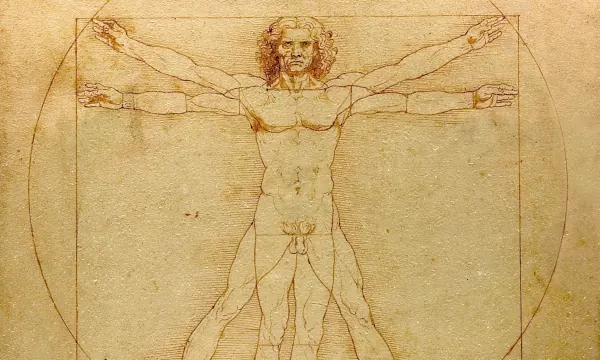
In her presentation, Vilallonga defined humanism as the intellectual movement that gave life to the Renaissance, a cultural impulse that placed the human being and the recovery of classical antiquity at the centre of artistic, literary and philosophical creation. The ‘Studia Humanitatis’, a programme that included grammar, rhetoric, poetics, history and moral philosophy, formed the educational core of this new cultural elite. In contrast to medieval scholasticism, the humanists defended knowledge centred on classical letters and the comprehensive formation of the individual.
Among the protagonists of this cultural and pedagogical movement, the academician highlighted in her presentation Francesco Petrarca and Giovanni Boccaccio, considered the fathers of humanism, whose figures were immortalised by Andrea del Castagno. She also mentioned the less well-known Poggio Bracciolini, a tireless seeker of ancient manuscripts, and institutions such as the Library of Saint Gall, one of the great medieval repositories that the humanists explored with avidity. The expert also evoked the brilliant Florentine generation of the late 15th century, made up of Marsilio Ficino, Giovanni Pico della Mirandola and Angelo Poliziano, portrayed in a fresco by Cosimo Rosselli from 1486 in the Chapel of the Miracle in Florence. These thinkers, protected by the Medici family, fused classical wisdom with Neoplatonism and an optimistic vision of human potential.
 Patronage, in fact, played a key role in the consolidation of this movement, Vilallonga explained. An emblematic example is Federico da Montefeltro, Duke of Urbino, portrayed with his son Guidobaldo by Pedro Berruguete in an image that symbolises the union of arms and letters. Likewise, Pope Sixtus IV promoted humanist culture by appointing Bartolommeo Sacchi as librarian of the Vatican Library in 1477, a scene immortalised by Melozzo da Forlì. The expert concluded with the figure of Aldus Manutius, the great Venetian printer whose typography and critical editions of Greek and Latin classics allowed humanist knowledge to spread massively throughout Europe.
“The ‘Studia Humanitatis’ were not only an academic programme, but the cultural engine that transformed the vision of the world in the transition from the Middle Ages to the Renaissance. A lesson in how ideas, books and patrons can change the course of history,” the academician concluded.
After her period as Minister of Culture of the Government of Catalonia between March 2019 and September 2020, a position for which she resigned as vice-president of the Institute for Catalan Studies, Mariàngela Vilallonga resumed her teaching activity until her retirement three academic years ago. In 2016 she was awarded the Creu de Sant Jordi, the highest distinction granted by the Government of Catalonia, for her research into Latin humanistic literature in the Crown of Aragon. She was also appointed adviser to the publishing group Grup62. Beyond her extensive career as a researcher and as one of the leading experts on the life and work of Mercè Rodoreda, Vilallonga has recently published the book “Retrat interior” (Proa), a collection of poems written between Girona and New York between 2003 and 2009.