

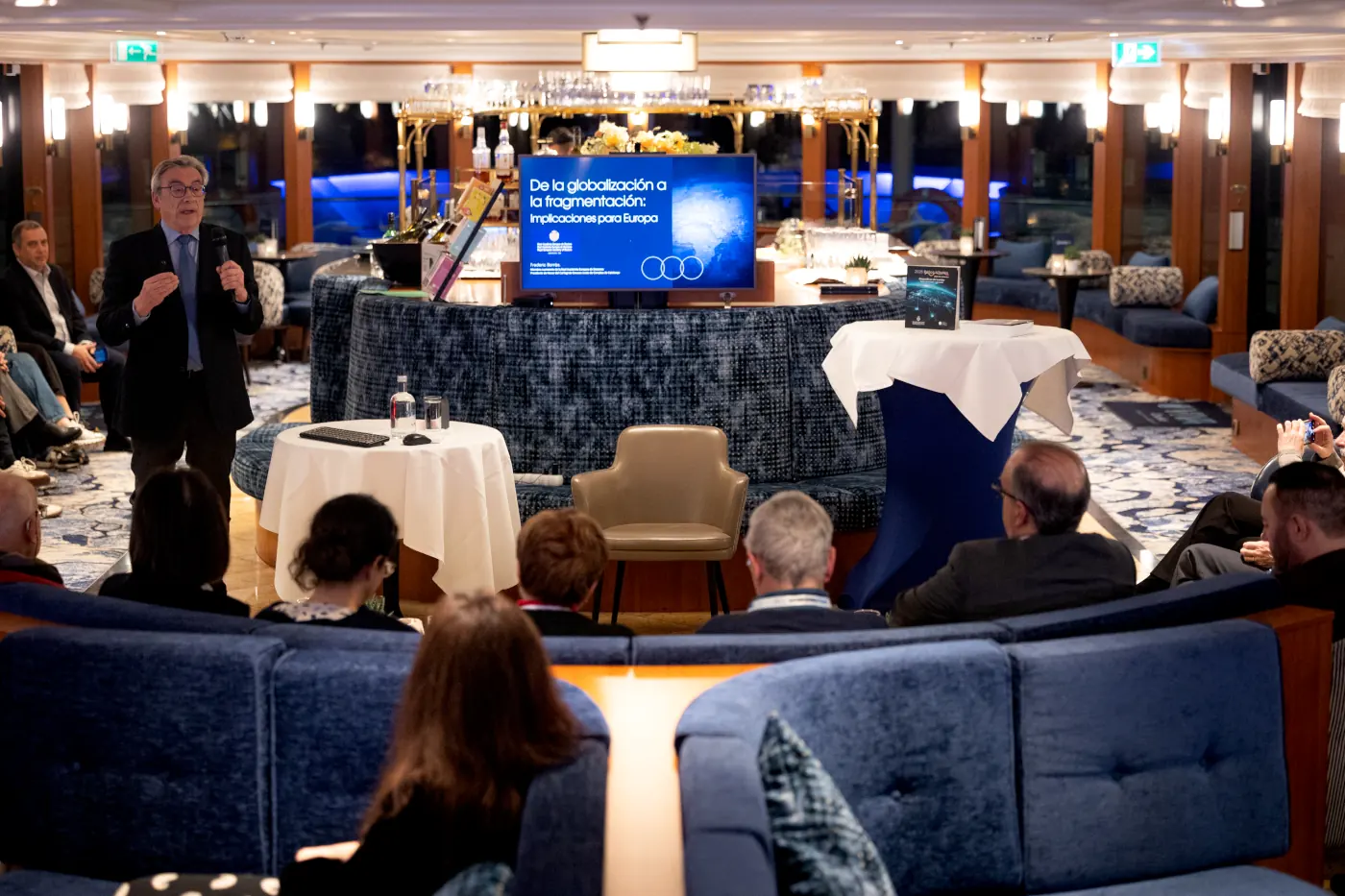
Dr. Frederic Borràs, in his speech during the 10th International Meeting of the RAED
Frederic Borràs, honorary president of the Institute of Chartered Accountants of Catalonia and Numerary Member of the Royal European Academy of Doctors (READ), addressed the current state of the new geopolitics and the role that Europe can play in this scenario, focusing on the proposals put forward by Christine Lagarde, president of the European Central Bank, in the lecture “From Globalisation to Fragmentation: Implications for Europe”, which he presented during the 10th International Academic Meeting that the Royal Corporation held between 15 and 20 March in various German cities under the general title “The Rhine as a Current of Knowledge: Cross-Border Dialogues”.
“Europe is at a crossroads, watching as the United States and China compete for world leadership, both in the technological and financial fields, while Europe falls behind. Its role has become irrelevant, especially since Brexit and in the absence of strong leadership in France and Germany. The emergence of Donald Trump has disrupted the collaborative international order by imposing tariffs on all countries and declaring that each must assume the cost of its own defence, thereby weakening the Western bloc that emerged strengthened from the Second World War and had the support of the United States. We have moved from globalisation to fragmentation”, the expert said by way of introduction to his reflections.
For the academic, the world today has moved, practically overnight, from globalisation to fragmentation. Washington demands that each country assume the cost of its own defence, even inviting them to buy American weapons, and applies a strategy based on aggressive tariffs, the use of military power, the devaluation of the dollar and pressure on the Federal Reserve. Meanwhile, China and India are strengthening their alliances within the Shanghai Cooperation Organisation, shifting the geopolitical centre of gravity towards the East. In this context, he pointed out, Europe is paying dearly for its weakness, while international organisations such as the United Nations, UNESCO, and the G20 are losing relevance in the face of the new multipolar reality.
 Against this backdrop, Borràs draws on the warnings of figures such as Mario Draghi, former president of the European Central Bank, who argues that Europe continues to act as a confederation when it should behave more like a federation, and Christine Lagarde, its current president, who warns in turn that Europe’s growth model depends on a world that is disappearing and urges the completion of the internal market, the reduction of regulatory barriers, the simplification of rules and, especially, the extension of qualified majority voting in key areas for growth, overcoming the blockage caused by unanimity. In conclusion, the speaker articulated the paradox that although competitive fragmentation historically drove European progress, it has now become a disadvantage. In order to prosper, he argued, Europe must move towards greater real economic integration, strategic autonomy in defence and a profound reform of its governance.
Borràs is a member of the Global Board of the Association for Corporate Growth, the leading international community of professionals dedicated to mergers, acquisitions and corporate growth. He was recognised as an honorary member of IECnet, one of the leading international auditing, tax advisory, and consulting firms, after a long and successful career at the firm, during which he served on its Board of Directors for eight years and chaired its Audit Practice. The academic worked for almost four decades at KPMG, where he became a partner in charge of the Barcelona, Girona, Palma and Andorra offices.