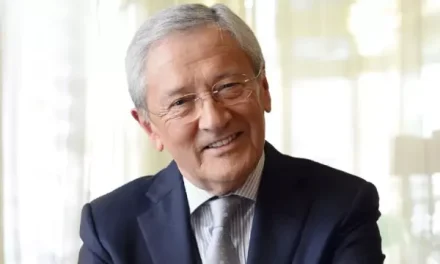


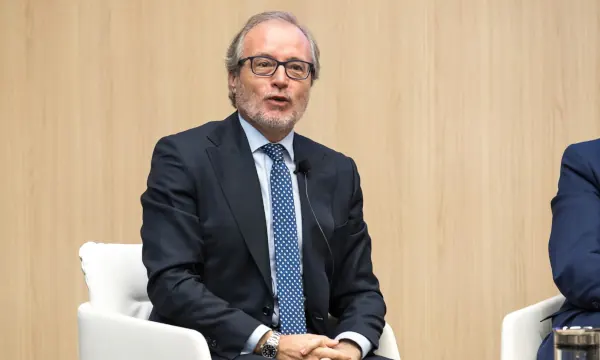
Dr. Daniel Berzosa
Daniel Berzosa, Professor of Constitutional Law and Fundamental Rights at CUNEF Universidad, the Institute of Stock Exchange Studies and the IE Law & Business School, member of the Global Academy and of the Scientific Council of the international collective Citizens pro Europe, as well as full member and member of the Board of Governors of the Royal European Academy of Doctors (READ), examines the role of the Crown at the present moment of intense confrontation in Spanish politics in the article “A King for a Democracy under Siege,” published on 24 March in the prominent “La tercera” section of the newspaper “ABC.” The academic argues that parliamentary monarchy is a useful model for organising power, designed precisely to prevent those who govern from ultimately identifying themselves with power itself.
“In a democracy increasingly wearied by polarisation, distrust and plebiscitary logic, the figure of the King takes on a meaning that deserves more careful reflection than is usually given to it. When politics becomes a succession of heightened emotions, confrontational majorities and partisan loyalties, the Crown represents something different. It is not an alternative source of power, but a limit to its excess. Parliamentary monarchy is one more element in the technique of organising power. It is not, therefore, a historical vestige, nor an aesthetic concession by the constitutional framers. It is a modern response to a classic problem: how to prevent those who govern, even when they do so in the name of the people, from ending up identifying themselves with power itself,” the expert begins in his argument.
For the jurist, the monarchy’s great asset in defending the rule of law is that it does not compete, does not accumulate, does not promise and, precisely for that reason, reminds all political actors that no one governs solely by their own will. In this regard, he draws on Montesquieu to warn that there is no worse tyranny than that exercised under the appearance of legality, and also cites Walter Bagehot to recall that the King has the right to be informed, consulted and to warn, but not to decide. That influence without decision is, according to Berzosa, the institution’s greatest contribution in times of extreme personalisation of leadership and partisan occupation of oversight institutions.
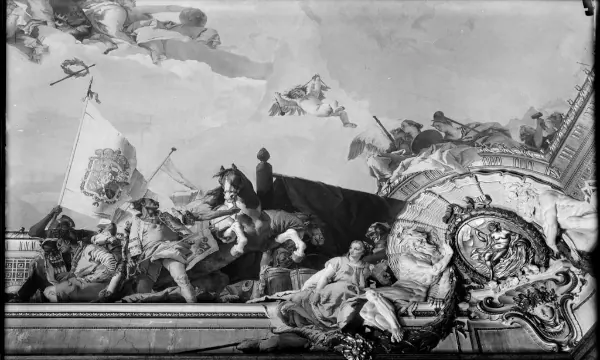 Addressing the figure of Felipe VI, Berzosa praises the sobriety with which he has exercised his role, clearly and steadfastly defending the constitutional order and the rule of law as the framework for everyone’s freedom. “He does not speak as a political actor, but as one who recalls the very conditions of the game,” he notes. The academic maintains that, in the face of the democratic fatigue affecting Spanish society according to opinion studies, and the dramatisation of politics, the Crown introduces continuity, predictability and a language different from that of partisan confrontation. Polls, he notes, reflect a demanding but largely positive public opinion towards the monarchy, because it perceives in it a stabilising function: reducing the temperature of the system, introducing distance where there is immediacy, and reminding everyone that power is never one’s own.
Berzosa is a member of the United States Society of Diplomacy and Political Sciences, coordinator of the International Observatory on the Regulation of Public Sector Entities at the University of Santiago de Compostela, member of the organising committees of the World Law Congress in Cartagena de Indias 2021 and Madrid 2019, and author of books and scientific articles published in prestigious journals. He is also a recognised commentator on legal and political science issues in Spain’s leading media outlets.